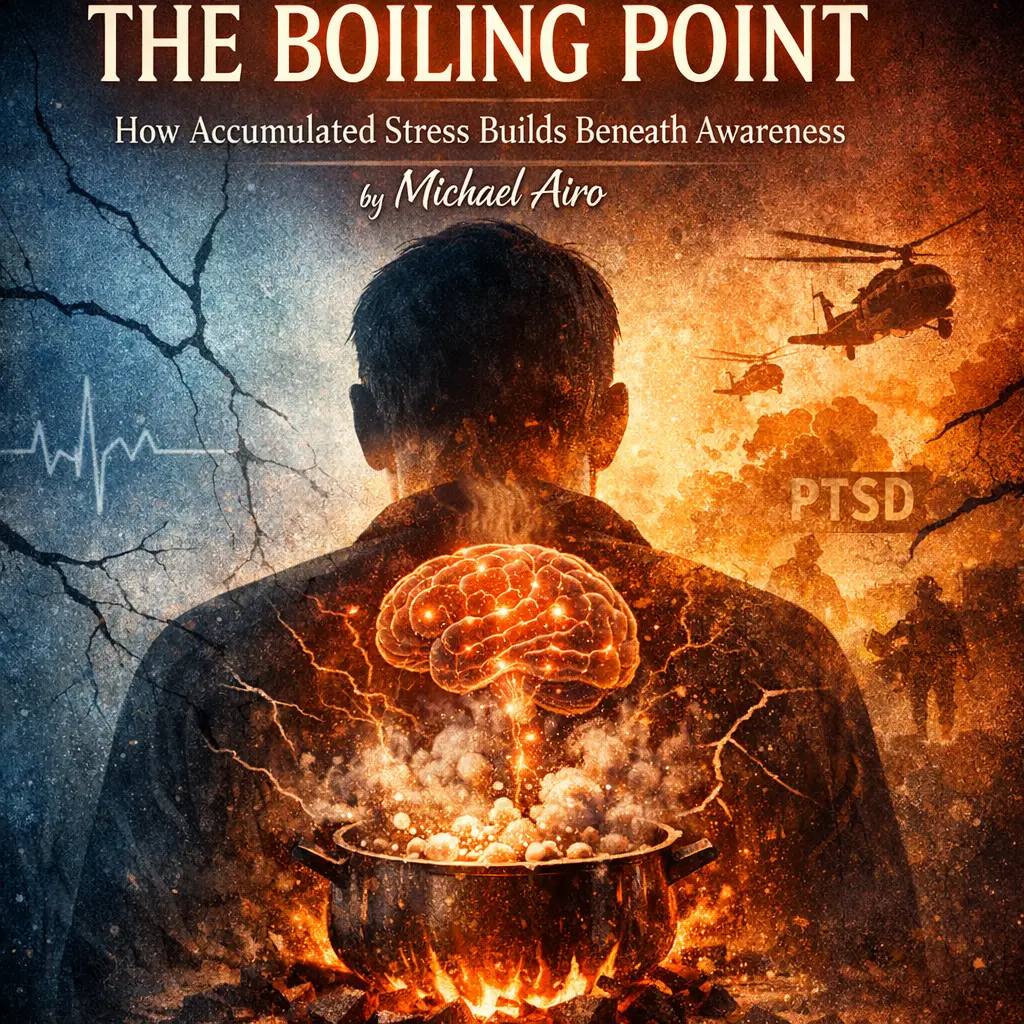
The boiling point arrives quietly. Long before the mind notices, the body begins to shift.
Identity work doesn’t just change how you think. It changes how you feel in your body. Every shift in who you are becoming creates a physiological response long before it becomes a conscious one. The Boiling Point continues the Identity Series by Michael Airo, exploring the physical side of internal change.
There’s a moment after the identity mirrors show up when everything gets a little quieter on the outside but a little heavier on the inside. You start noticing the way certain interactions linger. The way a comment stays in your body longer than it should. The way a small reaction feels bigger than the moment that caused it.
Subtle shifts like these often mark the beginning of an internal change.
This is where the next layer of the work begins.
Most stress does not arrive with a dramatic entrance. Stress slips in quietly through the small moments we brush aside because they seem too minor to matter. A conversation that lingers longer than it should. A responsibility we carry without acknowledgment. A shift inside us that we do not yet have language for. None of these feel significant on their own, but the body keeps score even when the mind moves on.
This is also where the reflections from the last article, Identity Mirror, start to settle.
Identity mirrors don’t just show us who we’re becoming. They leave traces. A moment of irritation. A flash of inspiration. A feeling of being seen in a way we weren’t prepared for. These moments don’t disappear when the interaction ends. They land in the nervous system. They accumulate. They become part of the internal load we carry without realizing it. This is the quiet part of transformation that rarely gets named.
The part where the outside world stops speaking, and the inside world starts echoing.
What Stress Actually Is
Stress is not a feeling. Stress is not a mood. Stress is not a personality trait.
Stress is the body preparing for something it believes it must survive.
Stress is a physiological mobilization. A shift in chemistry, breath, posture, and attention. Stress is the body trying to protect you. Stress is the body saying, “Something here matters.”
Under stress you might find fear.
Under stress you might find grief.
Under stress you might find anger, shame, pressure, or exhaustion.
Stress is the smoke, not the fire.
When we only name the smoke, we miss the source.
For more on how the body stores stress, see this research summary:
Stress.
How Stress Accumulates Without Being Noticed
Over time, micro-stresses settle into the nervous system. No announcement accompanies their arrival. They collect quietly, like sediment. You feel the buildup in the way your shoulders inch upward without you noticing. In the way your breath stays just a little too high in your chest. In the way your jaw holds tension even when you think you’re relaxed. In the way your patience thins faster than it used to.
Sometimes the accumulation shows up as a heaviness behind the eyes.
Sometimes as a tightness in the ribs.
Sometimes as a sense that you’re slightly out of sync with yourself, like you’re half a step behind your own life.
Because the buildup is slow, you rarely catch it in real time. You just wake up one day feeling off, or brittle, or strangely tired in a way that sleep doesn’t fix. And then something small happens. A comment. A delay. A missed shot. A moment that shouldn’t matter. But it lands harder than it should, and suddenly the body reacts as if the moment is much bigger than it is.
That is the boiling point.
Not a collapse.
Not a failure.
Just the body signaling that the load has exceeded what it can quietly absorb.
The nervous system is essentially declaring, “I can’t hold this alone anymore.”
How to Recognize Your Own Boiling Point
The boiling point often hides behind ordinary moments:
- snapping at someone you care about
- forgetting simple tasks
- feeling foggy or disconnected
- losing your words
- craving silence
- feeling “off” without knowing why
- wanting to withdraw from everything
These are not personality flaws.
These are physiological signals.
The body is asking for space.
The body is asking for acknowledgment.
The body is asking for a new way forward.
Why Naming the Load Matters
Naming these matters. When we do not have words for what is happening inside us, the mind fills the silence with pressure. The mind tells us to push through. To toughen up. To handle it better. Without language, the experience becomes personal. It becomes a flaw. It becomes something we think we should be able to manage if we were stronger or more disciplined.
The body doesn’t speak in thoughts.
The body speaks in sensations.
Tightness.
Heat.
Constriction.
Fatigue.
A sudden spike of irritation that feels out of proportion.
A heaviness that settles in the chest for no clear reason.
Naming what is happening, even softly, changes the internal landscape. The body recognizes itself. The body feels seen.
Naming the load is not about dramatizing the moment. Naming gives shape to something that has been living inside you without acknowledgment. Naming turns a vague internal pressure into something you can relate to, something you can hold, something you can respond to instead of brace against.
Declare “This is a lot,” and the body loosens.
Announce “I’m overwhelmed,” and the breath deepens.
Acknowledge “Something in me is tired,” and the nervous system softens its grip.
Naming is not the solution.
Naming is the release valve.
A named experience no longer has to be carried in silence.
And that alone begins to lower the temperature inside you.
How the Body Treats Imagination as Reality
The nervous system makes very little distinction between what you live, what you remember, and what you vividly imagine. The body responds to all three with the same physiological signatures. Breath shifts. Muscles tighten. Emotions rise.
Accumulated stress can come from real events, anticipated events, imagined worst-case scenarios, and internal stories that replay without our awareness. The body reacts to all of them as if they are happening now.
A person can live through an event once in the real world and ten times in their mind.
A person can suffer from the memory of something that never actually occurred.
A person can carry the imprint of a future that never arrives.
This is a kind of PTSD for events that never happened.
The body lived them anyway.
For a deeper exploration of this, see my flagship resilience article.
Dwelling, anticipating, rehearsing disaster, replaying old scenes, bracing for impact that never comes. These patterns create a nervous system that is always preparing, always tightening, always waiting.
Children show us the other side of this. When they experience something overwhelming, they often reenact it through play. A child frightened during a medical procedure will later play “doctor,” but this time they hold the stethoscope. A child who got lost in a store will later play “store,” but this time they find their parent quickly or help someone else who is lost. A child who felt powerless during a chaotic moment will reenact it with stuffed animals, but this time they guide the characters to safety.
This is not avoidance.
This is completion.
This is the nervous system reclaiming agency.
Adults have to relearn what children already know.
The body heals by rehearsing a new outcome.
Visualization works for the same reason. When done with intention, visualization gives the body a new internal world to inhabit. Visualization interrupts the stress loop and creates a lived experience of clarity, steadiness, or possibility.
Justin Michael Williams and the Future Self You Are Growing Into
Justin Michael Williams teaches a form of visualization grounded in identity. Visualization is not about escaping into a fantasy. Visualization helps the body feel the version of you that already exists on the other side of the transition. His work shows how the nervous system needs a lived experience of the future self in order to stop bracing against the unknown.
The practice is simple. You imagine the version of yourself who has already crossed the threshold you are approaching. You feel what that version of you feels. You let the body experience the end state so it can begin to trust it.
A deeper way to understand this is through sensation.
Imagine the breath of your future self.
Imagine the weight in their shoulders.
Imagine the steadiness in their chest.
Imagine the way their body occupies space.
Imagine the way their nervous system rests.
Let your body borrow that physiology.
Let it practice the feeling of being the person you are becoming.
The body learns through repetition, not logic.
Give it a future to rehearse.
Neville Goddard and the Felt Reality of Imagination
Neville Goddard taught a similar principle long before neuroscience could explain it. He believed imagination is not a place you visit. Imagination is a place you live. According to Neville, the key is not the image itself but the feeling. The body must feel the wish fulfilled. When the feeling becomes familiar, the identity begins to shift.
Neville’s work offers a simple truth. The body believes what it feels. When you give it a new emotional landscape, the body begins to reorganize around that experience.
This is where Justin and Neville meet. One speaks the language of modern identity work. The other speaks the language of metaphysical embodiment. Both point to the same doorway.
What to Do After the Boiling Point
When the boiling point arrives, the first step is not to fix anything. The first step is to pause. To breathe. To acknowledge the load. To let the body come down from the peak before you try to make meaning of it.
A nervous system at capacity cannot integrate insight.
It can only seek safety.
Give yourself a moment.
Give yourself breath.
Permit yourself to not be okay for a second.
Only then can the body begin to reorganize.
Why Accumulated Stress Needs a New Internal Reference Point
When stress accumulates, the body becomes familiar with tension. The body becomes familiar with vigilance. The body becomes familiar with the emotional weight of holding everything together. Familiarity becomes identity. Even when the mind wants change, the body stays loyal to what it knows.
Visualization interrupts that loyalty. Visualization gives the body a new reference point. A new emotional home. A new pattern to recognize as safe.
This is why visualization is not a luxury. Visualization is a tool for recalibration. Visualization helps the body release what it has been carrying and step into a state that feels more aligned with who you are becoming.
A Simple Embodied Visualization for the Boiling Point
Imagine you are sitting in a quiet room at the end of a long day. Warm light fills the space. Your shoulders soften. Your breath slows. The air smells clean. You taste the last sip of something warm. Your hands rest easily in your lap. Inside, there is a steady sense that you are safe, supported, and allowed to release what you have been carrying.
Stay with the feeling. Not the image. The feeling.
Let the body learn it.
A Closing Loop Back to Identity Work
Every identity shift asks the body to release an old way of being. Stress is simply the residue of that release. The boiling point is not the breaking point. The boiling point is the turning point. When you give the body a new emotional landscape to inhabit, you give your future self a place to land. To revisit the earlier articles in this series:
A Gentle Invitation
If you recognize yourself in these patterns, you’re not behind. You’re not failing. You’re simply at the point where the body is ready for something new.
To learn more about my work, visit Michael Airo About Page.