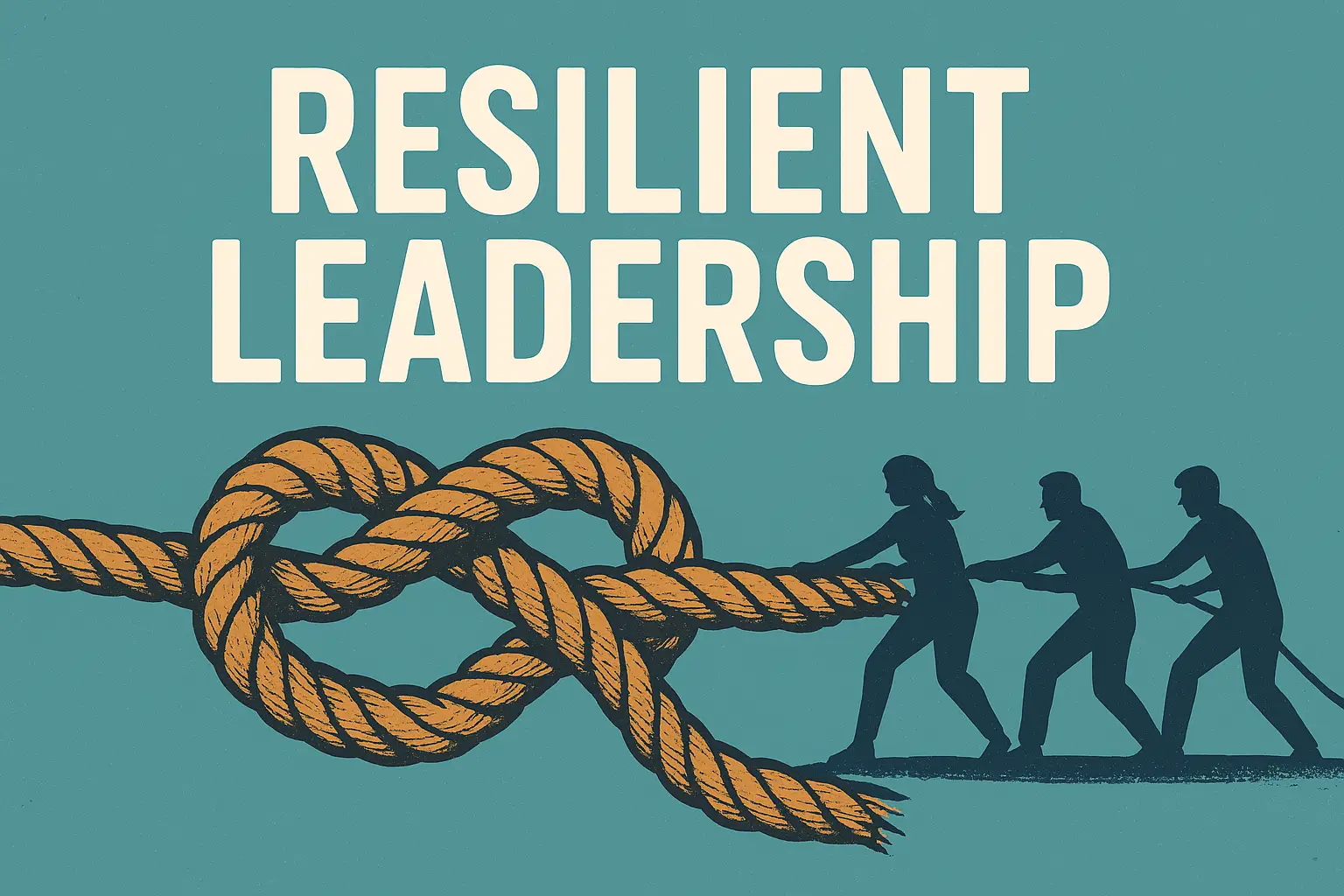
Resilient leadership begins the moment a leader chooses to share strength instead of carrying it alone.
Resilience is often described as an individual trait, but in practice it is also collective. Resilient leadership shapes how teams respond to adversity, and their style determines whether organizations bend and grow or snap like a brittle branch in a storm. A resilient leadership culture is more like bamboo than oak, flexible and wind-wise, rooted deeply enough to rise again.
A resilient leader does not simply endure. They create conditions where others adapt, learn, and thrive. That requires modeling awareness, building trust, and fostering connection. Resilient leadership also shows up in how leaders train others, share control, and embrace change. When leaders multiply leaders, resilience becomes the fabric of the team rather than the burden of one person. This perspective comes from years of watching how people grow through challenge, something I explore more fully on my About page.
Training leaders to lead
John Maxwell, in The 21 Irrefutable Laws of Leadership, reminds us that the mark of a great leader is not how many followers they have but how many leaders they create. Resilience multiplies when leadership is shared. A company with one person holding the roof alone will eventually collapse under weather and weight. A company with many beams, trussed together, can carry storms and seasons.
This is trust in action. A leader who invests in others signals confidence in their capacity. Even a small compliment while observing, “I trust how you handled that decision,” is sunlight on a seedling. It is water for roots. Over time, those brief moments of recognition become tall, resilient trees that can shelter others.
Henry Ford: Knowledge at his fingertips
Henry Ford faced ridicule during his 1919 libel trial against the Chicago Tribune, when lawyers tried to prove he lacked education by peppering him with trivia. Ford famously pointed to the row of buttons on his desk and explained that he could summon the right expert for any question, reframing intelligence as a network rather than a memory test. He did not need to know everything himself. He needed trusted people and systems.
His buttons were more than technology. They were lifelines, like ropes woven into a safety net. Ford showed that resilience is not about standing alone with answers. It is about knowing whom to call when the questions come. Leaders who cultivate deep networks build teams that are strong like braided cord, each strand supporting the whole.
Adaptability and new trends
Learning something new can feel traumatic. It shakes our habits and rattles our certainty. Yet disruption is often the seed of resilience. Today, AI and other emerging tools are clear stress tests. Those who resist adaptation risk being left behind, while those who embrace learning grow stronger.
A friend of mine changes jobs every few years to stay motivated. Constant learning keeps her resilient. She treats each new role like mountain terrain. The air is thinner at first. The path is not familiar. But step by step, the view opens, and she finds a summit she could not see from the valley. Adaptability is not just survival. It is becoming.
Facilitation and shared control
Resilient leadership is facilitation more than control. In classrooms, it looks like letting students solve problems themselves. When a student asks for a pencil and insists they do not know where to find one, I do not hand it over. I say, “That sounds like a problem you can solve.” The lesson is not about the pencil. It is about building the belief that solutions live within their reach.
On the Columbia in San Francisco, the lesson cuts deeper. Parents are not allowed to speak. Teachers hold back. For many families, it is the first time adults cannot step in. It is uncomfortable. It is necessary. If you always help someone who is lost, they will always be lost unless you are there. The Columbia program, run aboard the historic ship at Hyde Street Pier, asks green recruits to earn their sea legs by solving real tasks together:
- Rigging a bosun’s chair: The crew receives rope, spars, and basic safety notes, but no step-by-step directions. They must tie secure knots, test load-bearing points, and coordinate a lift. It begins as a tangle. Voices rise. Then someone notices the pattern, cinches a bowline, sets a clove hitch, and the chair finally bears weight. Confidence clicks into place like a carabiner.
- Cooking for the whole crew: Raw supplies. Limited fuel. A rough headcount. The team must portion, season, and time the cooking so everyone eats hot. It is logistics disguised as lunch. They discover that leadership tastes like delegation, that salt is most effective when shared, and that timing is just trust wearing a watch.
- Researching ship roles and decisions: Each group must interview, read posted manifests, and map how roles interlock. They learn that the deckhand and the cook are part of the same equation, that accountability moves like current beneath the hull.
By the end, they stand taller. Pride arrives not like a medal but like steady balance on a moving deck.
Bonding tasks that build belonging
Resilient leadership teams are bonded teams. Belonging is the braid that keeps effort and emotion aligned. Here are detailed, high-impact challenges you can run with students or staff to build shared problem-solving, trust, and voice:
- Toxic waste circle: Move a “waste canister” from the center of a boundary circle to safety using only ropes and clamps. No one may step inside. Precision beats panic, and shared voice becomes the safest tool.
- Limited boards crossing: Six people, four boards, a “river” to cross. Boards must be placed and used as shared stepping stations. Scarcity becomes creativity, and one person’s stability becomes everyone’s path.
- Blind trust lane: Half the team blindfolded, the other half guiding with signals. Guidance becomes leadership in a whisper.
- Escape logic room: A chain of clues and locks tied to a narrative. Leadership rotates like a relay baton.
- Raft build and ferry: Barrels, rope, and slats become a raft. Buoyancy is tested, cargo ferried, and lessons learned in iteration.
- Nuclear toss: A marked hazard zone with a container in the middle. Teams must secure and throw the “core” into safety without entry. Timing and tension become resilience in motion.
Run these with a simple rhythm: brief the objective, let the team struggle, observe quietly, then mirror back one specific strength you saw. One precise compliment is a compass. It points people toward their own capability.
Gender and leadership in crisis
When companies are sinking, boards often choose women CEOs to steady the ship, a pattern researchers call the “glass cliff”. The style they bring is shared, collaborative, and voice‑driven. This resilient leadership emphasizes empathy, adaptability, and connection. In crisis, this approach calms turbulence and rebuilds trust.
Autocratic leadership may move fast, but it cracks like glass when struck. Shared and transformational leadership bend like bridges woven from many cables. They carry weight because many hands hold the tension.
If the goal is resilient leadership, choose the style that multiplies leaders and strengthens bonds. Choose the style that trains people to speak up, to learn together, and to solve without the constant hand of the boss. In calm seas and in storms, distributed leadership turns crew into navigators rather than passengers.
Practicing resilient leadership in daily life
Resilience is not only for boardrooms, classrooms, or ships at sea. Resilient leadership is lived in the ordinary moments where leadership makes the difference between stagnation and growth. Every principle in this essay can be practiced daily:
- Awareness: At home, pause to name what is happening instead of glossing over it. If your child is frustrated, say it aloud. Naming challenges openly builds clarity and trust.
- Trust: Leave compliments when you observe effort. At work, tell a colleague, “I noticed how you steadied the team when things got tense.” In relationships, affirm the small acts of care. Trust grows like a garden watered by recognition.
- Connection: Choose collaboration over isolation. Cook with your children instead of for them. Invite your partner to co-create plans rather than deciding alone. At work, ask quieter voices to share their perspective. Connection is the bridge that carries resilience across divides.
- Adaptability: Treat new tools or trends as opportunities. If AI feels daunting, experiment with it in small ways. At home, let your kids teach you a new game. In friendships, try a restaurant outside your comfort zone. Adaptability is the muscle that strengthens with use.
- Facilitation: Share control. In the classroom, let students solve problems without immediate help. At home, let children lead the way on a hike. With your partner, try an activity neither of you has mastered. Facilitation is the art of stepping back so others can step forward.
- Bonding: Create shared challenges. Organize a family project where everyone contributes. At work, run a team-building exercise that requires collaboration under constraints. In community, volunteer together. Bonding is resilience braided through belonging.
- Initiation and flexibility: When indecision stalls progress, be the one to start. Suggest the first restaurant, the first weekend plan, the first idea in a meeting. Often, once one option is named, others find their voice. Then it is your turn to flex, to bend toward consensus. Resilience is the rhythm of initiating and adapting.
- Gratitude: Practice gratitude as a daily anchor. At home, thank your children for their effort, not just their results. In relationships, express appreciation for the small gestures that often go unnoticed. At work,
Indecision, initiation, and flexibility in practice
Indecision is where resilience can begin. Sometimes all it takes is one person to light the lantern and say, “Let’s start here.” That person might as well be you. When choices feel endless, stripping away options often reveals what the other person truly wants. Once they find their voice, it is your turn to flex, to bend toward the path that serves the relationship or team.
- Relationships: Suggest the first restaurant or plan. Notice how naming one option helps your partner realize their true preference. Then pivot with grace so the evening becomes ours instead of mine.
- With children: Offer a single starting choice for games or homework routines. When they push back with clarity, celebrate it. You are teaching voice and self-trust, not compliance.
- At work: In a stuck meeting, propose a draft decision with a clear rationale, then invite amendments. “Here is a Version 1 we can sharpen.” Momentum unlocks contribution, and you practice adaptability by shaping the final call together.
- With friends or community: Put a simple plan on the table for the weekend or volunteer day, then ask, “What would make this better for everyone?” Initiate the spark, then welcome the chorus.
This rhythm is resilient leadership in motion. Initiate, to create clarity. Listen, to surface true preference. Flex, to strengthen trust and connection. Over time, that cadence turns groups into crews that navigate together.
Conclusion
Resilient leadership is not about standing alone. It is about multiplying leaders, sharing control, and fostering connection. It is the bamboo grove bending together, the braided rope holding firm, the choir finding harmony when the wind rises. Whether through training future leaders, relying on trusted networks, or letting teams struggle and succeed on their own, the lesson is simple and profound. If you want people to be strong when you are not there, let them practice being strong while you are.
Leave one clear compliment when you observe. Plant seeds of trust. Invite challenge as a teacher. Then step back and watch resilience take root.
👉 Explore the full framework here: https://michaelairo.com/resilience-trauma-growth/