A series on identity, emotional growth, and the quiet work of becoming.
This piece is part of an ongoing series exploring how identity shifts, how we outgrow old versions of ourselves, and how to move through the in‑between with clarity and steadiness. If you missed the previous article, you can read it here:
Outgrowing Yourself
If you want to know more about who I am and why I write about this work, you can visit my About page:
Michael Airo About Page
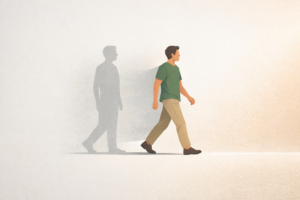
There is a moment in every transformation when the ground beneath you softens. You wake up inside a life that still looks familiar, yet something in your body knows you are no longer the person who built it. Conversations feel slightly off. Routines feel heavier. Even your own thoughts sound different, as if they are coming from a version of you that has already begun to outgrow the old shape.
This is the emotional middle.
A place between identities.
A doorway you didn’t choose but can’t step back through.
A season where nothing feels solid enough to lean on.
People rarely talk about this part because it is messy, unglamorous, and impossible to rush. The old self echoes. The new self-whispers. And you are left standing in the in‑between, trying to make sense of a landscape that keeps shifting under your feet.
Why This Phase Feels So Unstable
The nervous system is built for clarity. It wants recognizable roles, predictable reactions, and emotional terrain it already knows how to navigate. When you step out of an old identity, the system loses its map. You are not performing the old role anymore, but you have not built the new one yet.
That gap creates a kind of internal wobble.
• You feel unsteady in conversations.
• You second-guess your tone, your choices, your instincts.
• You pause more often because you are not sure which version of you should respond.
• You feel exposed without the old armor.
• You sense the new self forming, but it is still fragile.
Nothing is wrong. You are not regressing. You are recalibrating.
Where Old Patterns Fight the Hardest
Old identities rarely go quietly. They tug at you, trying to pull you back into familiar roles because familiarity feels safe. You might hear yourself using old jokes, old defenses, old tones that no longer feel like you.
This is the ego trying to protect you. It does not understand growth. It only understands change, and change feels like risk.
The middle becomes a tug-of-war.
• One part of you wants to move forward.
• Another part wants to retreat.
• A third part wants to freeze until clarity arrives.
All of these impulses are normal. They are signs that your system is reorganizing itself.
The Emotional Middle Has Its Own Weather
People often mistake this phase for failure because it does not feel good. It feels confusing, heavy, and strangely hollow. You might notice:
• a sense of drifting
• a drop in motivation
• a dip in confidence
• a quiet sadness you cannot name
• a desire to pull away from others
• a longing for clarity that refuses to arrive on your timeline
These sensations are not warnings. They are indicators that your internal architecture is shifting.
And if you feel afraid, that fear is not a flaw. It is a natural response to standing on ground that is still forming beneath you.
How We Distract Ourselves From the Middle
When the emotional middle becomes uncomfortable, the mind looks for exits. Not because you are weak, but because the nervous system is wired to avoid ambiguity. When identity becomes unstable, people instinctively reach for behaviors that restore a sense of control or familiarity.
You might notice yourself:
• scrolling to drown out the discomfort
• working long hours to outrun the quiet
• reverting to the part of your identity that feels safest
• filling every silence with noise or tasks
• numbing through food, alcohol, or constant stimulation
These behaviors are not failures. They are attempts to avoid the rawness of becoming. Beneath every distraction is a fear of stillness, a fear of grief, a fear of being seen without the old armor.
If you want a deeper look at why humans avoid discomfort, this piece from Greater Good Science Center offers a helpful lens: Distraction.
But distraction only delays the new identity from taking shape. The middle requires presence, not performance. Stillness, not speed. Attention, not avoidance.
And when distraction stops working, something else begins to happen.
A Brief Note on Mirrors
As the noise quiets, the world around you becomes reflective. Qualities in others stand out with unusual intensity. Some inspire you. Some irritate you. Some unsettle you in ways you cannot explain.
This is not coincidence.
This is mirror work.
You notice certain traits because they are active in you.
Some are rising.
Some are suppressed.
Some are waiting to be reclaimed.
There is a simple phrase that captures this truth.
If you see it, you have it.
The full mirror work deserves its own article, but here is what matters for the emotional middle. When your identity is shifting, mirrors become louder. They show you the traits you are ready to integrate, the ones you are ready to release, and the ones you are learning to trust.
Mirrors are not judgments. They are invitations.
What you are shown is what you are ready for.
The Architecture of Identity
Identity is not a single structure. It is a house built over years, shaped by experience, pressure, longing, and the need to belong. Some rooms are bright and familiar. Others are sealed off. Some were built in childhood. Others were built in survival. Every room influences how you move through the world.
Understanding these sections explains why the emotional middle feels so disorienting. You are not just rearranging one part of yourself. The entire house is shifting. And each section of identity plays a role in every corner of your life.
The Protective Self
This part learned how to keep you safe long before you had language for danger. It carries your instincts, your boundaries, your hypervigilance, your caution. It senses threat before your mind catches up.
In relationships, it decides how close you let people get and how quickly you trust.
At work, it shapes how you respond to pressure, conflict, and criticism.
At home, it influences your routines, your comfort zones, and the environments where you feel grounded.
Internally, it whispers slow down, something feels off.
During the emotional middle, the protective self becomes louder. Change feels like exposure, even when the change is good.
The Performed Self
This is the version shaped by expectation. It learned how to read a room, how to adapt, how to be who others needed you to be. It equated belonging with performance.
In relationships, it manages tone, harmony, and emotional labor.
At work, it handles professionalism, presentation, and the roles you play to succeed.
At home, it maintains order, keeps the peace, and holds old family roles in place.
Internally, it asks who do I need to be right now, even when that question exhausts you.
During the emotional middle, the performed self loses its script. The old role is dissolving, and the new one has not yet taken shape.
The Aspirational Self
This part dreams forward. It imagines who you could become. It holds your potential, your vision, your longing.
In relationships, it shapes the kind of partner or friend you want to be.
At work, it fuels ambition, creativity, leadership, and the desire to grow.
At home, it influences the life you are building, not just the one you are maintaining.
Internally, it whispers there is more for you, even when you feel stuck.
During the emotional middle, the aspirational self stirs. It waits for space to expand.
The Authentic Self
This is the quiet center beneath all the noise. It knows what feels true, even when you are afraid to admit it. It cannot be faked.
In relationships, it shapes intimacy, honesty, and emotional presence.
At work, it influences integrity, alignment, and meaningful contribution.
At home, it determines what feels nourishing, peaceful, and real.
Internally, it acts as the compass that points you toward what matters.
During the emotional middle, the authentic self holds steady. It does not rush. It does not force. It waits for you to catch up.
Why the Middle Feels So Disorienting
All four sections shift at once.
The protective self tightens.
The performed self glitches.
The aspirational self stirs.
The authentic self anchors.
This is why the middle feels like standing in a house where the walls are moving.
Your internal architecture is being rearranged.
Why You Cannot Rush This Part
Growth rarely happens at the beginning or the end. It happens here, in the emotional middle, where you are asked to sit with the discomfort of not knowing who you are yet. The nervous system needs time to release the old identity and learn the emotional posture of the new one.
Push too fast and the old identity rebuilds itself out of habit.
Move slowly and the new one has room to take shape.
The middle is not punishment.
The middle is the deep soil where the next version of you takes root.
How to Stay Steady When Everything Feels Uncertain
A few practices help you move through this phase without collapsing back into the old self.
- Let yourself pause before reacting. The pause is where the new identity begins.
- Notice the small signs of change. A softer tone. A boundary you once avoided. Silence instead of defensiveness.
- Let relationships adjust at their own pace. People respond to the version of you they remember. Give them time to meet the one you are becoming.
- Allow the grief to move through you. You are not just gaining something new. You are losing something familiar.
- Anchor yourself in the body. Breath, grounding, and sensory awareness help the nervous system feel safe enough to evolve.
Where the New Identity Learns to Stand
A new identity does not arrive fully formed. It grows in the small choices you make when no one is watching. It strengthens each time you choose honesty over performance, presence over habit, alignment over approval.
You are not lost. You are in transition.
You are not failing. You are unfolding.
You are not empty. You are clearing space.
And one day, without realizing it, you will look around and notice that the ground beneath you has settled. The doorway behind you has closed. The house inside you feels different. Stronger. Wider. More yours.
This is the quiet promise of the emotional middle.
It is the place where you stop pretending and start becoming.