The states that widen your perspective and help you think clearly.
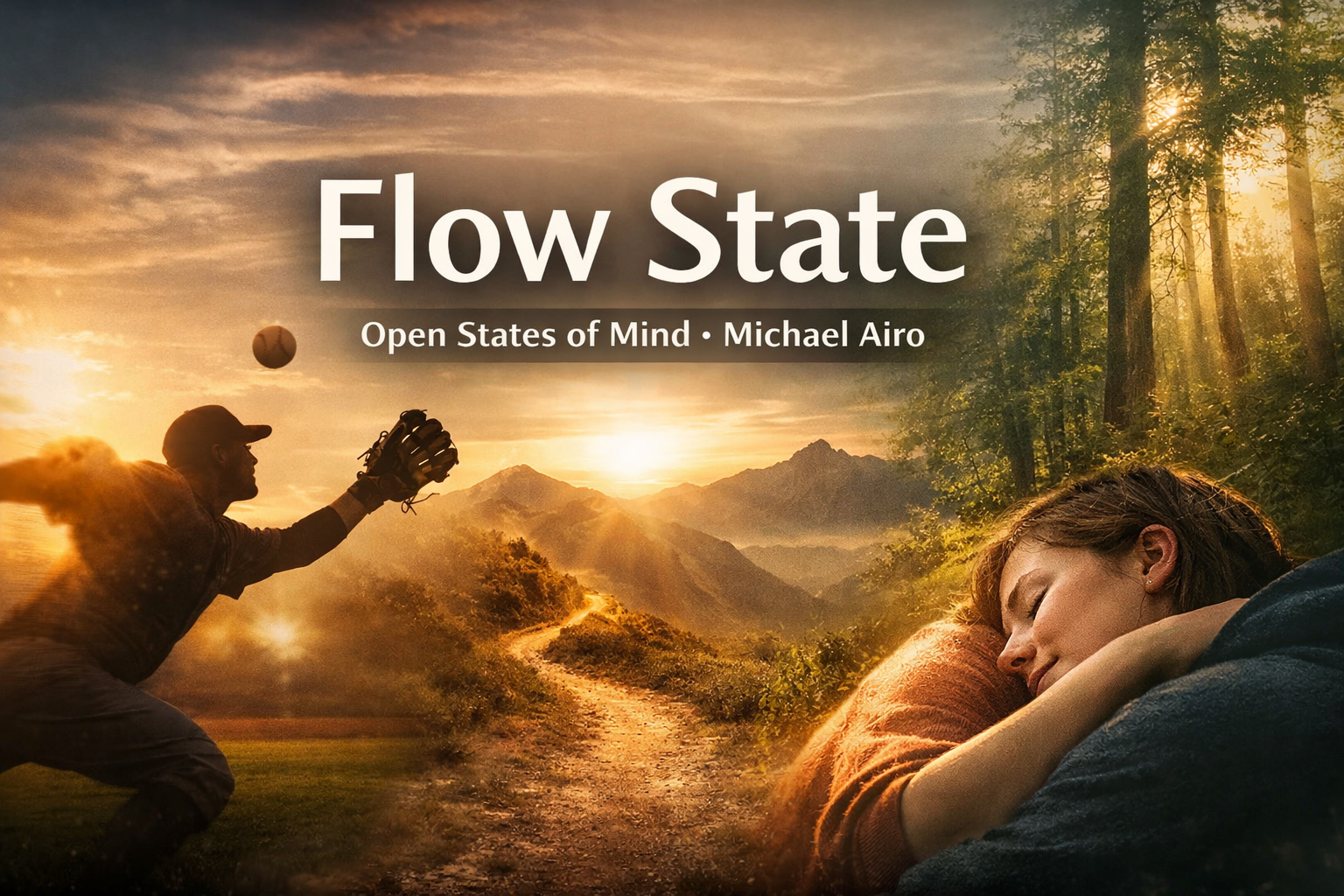
Fourteen years old, standing in the outfield, and the smell of the grass did something it always did.
Took me back to summers on the golf course with my brother. Just the two of us out there with nowhere to be and nothing at stake, hitting ball after ball into the open sky to see if the body could find them. No crowd. No score. Just the sound of contact and then the tracking, legs moving, hands arriving. A whole summer of that. A body learning things the mind never had to name.
That smell carried meaning before baseball ever gave it a context. Ease lived in it. A body discovering what it was capable of when nobody was keeping score and the only thing that mattered was the ball and the air and the grass coming up fast beneath running feet.
A breeze crossed the field, and the fine hairs on the forearms lifted and settled. Low sun sat warm on the back of the neck. Behind the fence, the crowd moved and murmured, a continuous sound like weather approaching, present but not yet arrived. Everything felt unhurried. Weight dropped low without instruction, feet settled into the ground, breath moving without management. Years of practice had gone somewhere below the threshold of thought, and the system was simply ready, the way readiness stops being a decision after enough repetitions.
The batter stepped in.
Something shifted and sharpened simultaneously. Not tension. A narrowing that brought everything into a single point of attention without closing anything off. Grass smell sharpened. Light grew specific. From behind the fence, the crowd separated itself from ambient noise into individual textures, shuffled feet, held breath, the particular silence of people who have stopped talking because something is about to happen. Everything reduced itself to the batter, the pitcher, the charged space between them, and a body standing ready in the outfield grass.
Crack of the bat.
Already moving before the decision arrived. Trajectory was known the way certain things are known, not calculated, not reasoned, simply present in the system as fact. Legs driving back toward the warning track, hard and fast, the fence coming up without being visible, everything narrowed to a single white dot swallowed by the brightness of the sun. Blind spots navigated by feel. Adjustments made without instruction. Arrival without negotiation.
A collective breath held somewhere behind the fence, the dripping hope of everyone watching pressing in from all sides, a wordless question hanging over the whole field.
Fence met body at the same moment ball met glove.
One beat of absolute silence.
Then the crowd came back all at once, and somewhere in the chest the awareness arrived that a runner on second was already tagging, a relay man cutting into the infield, an arm drawing back without being told.
The game wasn’t over. What came next was already known.
The feeling of having been completely, utterly present for something, every sense alive, every movement exact, the mind nowhere and everywhere at once, that feeling has a name.
If you’re just arriving here, the series begins with Your Mind Isn’t Broken, It’s Configured and the full map of all nine states lives in The Nine States of Mind.
Open states aren’t accidents. They’re conditions. And conditions, once understood, can be cultivated even if they can’t be forced. Three open states of mind shape the moments where everything becomes available, where perception widens, access deepens, and the best of what you’re capable of arrives without being summoned. Learning to recognize them is the first step. Learning what produces them is the second. Understanding why urgency and effort collapse them is the thing that changes how you approach everything else.
Flow State
Full absorption. Work pulls you forward rather than you pushing it. Time compresses or disappears entirely depending on the depth of the state. Effort becomes invisible because the gap between intention and action has almost closed to nothing.
Flow state is what the baseball story describes most directly, the moment when the body takes over, and the mind stops managing, when challenge and capacity meet so precisely that the nervous system runs clean. Psychologist Mihaly Csikszentmihalyi spent decades researching exactly this, finding the same conditions producing flow state across wildly different contexts. His work confirmed what athletes, artists, and writers already knew from experience: challenge matched to capacity, not so easy it produces boredom, not so hard it produces anxiety, but the precise meeting point between the two.
What the baseball story adds is something the research sometimes misses. Practice was what made the flow state possible. Not repetition alone, but the kind that moves skill below the threshold of conscious management. When the body knows what to do without being told, the mind is freed from managing execution and can do something more valuable instead. Simply be present for what’s happening.
That’s the paradox at the center of flow state. Trying to enter it is what blocks it. Grip tightens. Self-monitoring begins. Natural forward movement stalls under the weight of wanting to be in the state rather than being in the work. What produces flow state isn’t intention directed at the state itself. Attention directed at the task builds it. Skill is built low enough in the body that execution no longer requires management to sustain it. Release of the outcome lets it run.
Flow state doesn’t reward urgency. It rewards preparation and release.
When flow state has left, and the instinct is to chase it, that chasing is the problem. Break the task into something smaller instead. Return to the part that feels most practiced, most familiar, most below the threshold of effort. Lower the pressure of any single attempt until the work starts pulling again, rather than you pushing it. That’s how flow state finds you again, not through force but through the conditions that let it arrive on its own.
Grounded State
Late afternoon light filtered through the trees in long slanted bands, the kind that makes dust in the air look like it has its own slow pulse. A narrow trail stretched out before me, soft dirt giving under each step. Pine needles crushed beneath the heel released a faint resin smell that mixed with the cool shade.
Under the canopy, the air felt different. Cooler. Thicker. Nature encircled me in a quiet that wasn’t quite silence but a layering of small sounds, leaves brushing against each other high above, a distant bird calling twice then stopping, the soft thud of my own steps settling into a rhythm.
Nothing hurried here. Just movement.
A feeling of belonging settled inside, filling and opening the chest. An imperceptible shift that took over the entire body. Breath matched the calmness the forest radiated back, deeper, slower, each inhale reaching the bottom of the ribs before turning itself around.
Roots sprouting into the earth as if the surrounding energy and my own were blending their lines and feeding one another. Shoulders fell into their natural position. Spine stretched to its full length without thought.
Attention fully absorbed and in tune with the surroundings. Feeling the swaying of the branches far above as if they were my own. Sunlight warming from the inside out. A cool breeze kissing the inside of the wrist.
Just the ground underfoot and the sense of being held by something older than the day.
Grounded is the open state of mind that arrives not through effort but through surrender to what’s already present. Quieter than flow state, less dramatic than Abundant, and more underestimated than either.
From the inside, it doesn’t announce itself. No electricity, no absorption, no expansiveness. Just a steadiness sitting low in the body, unhurried, present, with no particular pull toward what’s coming or away from what just happened. Breath moving without effort. Attention resting on what’s actually here rather than cycling through what isn’t.
Something in a grounded body actually drops. Emotion that might otherwise build pressure in the chest moves downward and out instead, draining into something beneath the noise rather than accumulating into distortion. Not cut off from feeling. Letting it move through rather than collect. From that place, a stability becomes available that doesn’t come from having everything figured out. Strength comes from being connected to something beneath the noise.
Judgment becomes reliable from here. Not because everything is resolved or certain, but because perception isn’t being filtered through threat or urgency. A grounded mind sees what’s actually in front of it. An ungrounded mind sees what it’s afraid of, or what it wants, which are often very different things.
When Grounded has slipped away, the fastest return is through the body rather than the mind. Feet flat on whatever is beneath them, weight dropping rather than held, one breath that moves the belly before the chest. Not as a performance of calm but as a genuine signal to the nervous system that the threat has passed. Then something specific and close to rest attention on. Temperature of the air. Weight of the hands. Sound nearest to you right now. Sensation pulls attention out of the story and into the present, and presence is where Grounded lives.
Abundant State
Lying awake, feeling her tender breath against my arm. Sleep couldn’t find me; the moment kept expanding, her closeness filling me with a warmth too alive to dim. My whole being leaned toward her, open and awake. She curled snugly along the inside of my body, so free and natural, as if she was meant to fit there. Her warmth tucked comfortably in my arms was the most indescribably tender moment of my life.
Something in the chest expanded, a quiet fullness rising as if love were moving through me from a well with no bottom, no edge, no end.
After a moment that stretched on for what seemed like a lifetime, my arm strained under the pressure of supporting her weight. Her hair tickled my nose, but still I would not move her for fear of ruining this moment. The price of pain a worthy ransom for something this tender. Some truths live in the body long before the mind can name them. And still the warmth kept rising, as if love were determined to show me it had no limits.
What rose in that moment was the third open state of mind. Abundant doesn’t arrive through effort or decision. Something opens in the chest before the mind even registers why. Not happiness exactly. Not excitement. Something quieter and more structural than either, a sense that there is enough, that possibility is real rather than theoretical, that the way you meet other people can be open rather than guarded.
Generosity arrives without calculation from here. Creative work opens. So does genuine connection, because the subtle defensiveness that scarcity produces has gone quiet, and something in you is extending outward rather than pulling inward.
Most people encounter Abundant accidentally. A morning where everything arrived easily. A conversation that left more than it took. A stretch of work where ideas came without effort, and generosity cost nothing. Then it passed, and the way back wasn’t clear because it hadn’t been recognized while it was happening.
Recognition is the beginning of cultivation.
Abundant follows certain conditions reliably. Genuine rest rather than performed rest. Time with something that filled rather than pulled. Movement that completes the body rather than depleting it. A conversation that left the chest more open than it found it. These aren’t formulas. They’re patterns worth tracking in your own life, the specific inputs that have reliably produced spaciousness, because your version of Abundant has its own conditions, and nobody else’s map will get you all the way there. When Abundant has closed, depletion is almost always underneath it. Rest first, because depletion produces scarcity as reliably as replenishment produces spaciousness. Then attention toward what’s already present rather than what’s absent. Not as performance but as a genuine redirect of the same scanning the mind does toward lack. What is actually here? What is already working? What has already arrived? The chest begins to open from there, slowly, the way a room warms when the window that’s been letting cold air in finally closes.
None of these open states of mind rewards forcing.
Flow state collapses under pressure. Grounded dissolves when you perform it rather than inhabit it. Abundant closes the moment you chase it. All three share a common requirement: stop trying to produce them and start creating the conditions that make them possible.
The fourteen-year-old in the outfield didn’t try to enter flow state. He practiced until flow state had somewhere to land. He didn’t try to feel Grounded. He stood in that position long enough that the nervous system learned what settled felt like. He didn’t manufacture spaciousness. He showed up, the body did what it had been trained to do, and the state arrived because the conditions were right.
Practice builds the container. Presence fills it.
Every open state of mind responds to the same principle. Not effort directed at the state itself, but attention directed at what produces it. Learn your own conditions. Notice what fills rather than pulls. Build the skills that move below conscious management. Then release the outcome and let the state find you.
The state will find you. Already has, more times than you’ve had a name for it.
Next: Protective states, what anxiety, defensiveness, and overwhelm are actually trying to tell you, and how to listen so they’ll let you go.
This series is written by Michael Airo. New pieces are published regularly at michaelairo.com.
If you’re new here, you can learn more about my work and background on Michael Airo’s About Page.
Or, if you want to explore a connected idea, read Outgrowing Yourself.