Drained, resistant, and reflective aren’t the absence of productivity. They’re a different kind of it.
Some mornings, the body wakes already behind, carrying the particular gravity of emotional exhaustion before the day has asked for anything yet.
Not pain. Not illness. Just weight, sitting low in the limbs before the feet have found the floor, the kind of weight that turns the simple act of standing into something coaxed rather than automatic. Arms that don’t quite feel like they belong to the rest of the body yet. Eyelids holding a gravity that has nothing to do with how much sleep happened the night before. The whole system is asking, without words, for something the morning hasn’t been built to give.
Sit too long in direct sun, and a different version of the same heaviness arrives. Not gradually. A line gets crossed, and the air itself seems to thicken, the limbs sinking into something closer to water than atmosphere. Lifting a hand requires negotiation. Even blinking starts to feel like an event the body has to consent to separately. Thought slows to match the body’s new pace, the mind wading rather than walking through whatever needs to be thought.
Sleep carries its own version of this weight. Lying awake when the body is emotionally exhausted, the mind still running when everything underneath it wants to stop, alert and restless in the dark, while the body holds a particular kind of stillness that isn’t peace. Then morning comes, and the current reverses. The pull back into sleep thickens the longer you linger in it, the body claiming you back regardless of how many hours have already passed. That heaviness on waking isn’t always laziness. Sometimes something underneath is still working and asking, with increasing insistence, not to be interrupted. But not always. Sometimes the pull back into sleep is the mind using the dark and the warmth to avoid what waits on the other side of waking. The difference between the two is worth learning to feel, because they wear the same clothes and ask for the same thing.
Most people try to rise above all of this. A jolt of caffeine. A surge of willpower. The familiar insistence that the day must move and the body can catch up later.
That argument has a cost. Sometimes the cost arrives slowly, a tax paid in small increments over weeks. Sometimes it arrives all at once, in a single moment, the body has been building toward for days.
Six rounds. Thirty box jumps, thirty wall balls, a four-hundred-meter run between each one, the kind of workout that doesn’t ask permission before taking everything out of the body that’s available.
By the fifth round, something had changed. Legs that had been firing clean and full now answered late, the box a few inches higher than it had been an hour ago, even though nothing about it had moved. The body knew. Somewhere underneath the noise of breath and pace and the count still left to go, something low in the chest was already asking to be heard.
Pushed through anyway. One more round. One more set of jumps with legs that didn’t have the lift left that the movement required.
The shin caught the edge of the box on the way up, the skin opening in a long raw line that didn’t register as pain until a few seconds later, the way injury sometimes arrives after the body has already decided to keep moving regardless of the cost. Blood and chalk. The workout finished anyway because stopping wasn’t part of the plan the mind had made, even though the body had been trying to renegotiate that plan for at least a round and a half.
A year later, after months away from the barbell, the front squat felt like an old friend worth visiting again. Same number on the bar that used to move clean. Same confidence that the body would simply remember how to carry it.
Except the body had been saying something for days before that. A tiredness that sat low and persistent, not sharp enough to name as injury, not obvious enough to take seriously. Easy to mistake for ordinary fatigue. Easy to override with the same argument that had worked before.
Weight on the bar. Down into the squat. And somewhere near the bottom, the core that was supposed to hold everything together simply didn’t. A give, sudden and specific, low in the back, the stabilizer muscle announcing its limit in the only language the body has available when everything else has been ignored.
Two different injuries, a year apart, with the same signal arriving both times. A body trying to say something before the moment of failure, and a mind too committed to the plan to translate what it was hearing.
A few minutes into a workout, if the heaviness doesn’t lift once you start moving, the body is saying something worth hearing. Not always. Sometimes the body needs warming up, needs coaxing, needs to be reminded of what it’s capable of. But there’s a difference between resistance that softens once movement begins and resistance that deepens the longer you push. One is inertia. The other is information.
Knowing which one you’re in is the work.
Emotional Exhaustion
Much of what gets labeled as laziness or low motivation is something more specific. Emotional exhaustion builds slowly when demands stack without enough recovery, producing physical and emotional symptoms that look like character flaws but are really signs of a system at its limit. Mayo Clinic describes this pattern precisely, noting that emotional exhaustion tends to accumulate quietly over time before the body and mind finally signal that something has to change.
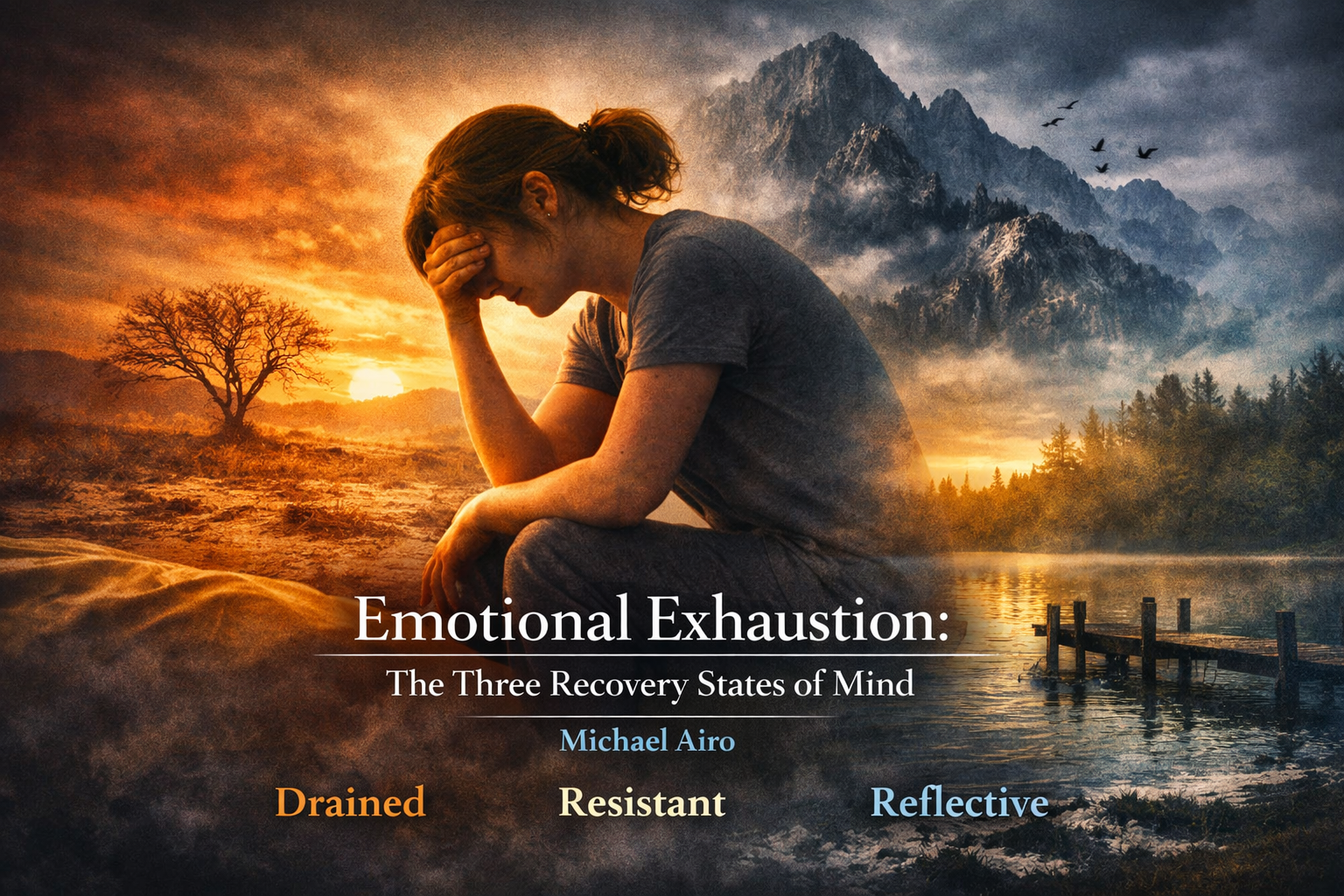
Recovery states are the three states in the nine-state map that ask you to stop. Not as punishment. Not as a failure. As intelligence. Drained, Resistant, and Reflective each arrive with a different quality, a different message, and a different request. Treating them as the same state, or treating all three as emotional exhaustion dressed as avoidance, is what makes them linger longer than they need to.
If you’re just arriving here, the series begins with Your Mind Isn’t Broken, It’s Configured, and the full map of all nine states lives in The Nine States of Mind.
The first step is learning to tell them apart.
Drained
Drained is the most physical of the three. Weight in the limbs. A flatness in perception where things that normally interest you land without registering. The effort required to begin even simple tasks feels disproportionate to the task itself, not because the task has changed, but because the account is low.
You gave more than you took in. The body is just letting you feel the balance.
This is the state most people try to think their way out of, looking for motivation, looking for inspiration, waiting for the feeling of readiness that won’t arrive on an empty account. Readiness is downstream of replenishment. You can’t reason your way to energy you haven’t restored.
Genuine depletion needs genuine rest. Not distraction or numbing. Not the passive consumption of content that feels like rest but leaves the balance exactly where it was. Actual stillness. Sleep that completes. Quiet with no agenda. Time with something that adds back to the account instead of pulling from it.
But depletion has a more complicated cousin worth knowing about.
Sometimes what presents as physical exhaustion is the body doing something more specific. Dr. John Sarno documented this extensively in Healing Back Pain: The Mind-Body Connection, arguing that the mind uses physical sensations to keep emotional content below the surface. The body creates real, felt symptoms to redirect attention away from something the mind isn’t ready to face. Fatigue that felt structural turns out to have been carrying a message. When the emotional content is recognized and named directly, the physical symptom loses its function and releases.
This distinction matters because the response needs to be different. Genuine depletion needs rest. Emotional shielding needs the right question.
When the heaviness arrives, rest first. Let the body do what it’s asking to do. If the rest doesn’t move the needle, if the weight remains after real sleep and genuine quiet, something worth asking directly sits underneath. What am I actually feeling beneath this? What has been sitting unacknowledged long enough that the body decided to carry it as weight?
Sometimes the heaviness lifts with the simple question because there is no need to hide an emotion you are ready to face. Sometimes rest was all it needed. Either way, the body was telling the truth.
Resistant
Resistant is subtler than Drained and more frequently misread.
Drained has a physical quality that most people can feel and name, even if they push through it. Resistant is more ambiguous. Friction without a clear source. The task sits open, and the hands hover over it, and nothing begins. Minutes pass. Something else gets done instead. The thing stays on the list. The day moves forward without it.
Most people read this as laziness. As procrastination. As a character flaw that requires discipline to overcome, they override it through force of will, guilt, or the accumulated pressure of a deadline.
Sometimes that’s right. Avoidance is real. The difference between Resistant as a signal and Resistant as avoidance is one of the most important distinctions in the body, and it isn’t always obvious in the moment.
But Resistant is also the state most worth examining before overriding. Because sometimes the friction is the most intelligent thing the mind produces. Something about the task, the direction, the relationship, or the timing isn’t right yet, and the system flagged it before the conscious mind caught up. The body knows things the analytic mind hasn’t processed. The resistance that keeps showing up before a particular conversation, a particular decision, a particular commitment, is sometimes the most honest assessment available.
Think of it as the body’s version of a yellow light. Not a stop. A slowdown and check.
A trainer who has worked with enough bodies knows the difference between the discomfort of growth and the signal of damage. Both hurt. The quality of the hurt is different. Growth discomfort has a productive quality, a burning that says something is happening. Damage signals have a different register entirely, sharper, more insistent, the kind that doesn’t improve with warming up and gets louder the more you push. The shin that caught the box edge was a damage signal. The low back that gave under the bar was a damage signal. Both had been speaking for longer than the mind was willing to hear.
Mental and emotional resistance work the same way. The friction that softens once you begin is inertia. The friction that deepens the more you push, that keeps returning no matter how many times you override it, is trying to tell you something worth hearing before you override it one more time.
Sometimes what sits underneath the resistance is simpler and more personal than misalignment. Fear of getting it wrong. Fear of not being good enough to do it justice. A quiet dread of the person the work is being done for, the boss whose approval never quite arrives, the professor whose standards feel impossible to meet, someone whose presence in the task has made the task feel unsafe, without the mind ever naming why. And sometimes the resistance is something more fundamental than fear. Something is off, and the body registered it before the conscious mind caught up. Sometimes the task itself is asking you to work against yourself. Nobody moves quickly when they’ve been asked to dig their own grave.
Become a detective here. The mind already knows the answer. Once you stop pushing long enough to ask the right question, what surfaces is almost always specific. Not a vague unease but a particular thing, a name, a fear, a dynamic that has been sitting underneath the resistance the whole time, waiting to be identified rather than overridden.
Sit with it for ten minutes before you decide. Ask what specifically feels wrong. Not wrong in the sense of difficult or uncomfortable, but wrong in the sense of something hidden underneath that hasn’t been named yet. If the answer is nothing, if it’s just the discomfort of beginning something hard, begin. If the answer points to something specific, that specificity is worth more than another hour of pushing through. The resistance wasn’t blocking the work. It was protecting you from doing the work in a way that wasn’t going to serve you.
Reflective
Reflective is the quietest of the three and the most misunderstood.
From the outside, it looks like nothing is happening. From the inside, it feels like being in between things, not drained, not stuck, just slow. A pulling inward. A quality of attention that has turned toward something interior rather than exterior, processing something below the threshold of what the busy mind can detect.
Something has happened. An experience. A conversation. A realization that hasn’t fully formed yet. A loss, a change, or a transition that the conscious mind has acknowledged, but the deeper self is still working with. Reflective is the state that integration lives in. And integration takes time and quiet, neither of which modern life tends to offer without resistance.
The worst thing you can do in a Reflective state is fill the space.
More input. More stimulation. More content. More noise. All of it lands on top of something that was in the middle of being understood, interrupting a process that can’t be hurried without being broken. The insight that was forming goes underground. The integration that was happening pauses. What remains is the vague, unsettled feeling of having been close to something that is no longer accessible.
Reflective asks for one thing. Space.
Not productive space. Not intentional journaling, structured meditation, or any particular practice. Just the absence of noise long enough for what’s underneath to surface on its own terms. A walk without headphones. A morning without a screen. A few minutes of sitting in the particular quality of quiet that has no agenda except to let whatever is moving below the surface keep moving.
Some of the most important understandings in life arrive in Reflective states. Not through effort. Through patience with the process that was already happening.
The Line Between Honoring and Avoiding
Not every low-energy state is a signal worth honoring. Not every resistance is intelligent friction. Not every quiet is integration. Sometimes Drained is being used to avoid something difficult. Sometimes resistance is fear dressed as wisdom. Sometimes reflective is a comfortable label for hiding.
The line exists. And knowing which side of it you’re on is an important skill.
A trainer who has worked with enough bodies understands this distinction in the physical domain. There is damage pain, and there is growth discomfort. Rest when there is damage. Work through the discomfort of growth. The question is always the same: am I doing more harm by pushing through than by stopping?
The same question works for mental and emotional states. The answer requires honesty that most people find uncomfortable. Because the honest answer is sometimes yes, you’re avoiding. And sometimes yes, you genuinely need to stop. The work is developing the discernment to tell the difference.
Here are three questions that help. Not as a checklist. As an honest conversation with the state, you’re actually in.
The first question: Where does this live in the body?
Genuine emotional exhaustion has a physical address. Weight in the limbs. Heaviness behind the eyes. A flatness in the chest that sits deeper than thought. Avoidance tends to live higher up, in the head, in the circling thoughts, in the elaborate reasons the mind constructs for why today isn’t the right day. Ask where the state lives. The body answers honestly even when the mind won’t.
The second question: What would change if the thing I’m avoiding were already done?
Genuine recovery states don’t respond to this question with relief. Drained doesn’t lighten because the task is finished. Resistant stays resistant even when the task is imagined as complete. Reflective continues regardless of external circumstances. But avoidance responds to this question with a distinct shift in the body, a loosening across the chest, a drop in the shoulders, the subtle relief of imagining the weight lifted. That relief is the clue. Something was being carried that wanted to be set down. That’s not depletion. That’s avoidance of a specific thing, and the specific thing is the clue.
The third question: Has genuine rest actually been tried?
Not scrolling. Not watching. Not the passive consumption that feels like rest but leaves the nervous system exactly where it found it. Actual stillness. Sleep. Quiet with no agenda. If genuine rest hasn’t been tried, the question of whether this is emotional exhaustion or avoidance can’t yet be answered honestly. Rest first. Then ask again.
Recovery states aren’t the absence of your life. They’re the part of your life that makes the rest of it possible.
Drained is the account asking to be replenished before more is withdrawn. Resistant is the friction that might be protecting you from a direction that was never quite right. Reflective is the process that turns experience into understanding, that takes what happened and makes it into something you can carry forward, rather than something that simply happened to you.
None of them are weaknesses. All of them are doing something on your behalf.
The question isn’t how to get out of them faster. The question is what they know that you don’t, and whether you’re quiet enough yet to hear it.
Next: The shift, a repeatable way to move between states with intention, and the states you don’t shift into but can only invite.
This series is written by Michael Airo. New pieces are published regularly at michaelairo.com.
If you’re new here, you can learn more about my work and background on Michael Airo’s About Page. Or, if you want to explore a connected idea, read Outgrowing Yourself.