You can’t force a state. But you can build the conditions for the one you need.
The Matterhorn was visible from the hotel window.
White peak against a sky still deciding its blue, close enough to touch and impossibly far at the same time, and the buzz had already started. Every year, this exact morning, no other. A low current under the skin, humming in the wrists and the back of the neck, feeding on each second the way a held note feeds a room. Even the hotel soap smelled different this morning. Even the carpet under bare feet felt like the last flat mile before something enormous.
Seven years old and already alive with anticipation.
Then the toy store.
Down the street, on the way, holding a specific toy that had been living behind my eyes for weeks, so vivid I could feel the weight of the box. A five-minute stop. Maybe ten. The request came out casual and landed like a match on dry grass.
My brother, three years older, could not believe what he was hearing. Time. Disney time. Traded for a toy store that existed in every city we had ever driven through, against a place that existed nowhere else on earth. His voice climbed. Mine climbed after it. Heat rushed up into my face, the particular flush of being seven and overruled, and the argument burned short and hot and ended the way arguments between brothers end, with nothing resolved and a wall standing where the buzz had been.
The walk to the park went quiet.
Same sidewalk as every year. None of it reached me now. The morning had gone flat and gray at the edges, sounds arriving from a distance, as if the day were happening one room over. Arms crossed so tight the shoulders ached. Jaw set. The sweetness had drained out of the air entirely, and the Matterhorn, when I refused to look at it, sat there anyway in the corner of my eye like a promise someone else was going to keep.
Where I was: furious, seven, staring at the sidewalk.
Where I wanted to be: the place I could see from my hotel window.
The space between those two things had nothing to do with distance.
Then the smell found us.
Sugar first. Then vanilla, then something baking underneath it, warm and buttery, reaching down the sidewalk the way those smells are engineered to reach, drifting past the wall without asking permission. One breath arrived deeper than the ones before it. The jaw loosened a fraction. Somewhere underneath the sulk, in a place too old and too honest to argue with, the knowing was already there. The fight would not survive the gates. Never had. Not once in all the years.
And then the oldest game we had kicked in on its own.
Who sees Space Mountain first.
One of us spotted the white curve of it and called it, and the other one argued the call, loudly, immediately, and just like that we were arguing about the right thing again. The wall didn’t come down so much as get forgotten, left standing on the sidewalk behind us with the fight still attached to it, both of us suddenly too busy scanning the skyline to carry it the rest of the way.
Under the railroad station, through the cool shadow of the tunnel, the air changing temperature on the skin, and Main Street opened.
Every building drawing the eye down toward the castle, all of it polished to a shine the way the whole park gets polished every single morning, brass and glass and paint throwing the light back, music drifting from somewhere and everywhere, the whole street unfurling and appearing endless. Mom was already pulling ahead of all of us, racing toward whatever came first. Dad would have the Dole juice in our hands before noon, pineapple sweet and cold enough to ache against the teeth, because he always did. And the buzz came back all at once, bigger than before, the way a river is bigger after the dam breaks, every sense turned up and drinking, the body seven years old, charged with wonder and exactly where it belonged.
Years later I learned the street is built on a trick of perspective, scaled to look enormous walking in and gentle walking out, welcoming you and then letting you go easy. The same way the statue that eventually stood at the end of it, Walt holding Mickey’s hand, always seemed to be waving you in at the start of the day and waving goodbye at the end of it, every single year we came.
Nobody shifted anything that morning. Nobody named a state or honored it or chose where to go next. Two kids got in a fight, and then a place built by people who understood something about wonder did the work for them.
This article is about learning to do on purpose what that morning did by accident.
There is a moment suspended between where you are and where you want to be.
Just a heartbeat, brief enough to miss if you’re moving fast enough, where something in you recognizes the state you’re in and decides it doesn’t want to stay there. Learning how to change your state of mind begins here, in this pulse, before any technique arrives. The state came for a reason. Announced what it came to show you, or is still whispering it in your ear, and either way a choice now sits in front of you that was invisible until you learned to see it.
Everything in this series has been building toward this heartbeat.
The state has never been the problem. Staying in it past its usefulness is.
And the only way to move through a state rather than being moved by it is to understand what it was doing on your behalf before you ask it to step aside. That understanding is what makes a shift durable rather than temporary. Override a state and it returns. Listen to it first and it releases.
Every escape artist knows the secret the audience never sees. The locked box was never truly sealed. A release waits inside the design, built in from the beginning, and the entire act depends on knowing where it lives and how to reach it. To everyone watching, the escape looks like magic. To the one inside, it was always just knowledge. The state you’re in works the same way. Never trying to trap you. Only trying to get your attention. And once the message lands, once the system knows someone is home and listening, the mechanism gives.
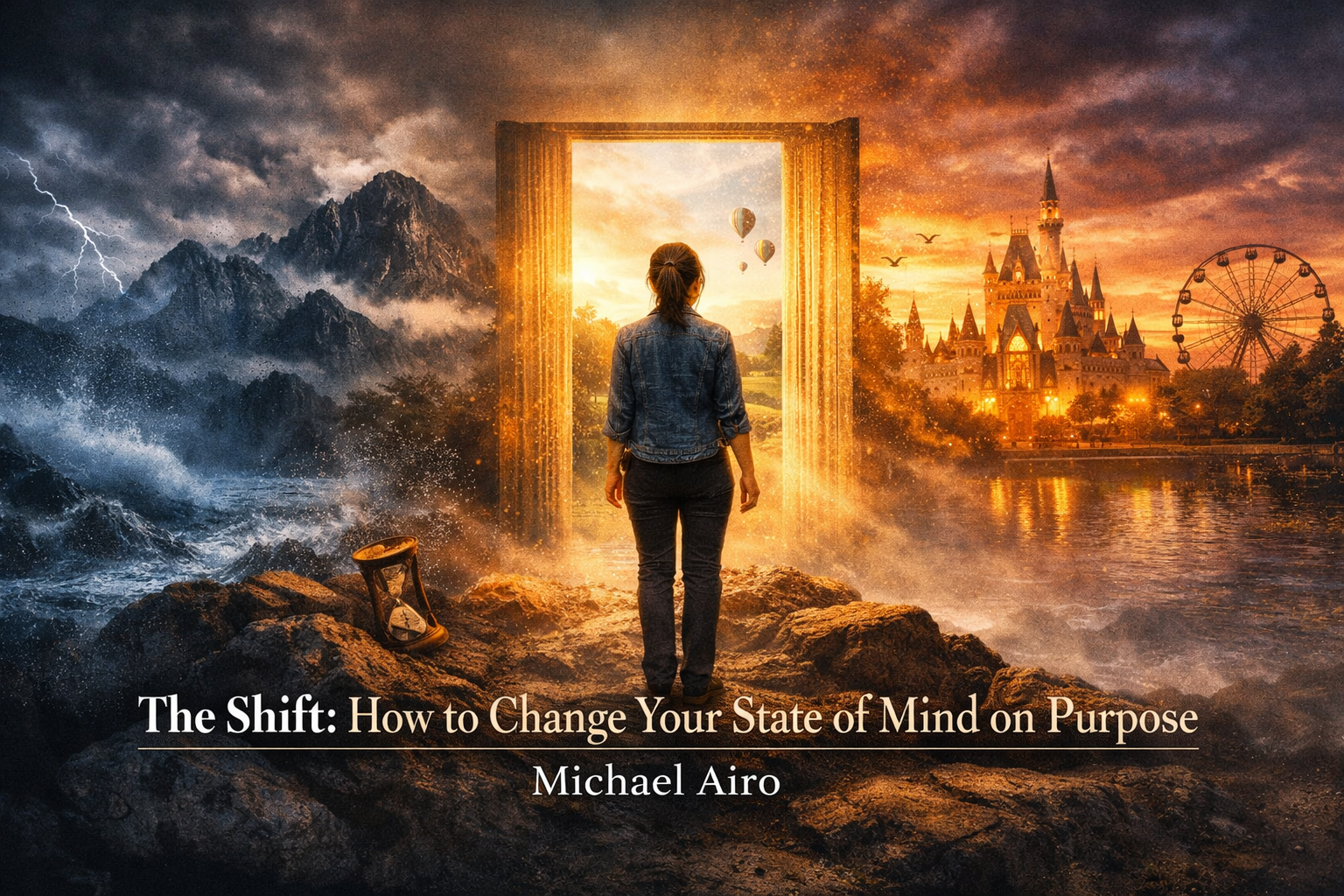
The door opens from the inside.
If you’re arriving here for the first time, the series begins with Your Mind Isn’t Broken, It’s Configured, and the full map of all nine states lives in The Nine States of Mind.
Before the protocol, one thing worth saying clearly.
Knowing how to change your state of mind is not the same as performing wellness. Not the practice of pretending to feel something you don’t, or forcing positivity over something that deserves to be heard, or moving so efficiently between states that you never inhabit any of them long enough to learn what they know. Neuroscientist Ethan Kross, one of the world’s leading researchers on emotion regulation, describes the goal in Shift: Managing Your Emotions So They Don’t Manage You as learning to move from one emotional state to another with intelligence, experiencing all of them, learning from them, and when needed, shifting with intention rather than being carried by momentum.
Not emotional management in the sense of control. Emotional navigation in the sense of choice.
The Shift Begins With a Name
Not a mood, not a vibe, not a general sense of being off. A specific name from the map. Bad is not a state. Neither is stressed, fine, or okay. Anxious is a state. Drained is a state. Resistant is a state. The difference between a vague description and a precise name is the difference between wandering in unfamiliar territory and having a coordinate. One tells you approximately where you are. The other tells you exactly, and exactness is what makes it usable.
The body is the most reliable instrument for this. Not the mind, which tends to narrate rather than locate. Ask where the sensation lives, what quality it has, whether it’s pulling forward or backward or inward, whether it feels like pressure or weight or friction or flatness. A jaw set without permission. Shoulders aching from arms crossed too tightly. Let the body answer before the mind has a chance to explain. The name that arrives from sensation is almost always more accurate than the one constructed from thought.
Once the state is named, the temptation is to move immediately. Most people do. Most people have been trying to change their state of mind by skipping this next part their entire lives, which is why the same states keep returning with the same urgency, carrying the same unheard message.
Honor it first. Sixty seconds of genuine acknowledgment that the state arrived for a reason and the reason was legitimate. Anxiety was scanning for something real. Defensiveness was protecting something that matters. Drained was reporting the honest math of a system that gave more than it received. Whatever the state, it wasn’t wrong to arrive. Doing its job, is all.
Even the wall on that sidewalk was doing a job. A seven-year-old had wanted something small and been made wrong for wanting it, and something in him moved to protect the wanting. The wall wasn’t the problem. The wall was the message, standing there waiting for someone to read it.
Turn toward it briefly and directly, the way you might turn toward someone who has been waiting patiently to tell you something important. What specifically are you afraid of right now? What is actually being protected here? What has been sitting unacknowledged long enough that the body decided to carry it as sensation? The answer is almost always smaller and more specific than the feeling produced. Name the actual thing. Thank the state for bringing it. The shift is available now in a way it wasn’t sixty seconds ago.
Now choose where to go. Not the best state in the abstract. Not the most positive or the most productive. The most useful state for what comes next.
Writing requires a different state than a difficult conversation. Rest requires a different state than a creative sprint. Leading a meeting requires a different state than processing something alone. The question isn’t what state do you want. The question is what state does this moment need.
Worth knowing before you choose: the nervous system doesn’t leap. Two boys on a sidewalk didn’t jump from fury to wonder. They moved from fighting to arguing about the right thing, the same energy pointed somewhere better, and wonder arrived a few hundred feet later on its own. Moving incrementally, toward something slightly more open than where you are, is how lasting change of state happens. From overwhelmed to grounded is a realistic shift. From overwhelmed to flow is asking the system to skip too many rungs at once. Choose the next state up, the one adjacent to where you are, and let each small shift build the conditions for the next. Momentum accumulates this way. Forced leaps collapse back to the start.
The Physical Levers
The body is the fastest route to the chosen state. Faster than thought, faster than intention, faster than any amount of willing yourself to feel differently. The nervous system responds to physical input before the mind has finished deciding what to do with it, which means the body can begin the shift while the mind is still catching up.
Breath is the most immediate lever and the most underestimated. A slow exhale that lasts longer than the inhale activates the parasympathetic nervous system within seconds, signaling safety to a system that has been running on alert. Not a performative deep breath. A genuine slow exhale, four counts out, two counts in, repeated three times, until the shoulders come down a half inch without being asked. Kross’s research confirms what athletes and meditators have known for centuries: deliberate breath changes your state of mind before conscious effort has fully committed to the shift.
Posture changes what the body expects of itself. Shoulders that drop and open signal something different to the nervous system than shoulders that rise and tighten. A spine at its full length signals something different than a spine collapsed forward. Posture isn’t performance. Communication, from the body to the brain, about what kind of moment this is and what kind of person is moving through it.
Movement breaks the physical pattern of a state that has settled into the body as stillness. Walking specifically changes the rhythm of thought. The bilateral movement of the feet, left-right, left-right, engages both hemispheres and creates a quality of attention that stationary thinking doesn’t reach. A four-minute walk, no destination, no headphones, is one of the most effective ways to change your state of mind, and one of the most consistently underused.
Environment changes the input the nervous system is receiving and therefore changes what the nervous system produces. Moving from a confined space to an open one, from artificial light to natural light, from noise to quiet, all of these shift the sensory context and with it the state. Kross identifies sensory experience as one of the most effortless pathways between emotional states precisely because sensory input bypasses the mind’s tendency to resist change and works directly on the body’s most primitive response systems. A smell reaching down a sidewalk doesn’t ask the sulk for permission. One breath arrives deeper than the ones before it, and the jaw loosens a fraction before anyone decides anything.
Attention direction changes what the mind is tracking and, therefore, what the nervous system is generating. Anxiety pulls attention toward the future. Drained pulls it inward. Grounded rests on what’s immediately present. Two brothers on a sidewalk never argued the fight down. Attention got redirected, who sees Space Mountain first, and the state lost its grip because nothing was feeding it anymore. Consciously redirecting attention toward the temperature of the air, the weight of the hands, and the specific sounds in the room right now anchors the nervous system to the present moment, where most open states live.
A shift without an anchor drifts.
The system moves toward the new state, gets partway there, and then slides back because nothing in the environment or the routine has been updated to hold the new configuration. An anchor is a brief, deliberate action that signals to the system that you’ve arrived somewhere different. Writing the name of the target state before beginning work. Standing at the window for thirty seconds with both feet on the floor before a difficult conversation. One conscious breath before opening a message that might be hard to read. Small, specific, repeatable. The anchor doesn’t produce the state. Confirms it, and that confirmation is what the system needs to stop pulling back toward where it was.
The Morning Shift
The most powerful application of knowing how to change your state of mind isn’t reactive. Proactive is where it compounds.
Before the day asks anything, before the phone delivers its first round of inputs, before the first obligation arrives to shape the morning, there is a window. Small and quiet and frequently lost to the snooze button.
Not snoozing is itself a state decision. The pull back into sleep is real and sometimes worth honoring, as the recovery states taught. But when the pull is avoidance rather than genuine recovery, giving in sets the nervous system’s first signal of the day as retreat. The body learns, in the smallest possible way, that the first decision of every day is to choose comfort over intention.
Sunlight within the first thirty minutes of waking shifts the nervous system toward alertness, stable mood, and presence. Not because of motivation or willpower but because the body’s circadian system is calibrated to light, and morning light tells every system in the body what time it is and what kind of day to prepare for.
Movement before obligation changes what state arrives at the first demand. Even ten minutes. Even a walk around the block. The bilateral rhythm, the shift in environment, the breath that deepens naturally with physical effort, all of this stacks before the first challenge arrives and gives the nervous system a baseline that’s harder to destabilize.
Setting an intention before the day begins is not a gratitude list or an affirmation. A question. What state does today need most from me? Not what do you want to feel? What does the work, the relationship, and the challenge ahead actually require? Name it. Write it down. The named target state is easier to return to when the day pulls somewhere else, because you already know where you were headed.
The States You Can Only Invite
Everything above belongs to the territory of the workable mind. States you can navigate deliberately, shift between with intention, and change through practice. Honest work. Worth doing until it becomes instinct.
But some states don’t respond to protocol.
Flow arrives when it arrives, not when it’s called. Deep rest comes when the system finally releases what it’s been holding, not when you decide it should. Awe happens in the space between an ordinary moment and something larger than expected, and cannot be manufactured any more than lightning can be scheduled.
These states share one thing. They require the door to be open.
Nobody forced the wonder that came back on Main Street. A place built by people who understood the mechanics of it had stacked the conditions, the smells reaching down the sidewalk, the shine on every surface, the street scaled to make a small body feel like it was entering something endless, and wonder walked through the open door on its own. My grandmother felt it every single visit, well into her later years, a child again the moment the gates came into view. Availability to awe has nothing to do with age. Only with whether the door is open.
The protocol won’t produce these states. But a life built around the protocol creates the conditions in which they become possible. A nervous system that has been regularly listened to is a nervous system that doesn’t have to shout. Someone who has learned how to change their state of mind with intention has also learned how to get out of the way when something larger moves through. A person who has spent months learning to recognize and work with nine states is a person who has become, gradually and without drama, someone the uninvited states can reach.
Not mastery. Availability.
The Map You Carry Forward
Nine states. Three families. One practice.
Open states are conditions to cultivate. Flow asks you to protect it and practice what produces it. Grounded asks you to inhabit the present and let emotion move through rather than accumulate. Abundant asks you to redirect attention toward what’s already here and let spaciousness arrive from that.
Protective states are messages to decode. Anxious is scanning for something real and needs a specific object before it can settle. Defensive is protecting something that matters and needs the actual thing named before the wall can soften. Overwhelmed is a circuit breaker that needs reduction, not motivation, before anything else becomes accessible.
Recovery states are requests to honor. Drained needs genuine replenishment, not distraction or performing productivity. Resistant is friction worth examining before overriding, because sometimes it’s the most intelligent signal the mind produces. Reflective is integration in progress and needs space, just space, long enough for what’s underneath to surface on its own terms.
Every state has a message. Every message has a pathway. Every pathway leads somewhere worth going once you’ve heard what the state came to say.
What the shift gives you isn’t a perfect mind. Not a permanent state of ease. What it gives you is a different relationship with your own internal weather, one where you stop being surprised by where you find yourself and start getting curious instead.
The distinction is everything.
You’ll still move into protective states. Still have mornings where Drained is the only honest word for what’s happening. Still sit in Resistant and have to do the real work of figuring out whether to listen or to move. The nine states don’t disappear because you’ve learned their names. Something does change, though. The grip loosens. The story you tell about the state gets shorter. The time between entering it and understanding what it needs, that gap closes.
That’s the real shift. Not the technique. The relationship.
And here is where this series has to stop, at the edge of something the protocol can’t reach.
Everything in these six articles lives in the territory of the workable mind. States you can name, hear, understand, and respond to. Honest work. Worth practicing until it becomes instinct. But the mind has a wider range than what can be worked with directly, and pretending otherwise would be a quiet dishonesty at the end of something that tried to be honest throughout.
Some moments don’t arrive through technique.
A piece of music that stops you mid-sentence. A landscape that opens something in the chest without asking permission. The sudden feeling of being part of something that has been moving long before you arrived and will keep moving long after. Not states you shift into. States that find you, but only when you’ve stopped closing the door.
Awe works that way. So does deep joy. So does the particular quality of connection that makes you feel less like a separate person and more like a participant in something larger.
You can’t manufacture these. But you can become someone they can reach.
Every year, the walk out of the park ran the same direction down the same street, the exit looking closer than it had any right to look, the day complete, Walt and Mickey waving goodbye at the end of it.
The nine states were the map of the mind at work.
What comes next is different country.
This series is written by Michael Airo. New pieces are published regularly at michaelairo.com.
If you’re new here, you can learn more about my work and background on Michael Airo’s About Page. Or, if you want to explore a connected idea, read Outgrowing Yourself.