Moral Beauty opens the heart of everyone it touches
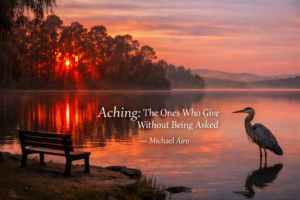
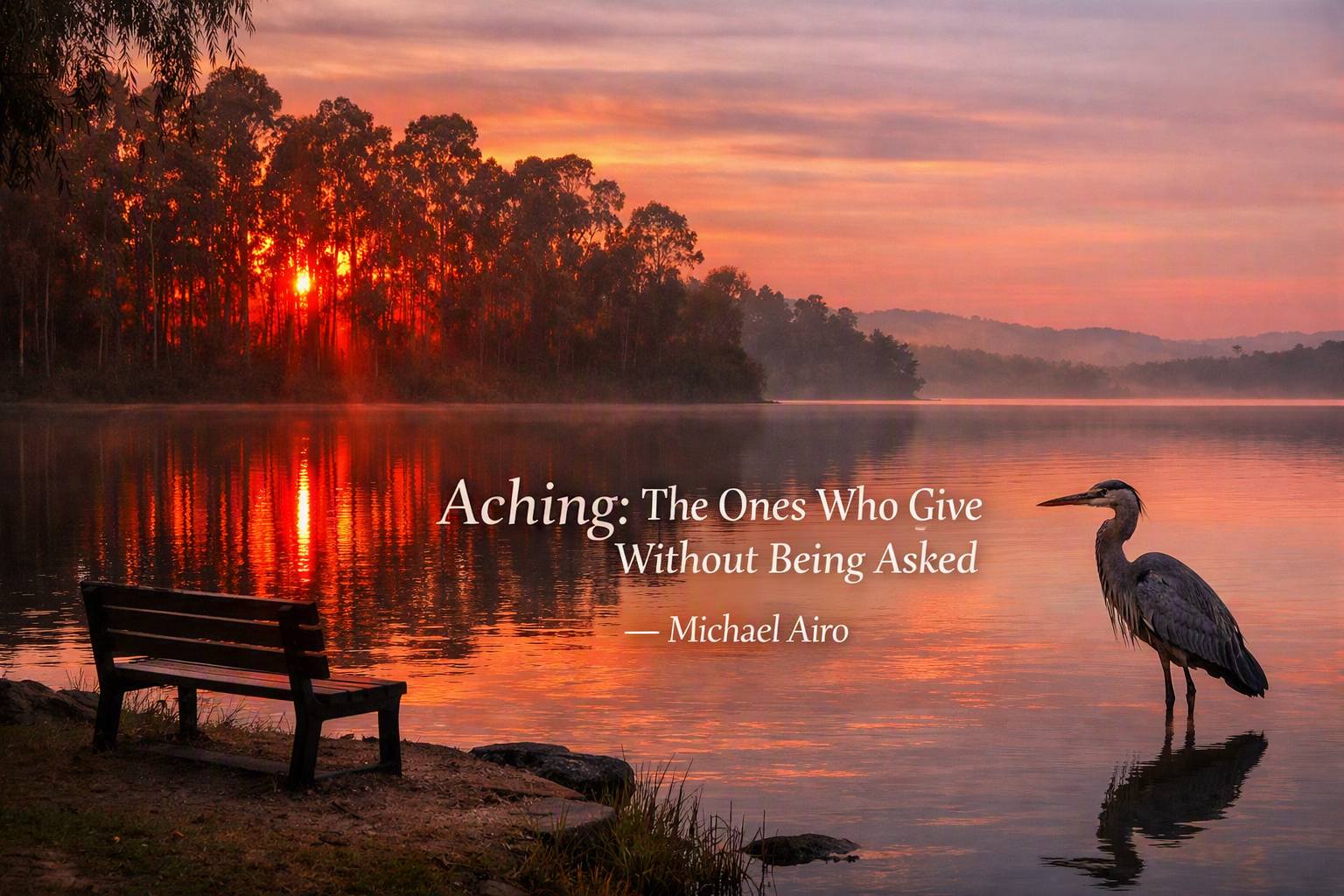
The car eases into a spot facing the water, no announcement about why here and not one of the dozen other spots along the loop. Windows down just enough to let the lake in, eucalyptus riding under the cooler mineral smell coming off the water, ducks working the shallows in short determined lines, each one steering around the others like commuters who’ve done this same stretch of water every morning for years. A heron stands close enough to the railing to pass for part of it, patient in the specific way that looks like waiting for something else to move first. Abbie sits in the passenger seat the way she has sat in it for months now, watching instead of doing, a woman whose whole life ran on doing until the doing simply stopped being available to her.
The Japanese Pavilion sits across the water, red railings catching whatever light makes it through the eucalyptus, and her eyes go there and stay there. No question about whether she’s comfortable. No question about whether she needs anything before he goes. He sets the brake, the door handle still warm from the drive, and steps out into the afternoon alone, the engine ticking as it cools behind him, a low steady weight settling into his chest the way it does before a task nobody has to ask him to do, because sitting with the view is the part she can still take in, and walking is the part he still needs, and neither of those facts requires saying out loud.
He circles the lake at his own pace, alone, and comes back to a woman who spent decades doing this exact thing for everyone else at that table, feeding whoever showed up, remembering whatever anyone mentioned once, never once making it look like effort. The doing had gone quiet in her and moved into him instead, and he carried it the same way she once had. Without announcing it. Without once making it the subject of the afternoon.
Something else moved under all of it that had nothing to do with water. His eyes went to her the way hers went to the pavilion, once, quick, checking without needing to check, the same look he must have thrown her way at a hundred crowded tables before either of them ever needed a word for it.
What Moral Beauty Actually Opens Onto
Moral beauty carries a specific ache with it, one that has nothing to do with sadness, the kind that lands in the chest watching someone give something away and never mention the price. Psychologist Jonathan Haidt gave it a name after noticing it didn’t fit anywhere else in the emotion research: elevation, a warm, expansive feeling that rises specifically in response to witnessing moral beauty, distinct from admiration or gratitude because it comes paired with a pull to go and do something good yourself. Haidt tied the feeling to the vagus nerve, the same nerve that slows the heart and opens the chest during compassion, which is why elevation lands as warmth spreading outward instead of a thought arriving in the head.
Watch someone act purely on behalf of another person, with no audience angling for credit, and the body doesn’t file the moment as information so much as an invitation. Awe usually opens onto something vast or strange, a canyon, a threshold, a wall giving way to a world in miniature. Aching opens onto something smaller and stranger: another person, choosing the harder kindness, in a moment nobody was going to grade them on. You’ll know you’re standing in moral beauty by the pull that comes right behind the warmth, some quiet insistence that watching was never going to be enough.
What He Wouldn’t Let Slide
A white elephant party once nearly came apart over a cookie jar shaped like a cow, ceramic, chipped at one ear, exactly the kind of ugly a seven-year-old can fall for instantly and completely. Greer had it, the youngest of us, still young enough that a chipped ceramic cow could wreck an entire evening, powdered sugar from a cookie still sweet on his tongue the moment he felt it leave his hands. Somebody older swapped it out from under him the way the game technically allows, rules on their side, nothing against them on paper, and Greer’s face did the thing a seven-year-old’s face does right before the tears actually land.
My dad didn’t raise his voice. Didn’t need to. Had a word with the man who’d taken it, quiet enough that most of the room never registered it as a confrontation at all, and walked away holding the cow again a minute later. Handed it back to Greer before the night ended, like it had never left his hands, and gave up whatever gift he’d have walked out with himself instead. Never mentioned the trade. Doesn’t now, as far as I know, unless someone else brings it up first.
A gym did the same thing to him a different way, years later. Middle school ball, my brother Jimmy glued to the bench most of that season while a coach ran his rotation by some math none of us could ever work out. My dad watched it happen for longer than most fathers would have, and then he didn’t watch it anymore. Said something to that coach hard enough that the possibility of getting barred from the next few games sat in the car the whole ride home, and nobody pretended it hadn’t been a real risk to take.
Jimmy played more the very next game. More again the one after that.
He never liked bullies, not the kind wearing a whistle and not the quieter kind who work a room instead of a court. Told Jimmy once to look out for me growing up, no bigger explanation attached to it than that.
Marine World, the summer I was seven, an obstacle course of padded pillars hanging from the ceiling, dozens of them swinging and knocking together every time a kid shoved through. I ran straight into a pack of older boys crowding the middle of it, bigger through the shoulders than boys that age should be, and the fear hit before my legs understood what was happening, radiating out from the chest and locking both feet to the ground. The biggest one reached for me. Time went the way that heron at the lake goes, holding so still it disappears, right before it moves too fast to track, every second stretched wide enough to walk through twice. Then Jimmy came through the pillars behind me and put both hands into that boy’s chest before the reach ever finished, and we were running before I’d even decided to move, his hand somewhere near my shoulder the whole way out.
Nobody ever explained why Jimmy did that, or why he kept doing it for years after. Nobody in that family ever needed it spelled out.
His hands did the same work every time, whether they were passing a ceramic cow back into a small kid’s grip or squaring up in a gym doorway with a coach who never expected to be challenged. He never waited to be asked. Not for a woman who could no longer say what she needed. Not for a kid who didn’t yet have the words to ask for it himself.
What the Ache Asks You to Do
The Celestine Prophecy names a version of this mechanic and gets half of it right. Stand in front of something beautiful long enough, a mountain, a stretch of granite older than every name ever given to it, and energy moves toward the one standing there, a charge building in the chest the longer the looking actually happens instead of just passing through on the way to somewhere else. I’ve sat at the base of mountains I couldn’t have named a single mineral in and felt exactly that, some current arriving that had nothing to do with anything I’d earned that day. On the difficult days, the ones where the tank reads empty by early afternoon, I’ve borrowed from that current more than once and kept walking on it.
The same current shows up now under a bar loaded heavier than last time. Feet find the floor and dig roots into it, the way a trunk digs into ground it has no plan of ever leaving. Strength that isn’t mine yet rises up through both legs before the first rep even breaks, borrowed rather than built in that moment, and the body finds one more rep than it thought it had left. Always one more. The book only names half the mechanism, though. Beauty gives you the charge. What happens with it after, whether it gets sent back out into the world or just spent on yourself, decides whether the current keeps running or goes dead.
Moral beauty asks the same question every time it shows up in you too, watching a stranger cover a toll they didn’t owe, or a friend quietly picking up something you never asked them to carry. Not whether it counts. Whether it gets spent on someone else before the current cools.
My father felt the same current. His mountain was a woman.
Something arrived in him standing near Abbie’s table, years before either of them needed anyone to explain what giving looked like, and instead of keeping that charge for himself, he spent his whole life sending it back out. At a lake. At a party, over a ceramic cow. On a gym floor loud enough to risk getting thrown out of it. Somewhere in a crowd of padded pillars, in a son who’d never once been taught to explain why.
Where the Ache is Actually Felt
Some afternoons now it’s my hand on the wheel, easing into a spot facing the water, no announcement about why here either. My father sits in the seat Abbie used to sit in, watching instead of doing for once, and when I crack my door I don’t leave him with the view by himself. I match whatever pace his knees will give me, and we walk the loop together, the two of us circling water he used to circle alone, and neither of us has ever needed to say out loud why that matters.
He taught me to notice who has nobody standing up for them, watching Abbie, watching Greer’s face right before the tears landed, watching Jimmy glued to that bench. Jimmy learned the same thing without ever being taught it twice, and came through a crowd of padded pillars behind me before I even knew what was happening. These days it’s my father I’m watching that way, matching his pace instead of running ahead of him, noticing what he isn’t saying before he has to say it. Somewhere a cow-shaped cookie jar still sits chipped at one ear on a shelf. Some mornings under a bar loaded heavier than the one before it, I find one more rep that isn’t mine, borrowed off a man who’s finally walking beside me instead of ahead of me. Borrowed. Spent completely. Never once counted out loud.
You can learn more about my work and background on Michael Airo’s About Page. New work is published regularly at michaelairo.com.
Read a connected piece: The Doorways of Awe.