Steam rose against the window over the sink until the glass went soft and the yard beyond it turned to a green rumor. Tomato and oregano hung in the room thick enough to lean on, the dark sweet edge of onion gone patient in the oil underneath. The chin sat level with the counter’s lip. Everything worth wanting lived above it.
Mom stirred the sauce in slow figure-eights, the wooden spoon ticking the rim of the pan, the back of her hand shining. She hummed something with no name, a thing she only ever hummed there.
The lid on the pasta pot began to rattle. She hauled the pot to the sink, and the noodles slid into the colander with a rush, the enamel ringing once, a hot breath rolling up into the face. Fingers were in before the steam cleared. Lift, fold, tip the head back. Salt from the cooking water, the slick give of them, the long slide down the tongue. We ate them standing at the counter’s edge, fingertips singing from the heat, and the pile in the colander thinned faster than anyone was counting. Mom glanced over, remembered, and set a second pot of water on the flame.
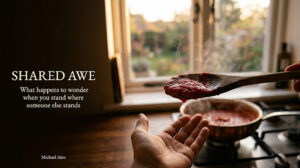
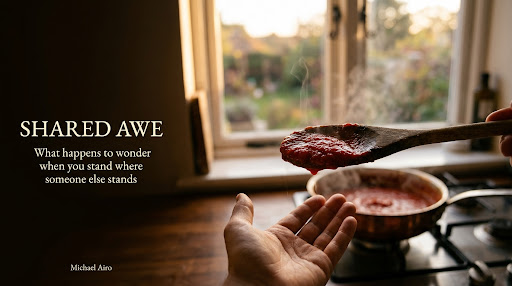
Then the spoon. She lifted it from the sauce, turned it once so the red ran back to the pan, and held it down and across to where the chin waited. Hot, sweet, salted, oregano whispering at the back, and the tongue chased the rim of the bowl for whatever was left. The eyes closed on their own.
When they opened, she had stopped. The wooden spoon hung over the pan, the figure-eights forgotten, and she was watching the taste cross my face. Something in her own face answered it, a softening at the eyes, the mouth easing open a little, as if the sauce had traveled the length of the spoon and over the counter and into her too. The lid rattled somewhere far off. For a long breath the kitchen kept no time at all.
A second spoon, white. Cool against the sauce still burning on the tongue, milky, soft, faintly sweet, and the two tastes folded into each other, layer over layer, the way the pan itself would be built within the hour.
Most nights the kitchen stayed quiet. Mom cooked a few dinners, only a few, and when she cooked one of them the house changed its mind about itself. Chairs came out of corners. Voices climbed the porch steps ahead of the knock, and she wiped her hands on the dish towel and went to the door already smiling.
Both spoons stayed in the fists, one warm, one cool. Long after she had gone to the door the tongue kept the layers, tomato, salt, milk, a green ghost of oregano, each one waiting its turn. Warmth low in the belly. Steam still climbing the glass.
Every year Grandma chose something new for the bird, and every year I stood at her elbow to find out what. The kitchen on those mornings smelled of raw poultry, cold and faintly mineral, and of herbs cut green and snapped between the fingers. Flour on the counter. A cutting board gone dark along the grain. The oven ticked itself warm behind everything.
The year of the bag, the experiment was a seasoning bath: the turkey sealed in plastic with the spices to drink them in overnight. Plastic crackled when she shook the bag open, a long clear sigh. The spices went in by the spoonful, paprika and sage and salt gone gritty at the bottom, and the kitchen turned warm and brown and earthy around us. Her hands measured and mine copied, clumsy and eager, the grit of salt biting into the cracks of the knuckles. Somewhere between the last spoonful and bedtime the evening slipped away from us, and the bird went back into the refrigerator bare.
Thanksgiving morning, the bag sat open on the counter with the seasoning in the bottom of it and nothing to season. The night had come and gone without it.
Neither of us spoke. Grandma looked at the bag. I looked at Grandma. Then the laugh started low in the belly and took the shoulders with it, and she was wiping her eyes with the back of a floury wrist while I held onto the counter’s edge.
The next year the bag went on the night before. Still Grandma changed something else, because that was the rule of that kitchen, the experiment first and the bird second. By afternoon the oven fan was roaring low behind the glass.
When the door came open, the heat rolled out over both of us like a hand laid flat on the face. Fat spat once against the pan. The bird sat in the middle of it, bronze and running with juice, the skin crackled gold at every edge, steam climbing off it in slow braids.
Neither of us moved. The oven mitt hung from her fist. Her other hand found my shoulder and stayed, and we stood in that heat with our eyes on the same gold skin, breath held in the same stretch of quiet, long enough that the kitchen leaned in and waited with us. Our best yet, and nobody had said a word.
First bite. Salt, sage, heat all the way down.
The First Invitation
Somebody held out a spoon, and the mouth opened before the mind knew what was on it. Trust, yes, and an offer: taste what I am tasting. A noodle from the colander. Another hand, on the shoulder, in front of an open oven. Nothing is asked in return except the tasting, and a person who has tasted something off someone’s spoon has been let into how that person tastes the world.
Small awe is an invitation into how you see the world. A relationship gets built, and gets rebuilt, out of the small moments when one person offers theirs and the other accepts.
Researchers at Radboud University surveyed romantic partners in two studies and found that shared awe, the kind felt together, predicted satisfaction, passionate love, and the sense of two selves overlapping, even after accounting for shared amusement. The data are self-reported, so happier couples may simply find more to marvel at together. Yale researchers saw the same pull at the scale of a square of chocolate. Two people tasted it at the same moment, no words between them, and each liked it more than when the other person sat beside them doing something else. Bitter chocolate went the other way and tasted worse shared. The amplifier does not pick sides.
The Empty Bag
Every reason to sour, that morning. The plan lay in ruins, the guests were coming, the bird sat cold and bare in the refrigerator, and Grandma’s shoulders were shaking with laughter. Anyone can toast the bird that comes out gold. The special ones laugh at the empty bag and find the silver in a morning going wrong, and she found it before I understood there was anything to find.
Her laugh was an invitation too. The day was still ours, and the mistake was material, not a verdict. The next year something else changed, and the bird that came out was our best yet, and every year afterward the empty bag stood in that kitchen like one more guest, making everybody a little softer.
Mise en Place
Cooks call the first part mise en place, everything in its place, the onions cut and the oil within reach and the knife square to the board. Then the heat comes on and nothing stays where it was put.
The spoon was the first thing I handed her. Five things were going at once in that small kitchen, the pasta water muttering under its lid, the vegetables waiting in a heap on the board, bread browning in the oven, oil in the pan beginning to talk, and the sauce, the one that decided the plate. I gave her the sauce. Then I stepped back to learn what she would do with it.
Music came up from the speaker on the counter, a bass line climbing through the soles of the feet. Her shoulders answered it before mine did. Mine caught up.
One body wide, that kitchen, and we were two. She turned to the stove as I reached past her for the salt, and hip met hip, and neither of us apologized. A step back. A step through. Two hands closing on the same cabinet handle and both of them pausing there. Somewhere in the work we began to dance, a little, in the gaps, a turn with a pan in one hand, a sway at the cutting board, the room finding its own pulse around us.
The timer chirped. The pasta water rolled over and hissed on the burner. Under all of it, thin and gray and patient, something began to burn.
Smoke curled from the oven door, bitter at the back of the nose and sweet at the front, sugar and flour caught on the edge of black. I turned with my mouth already open to fix it and found her laughing, mitt on, tray out, window up. The bread came out charred along one edge, steam lifting off the char, and she held it up between two fingers like evidence.
Plates. Her sauce went on first, glossy and clinging, and the room leaned toward it. She dipped the spoon and held it out to me, and I opened my mouth before she asked. Garlic, bright. Acid, then a slow heat behind it that stayed.
We ate the burnt edge anyway, shoulder against shoulder at the counter, and the bass line went on under the soles of the feet, and the ribs kept time.
On early dates I often cooked with a new partner, five things going at once, and made her responsible for something that mattered, the sauce, the vegetables, the part of the plate nobody could quietly fix. A kitchen shows how someone meets a small shared difficulty: whether she asks or guesses, whether a near miss makes her laugh or go quiet, what the shoulders do when three things want her at once. I found no research showing that a kitchen predicts compatibility. A person under mild pressure is still information, and a person being seen under it is being invited to see you back. Eustress is the word for it, stress with a ceiling low enough to grow under.
The Mango
She told me while I was cutting mango in her kitchen, for a lassi. Skin cool and faintly waxed under the thumb. The blade found the flat pit and slid along it, the cheeks came away, and the smell rose off the board, sweet and resinous, summer gone ripe. Before she could be considered for marriage in India, she said, she had to learn a test. Cut a mango fast and clean, and waste none of it.
The knife stopped. I did not change the subject.
Then I scraped the flesh clinging to the pit, and the thin sweet ends, and the scraps, and all of it went into the blender with the rest.
The test is small and it asks a large question, how this person treats what she has been given. The practice falls on women alone, and it has drawn fair criticism for exactly that.
She was graded on fruit. I only ever cooked beside people, and the kitchen did the grading for both of us. One person hands the knife back and asks what is next. Another drifts toward the phone. A third tastes the pot and adds the thing I never would have thought of. By the end of the evening I knew whether this was a friend or a passing acquaintance. The sorting is my own observation, not a finding, and it has held up for years.
Cooking also pulls out what stays hidden in a meeting room. Someone has to decide what goes into the pan that has never gone into the pan. Someone takes the risk of the extra chili, the odd herb, the experiment that might sink the pot. Grandma’s bag was one of those. How a person takes that risk, and what their face does when it goes sideways, shows up in the steam.
The Door
Every dish is also a small exposure. A recipe handed across the counter, a pot that took years to learn, a loaf that came out black along one edge: each one says here is what I made, and here is how it went. Whoever laughs at the bread and eats the edge anyway has accepted more than a dinner.
Offering wonder and offering vulnerability turn out to be the same lesson through different glass. Tell someone something you have never told anyone, a fear, a failure, the thing you still cannot explain about yourself, and the telling opens a door. The breath stops at the top. The ribs hold. Then comes the pause, the longest part of it, while the other person decides what to do with the open door. They can leave it where it is. They can nod and change the subject. Or they can walk through, with a hand on the arm or a confession of their own, and then both bodies come down together, shoulders, jaw, the breath finally going out. We both feel closer than we did a minute ago. The door works the same at the start of a friendship, a partnership, a new job, anywhere two people are still deciding what they can say to each other.
Going to war with someone is intimate by nature. Nothing in it is staged, and everything is shared: the fear, the long dull hours, the food. A kitchen is the gentlest cousin of that arrangement. A clock, a heat, a task too big for one pair of hands, and someone beside you who has to be trusted with the sauce. An evening of it can do what a season of small talk cannot.
The Rush
Another date was always some form of adrenaline. Go-karts. A climbing wall. The kart seat shook up the spine, the engine a hornet trapped behind the breastbone, hot oil and scorched rubber at the back of the throat. On the wall the chalk dried the palms to paper and the heart went loud in both ears. Afterward the person beside me stood in the same aftermath, pulse still pounding, hands still unsteady, and the body went looking for a reason.
Arthur Aron’s work points the same way. Couples assigned novel, exciting activities together rated their relationships higher afterward, and activities that were merely pleasant did not do the same. Grandma’s yearly experiment was that finding in an apron.
The Walk Where She Stopped
I walked fast in those years. Gravel bit under the boots, the shoulders half a step ahead of the legs, the next hour already pulling at the jaw the way a current pulls a swimmer. Her hand slipped out of mine.
Three steps on, I turned.
She stood very still with her face tipped toward the oaks. She said nothing. Her arm stayed at her side. Low sun combed through the branches and set the edge of every leaf burning, and damp earth and bark came in on the cool air, and somewhere downhill water talked to stone.
I was late for something. The something was already losing its shape.
I walked back and stood where she stood, and the light landed on my face the way it landed on hers. The breath I had been sipping dropped out of the chest and kept going. The shoulders came down from the ears. Her arm lay warm against mine, and the light went on burning along the branches, and the hour stopped pulling.
Pointing is not the problem. In the Gottmans’ own example, John says look at that hummingbird and Julie answers wow, that’s beautiful, and the exchange is a bid for connection met by a turn toward it. Couples still together six years later turned toward each other’s bids 86 percent of the time. Couples who had split averaged 33 percent.
What goes wrong is pointing that carries a verdict, a finger that tells the other person what to feel and when. She never told me what the light was. Her stillness was the offer, and an offer like that asks nothing of the one receiving it. The body feels the difference fast. An offer lets the shoulders stay low. A verdict raises them half an inch. You can point at a sunset. You cannot point at a taste. Sight and sound travel across a field, but flavor has to be carried across the gap, on a spoon, held out. Maybe that is why the kitchen teaches this lesson so well: the only way to share a taste is to offer it. Outside the kitchen the same moves work. Share the state instead of the object, an exhale or a low sound. Go still and let the other person find it. Rest a hand on an arm. Ask a question that doesn’t name the thing, what do you notice. Go stand where they stand.
Taste as You Go
A cook tastes all the way through. A spoon dipped, a pinch of salt, another taste, the pot adjusted in small moves long before it reaches the table. Nobody tastes once at the end and calls it done.
Shelly Gable’s research on what she calls capitalization found that how a partner responds to good news predicted intimacy and daily satisfaction on its own, apart from how the couple handled conflict. The helpful reply was active and constructive: real interest, follow-up questions. A lukewarm that’s nice sits closer to the dismissive reply than to the engaged one.
An awe story is the most breakable good news there is. I saw something. A flat reply teaches the teller to stop reporting. Receiving takes two small moves. Turn toward, even a half turn, the head, the eyes, the phone set face down. Then ask where in the body they felt it, not what they saw. Invitations also get declined. The other person may be tired, or elsewhere, or seeing something different. Offer once, plainly, and let it stand.
A relationship gone cold rarely warms from one grand gesture. Mom’s second pot of water was never a grand gesture. The Gottmans’ advice, drawn from decades of watching couples, is to skip the grand gestures and go for small things often. Small awe fits the same shape. Steam off a cup, light on a wall, a bird at the window, handed across the table with no demand attached, the way a good act is done without being asked. Each one is an invitation back in, and none of them ask the other person to do anything but look. In a relationship gone cold the body keeps its guard, shoulders up, breath shallow, and the invitation has to be small enough to pass beneath it. None of this asks anyone to stay somewhere unsafe.
The Long Table
Nothing here belongs to romance alone. A child in the back seat who points at a crane is making the same offer, and the adult who answers mm-hm without looking up has declined it. A friend who sends a photograph of the light on her kitchen wall is making it. So is the coworker who stops mid-meeting to look out the window. The parent, boss, coach, or teacher is the person for whom accepting an invitation costs the most and counts the most. A kid who points out a bird in the middle of a lesson is waiting to find out which kind of adult this one is.
Star Trek: Strange New Worlds gave this a captain. Anson Mount has said that when each captain was offered one personal request for his quarters, Christopher Pike, a horse lover who could not bring a horse aboard, asked for a kitchen. In the second season he glazes ribs for a feast that fills a table with his senior staff and other crew. One critic notes that by the end of the season, skipping Pike’s table is unthinkable. Fictional captain, writers’ room idea. Even so, the show seems to understand something real: a crew that keeps coming back to the same table starts to behave like a family.
Friendsgiving is the same instinct with the roles handed out. Everyone cooks at once in one crowded kitchen, elbows negotiating the narrow lanes between counter and stove, or everyone arrives carrying the dish they love and want to share, and the smell of five households meets in the doorway. Either way, each plate is an invitation to taste what someone else tastes. Spread across one table, the offers add up to a family made of people who were not born into one, chosen by invitation, one dish at a time.
When there is nobody to hand an invitation to right now, the first offer can go to a notebook, or a text to one person.
The Blind Taste
Set one up for your partner, a friend, a parent. Ask about allergies first. Then cover their eyes with a cloth, or ask them to close them, and sit close enough that a knee touches a knee.
Bring five small things, each its own doorway. A slice of orange, cold and bright. Then a pinch of flaky salt and a square of dark chocolate that takes its time to melt. Basil, a leaf crushed between your fingers and held under the nose before it ever touches the tongue. Honey on the end of a spoon, thick and slow. With the eyes closed the tongue grows loud. The salt crackles at the edges. The sweetness arrives at the hinge of the jaw before the mind has found a name for it.
Do not ask what it is. Ask where it lands. Let them describe the cold at the front of the tongue, the sour tugging under the ears, the warmth that spreads low in the belly, and only then let them guess. If you know a flavor from their childhood, hide it in the middle. A tongue remembers before the mind catches up, and watching a face find its way back to some old kitchen is its own kind of shared awe. Then trade places. The setting up is half the gift. You chose each thing for them, and they let you.
The Trust Walk
The same offer works outdoors. Pick a safe stretch of ground. One of you closes your eyes, and the other takes the elbow and walks slowly and says almost nothing.
Gravel first, loud under the soles, then grass going soft and damp, then packed dirt giving back the weight of each step. The air cools under a canopy you cannot see, and the skin of the face reads it before the mind does. Cut grass or woodsmoke drifts in from somewhere unseen. A bird off to the left that was there the whole time. The leader does not steer toward a reveal. The walker can stop whenever they choose.
Then the eyes open. A leaf turns on its stem, lit from behind, green going gold. The hand at the elbow is still there.
Back at the Counter
Now the wooden spoon is mine. Steam climbs the window over the sink until the glass goes soft and the yard turns to a green rumor, and somewhere behind me a lid begins to rattle. Whoever stands at the counter stands close enough that hip meets cabinet and neither of us apologizes.
I lift the spoon from the pan, turn it once so the red runs back, and hold it out.
Hot. Sweet. Salt first, then a green ghost of oregano.
Their eyes close on their own. When they open, I have stopped. The spoon hangs over the pan and I am watching the taste cross a face, and something in my own face answers it, a softening at the eyes, the mouth easing open a little, as if the sauce had traveled the length of the spoon and over the counter and into me too.
The lid rattles somewhere far off. Warmth low in the belly. Steam still climbing the glass.
This piece is written by Michael Airo. New work in the Invited States series publishes regularly at michaelairo.com. If you’re new here, you can learn more about my work on my About page.
Read a connected piece: The Resilience Effect: How Far You Stand Decides What You Can Carry, and the whole map at The Doorways of Awe.