Wind reached the far edge of the field first. A dry hush ran through the stems, a long breath let out through the teeth, and the whole slope leaned one way together before the push arrived cool across the cheeks. Stems straightened. Leaned again.
The hardest stretch of my life ran long, and that field carried more of it than almost anything else did.
Some mornings the looking began with one blade. Close enough to follow the pale seam up its spine, a single green thread holding its shape in a wind that moved everything else, the edge dry as paper against the knuckle whenever a gust leaned it into the hand. Then the ten beside it. Then the stand, until the blade dissolved into the field and the field stopped being grass at all. Water. Long swells rolling inland toward a shore that did not exist, each one lifting the light and setting it down a little farther on. Breath caught high behind the sternum. Skin lifted along both forearms.
Other mornings the order ran backward. The whole field first, every swell at once, then a slow narrowing, down and down, until one blade stood alone in the eye and the chest could finally take it. Some days the field was too much to hold. One blade was all the ribs had room for.
On the worst mornings nothing moved in the chest at all. The field stayed grass. Shoulders stayed hitched toward the ears and breath stayed sipped and small, and the standing went on anyway, boots planted in the dirt, until the light moved.
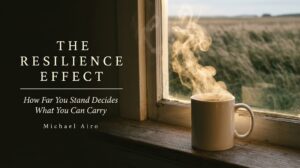
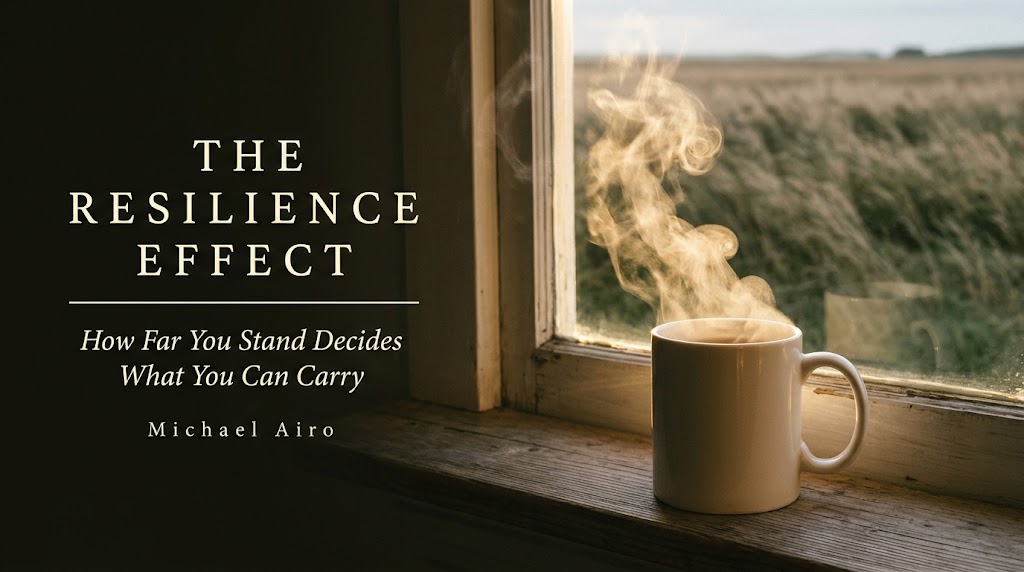
Even on those mornings, small things got through. Steam leaving the cup in both hands, curling up and bending sideways in the cold. A breath fogging in front of the face and thinning to nothing. One dew drop on a stem, holding the whole sunrise upside down. Small enough to lose, and they showed up anyway, whether the chest was open or shut.
What Grows Beside the Damage
Richard Tedeschi and Lawrence Calhoun spent decades sitting with people on the far side of devastation, and the same pattern kept turning up. Growth sat beside the damage and never replaced it. Five places it showed: a firmer sense of what a person can carry, doors that had been invisible before, closer people, a sharper taste for being alive, and a shift in what they believed held the world together. Shoulders can climb toward the ears on a bad Tuesday while the chest opens in front of a field, both inside one body, in one week.
Hold one blade close to the eye and it fills everything, a green so near it has no edges. Step back and it becomes one stem in a field that keeps moving without it. Ethan Kross has measured what the step back does. People who replayed a painful memory from a distance, the way a fly on the wall would watch it, showed less emotional reactivity and less cardiovascular reactivity than people who relived it from inside their own eyes. Same memory. A different place to stand.
Awe takes the same step without being asked. Dacher Keltner’s lab calls it the small self: attention leaving the self and landing on something much larger. The self goes right-sized and the world comes in. Frank White gave the largest version a name in 1987, the overview effect, after interviewing astronauts who came home from orbit changed in how they saw the planet and their own place on it. Where a person stands when they look at a hard thing changes how much of the sky it covers. Awe and resilience meet in that distance.
Two Machines, One Hollow
A relationship ended and left a hollow under the sternum, too big for whatever was left standing around it. Something always rushed in to fill the space. Never nothing. Never waiting it out.
One year it was a boat. Borrowed, at first. Canvas cracking overhead, a line biting into both palms under load, salt drying to a crust on the lips, a horizon too wide to see the end of. Beside it the hurt took up less of the water.
Another year it was a motorcycle. Same hollow, same rush, a different machine. Wind came harder and faster, a buzz climbing from the wrists into the elbows, and for an afternoon the hollow went quiet. Then the engine ticked itself cool, hot oil in the nose. Helmet off. The hollow sat there at exactly the size it had always been.
The boat gave the hurt a horizon. The motorcycle gave it a blur. Years later the first real wind on real water still lifts the skin along both forearms, and nothing from the motorcycle ever came back.
Berkeley researchers put a version of that question to a river. Seventy-two military veterans and fifty-two young people from underserved neighborhoods spent one or four days on whitewater, a sport with thrill built in, and logged their emotions each day. A week later, awe was the one that tracked best with lower stress and better well-being. Berkeley’s own account puts the veterans’ PTSD symptoms down about 30 percent, all of it self-reported, small samples, a long way from proof that a river heals anyone.
Awe Doesn’t Have to Be Big
Big awe like that arrives when it arrives and ignores every attempt to summon it early. A hard stretch is mostly the days in between, and the days in between need a way to take the same step back that does not wait on a horizon. Nobody has tested small awe against these larger findings side by side. What follows is my own reading of how they fit: a glimmer is the same distance, taken at the scale of a kitchen.
Deb Dana, a clinician who works from polyvagal theory, named them glimmers, the opposite of a trigger: a small cue that tells a nervous system it is safe enough to loosen for a second. Steam lifting off a cup of tea, and the shoulders drop. Steam lifting off a pair of shoulders after the last hill, a whole body smoking in cold air. The fog of your own breath, there and gone. Low sun catching the edge of a leaf until it burns green and gold. A rectangle of light on the kitchen floor with a dog asleep in it.
A glimmer is small enough to lose. Notice a white car once, though, and the road fills with them. Same road, same traffic, and suddenly white cars at the light, in the lot, rolling past the window, dozens before dinner, and no one can say where they were before. Before the first one, the eye had no reason to collect them. A decision to look changed what the eye collected, and glimmers answer to the same decision. Intention for attention, planted at the door, and the day begins handing them over.
The Hunt
Make it a scavenger hunt. Pull on shoes at the door and give the next fifteen minutes a job: find what the light is catching. Something unexpected. A film of oil on a puddle turning to a small rainbow. One window on the far hill gone to gold. The underside of a leaf lit from behind like stained glass.
Work it like a detective. Crouch to the spot the glow is coming from. Follow the warmth to its source. Ask what else in the room is lit that nobody has looked at yet. When one turns up, do what the field taught. Begin with the smallest piece the eye can hold and stay until its edges soften, then let the eye widen a little at a time, the leaf into the tree, the tree into the hillside. Somewhere in the widening the breath drops a notch and the shoulders ease down from the ears.
A team led by Virginia Sturm built a study around an instruction much like this one. Older adults took a fifteen-minute awe walk once a week for eight weeks. One group was told to walk. The other was told to look for something wide or strange along the way and let it work on them. The control walkers walked as much or more. Only the instruction differed. The awe walkers smiled bigger, reported more joy, and watched their daily distress fall faster.
The instruction sets the eye. The field arrives or it doesn’t. Either way, something small is catching the light within arm’s reach.
The Snowball
A hard season narrows the eye. Jaw set, breath quick and high under the collarbones, attention pulled down to the single point that hurts until the edges of the room go gray. The narrowed eye can hold small finds and nothing larger, and small finds are enough to start a snowball.
Gratitude shows how the snowball gets built. Pick something ordinary, a pillow, and think of every way it helps. Holds up the head. Takes the weight of a tired neck. Waits under the cheek on the nights sleep won’t come. Each reason opens another. The pillow leads to the bed, the bed to the roof, the roof to the hands that raised it, and somewhere around the third reason the jaw loosens. One object turns into a long list nobody planned to write, because each thought of thanks opens the door to the next.
Awe runs the same way. Take one glimmer, steam off the tea, and follow it instead of filing it. Warmth moving into the palms. The window light turning the steam gold. The cold outside that makes the steam visible at all. Each find is a doorway into the next, and the chain runs long before the cup goes cool.
Barbara Fredrickson’s research on positive emotion describes the loop: positive emotions widen what the mind reaches for in the moment, and the wider reach finds more to feel good about. She called it an upward spiral. Her work covers positive emotion in general, and awe is one member of that family. Awe and resilience build the same way, one small find at a time.
The Last Time
When was the last time you stood somewhere and did nothing else? No phone in the pocket tugging at the thigh, no plan for the next hour running underneath, no photograph forming behind the eyes, no use for the moment at all.
Sturm’s walkers took a photograph of themselves at the start, middle, and end of every walk. Week by week the awe walkers filled less of the frame with their own faces and more of it with the world behind them, and the smiles grew bigger as the faces shrank. The self had stepped out of the center. Attention had gone out through the front of the face and stayed out there.
Attention decides which hours a person keeps, and kept hours are the ones that stretch. A hard season runs the other direction. One loop of thought wears the days flat, and nothing gets filed. The grass, the boat, and the cup of tea each did the same plain work. They gave the loop somewhere else to be. Some of that gets decided at the door: what the next hour is for, and what is worth carrying home from it.
Late light on a dirt path, low enough to set every dry stem glowing at its edges. Gravel crunches under the boots, small and bright, then gives way to softer ground, and the air drops cool under a stand of redwoods that smells of duff and wet bark. Bark under the fingertips, deep-grooved and spongy, cold for a moment and then not. Cool air tastes faintly mineral at the back of the throat. The quiet comes in three parts: wind moving through the high canopy, water talking low to stone somewhere out of sight, and under both, the slow tide of your own breath. A spiderweb strung across the trail holds the sun in every thread and trembles on air too slight to feel on skin. Somewhere a gift shop sells this exact bend in the path on a rack of postcards, and you would buy it without a second look. You are standing in it. A held breath finally sinks from the chest into the belly. The path bends. Weight settles into the heels.
This piece is written by Michael Airo. New work in the Invited States series publishes regularly at michaelairo.com. If you’re new here, you can learn more about my work on my About page.
Read a connected piece: The Time Effect: How to Make Time Slow Down, and the whole map at The Doorways of Awe.