Seeing Yourself in a Character Is a Doorway You Cross One Stone at a Time
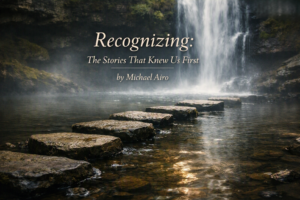
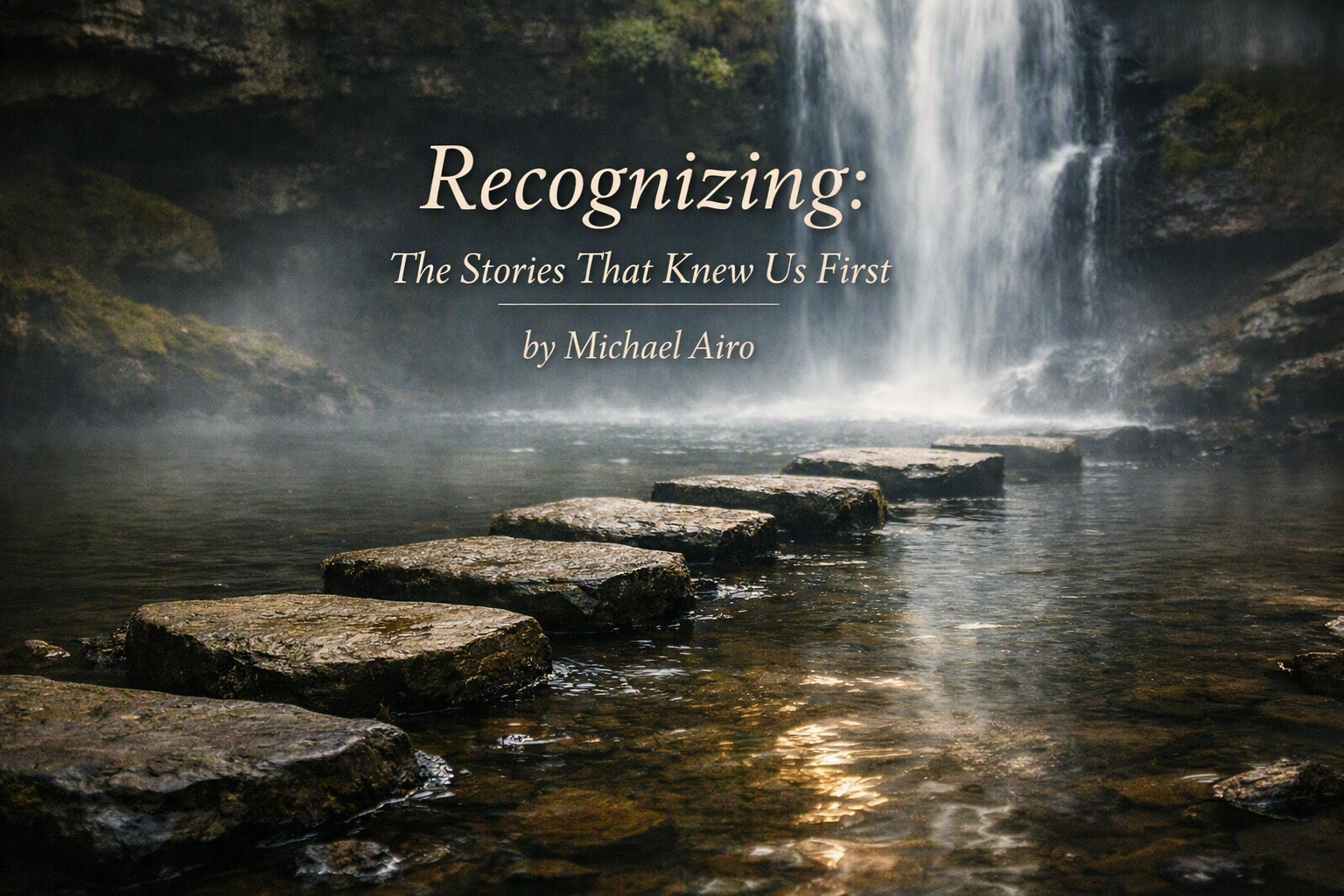
Water first. A roar that filled the skull from the inside out, three falls pouring somewhere overhead, spray drifting down to settle cold along the cheekbones and the backs of the hands. The first stone sat just under the surface, dark and slick, and the bare foot trusted its whole weight to it without a single test, as if it had crossed this water every night of its life. Moss gave under the arch. Cold climbed the ankle bone and kept climbing. Wet rock and something green and growing filled the nose, the smell of a place that had never once been dry.
Breath had been riding high all day, short sips caught under the collarbones. On the second stone it dropped a notch. Another on the third. Somewhere around the fifth the shoulders let go of the ears, and by the seventh the jaw had unlocked on its own, the stale, coppery taste a long day leaves at the back of the tongue rinsing away under the spray. Something under the ribs already knew where the eighth stone waited before the eyes ever found it.
Ten stones. Then the far bank, and a stillness that hummed.
A page turned. The roar became the low buzz of a desk lamp. Spray turned into the cool side of a pillow pressed against one cheek. The stones went back to being ink, a paperback gone soft at the spine, a high school bedroom with the house asleep around it. The boy crossing those stones was Peekay, the smallest kid in a boarding school that hated him, taught by an old healer to find three waterfalls and ten stepping stones inside his own mind whenever fear got too loud to think through. The Power of One. The feet on that bed had never stood in South Africa, never once touched those rocks. The breath had dropped anyway, exactly the way his did, on the exact same stone.
Seeing yourself in a character starts there, in the feet and the breath, the body claiming a familiar place it has never once stood in.
Where the Self Steps Aside
Somewhere in the second chapter of a good story, the room around you goes quiet. The chair stops registering under the thighs. The fingers holding the pages forget their own grip. Breath slows or quickens to match a person who has never drawn a breath at all, and when someone calls your name from the next room, the voice has to come twice, because the first time nobody was home to answer it.
Psychologists Geoff Kaufman and Lisa Libby at Ohio State named this experience-taking: the moment a reader stops watching a character and starts living from inside one, taking on that character’s thoughts, feelings, and goals as their own. Students who slipped inside a first-person story about someone from their own school pushing past obstacles to vote went out and voted days later at more than twice the rate of students who read about someone from another school. A story crossed out of the page and walked to the polls on borrowed legs.
One condition shut the whole thing down. Students reading in a cubicle with a mirror on the wall could barely do it. Their own face, catching at the edge of their vision, kept them anchored inside their own skin, too aware of who was holding the book to step into who was in it.
The self has to step aside for a story to show you what you already carry, going right-sized so something larger has room to come in. Recognizing aims that larger thing inward. The vastness waiting on the other side lives in you, and the body answers it the way it answers a canyon: skin rising along the forearms, breath catching high, the eyes going hot without a single sad thought behind them.
The First Stones
Long before the waterfall, the first stones went down without my knowing anyone was laying them. Cross-legged too close to the television, carpet pressing its pattern into the backs of both knees, the body already knew which one it was. Luke. The farm kid, a little naive, calm in a way the adults kept remarking on, feelings kept inside the lines no matter how loud the room got. Nobody needed to tell me. The recognition sat on the shoulders like a jacket that already fit.
Han was the one the body practiced. A lean against the doorframe, weight shifted onto one hip, the half-smile tried out in the bathroom mirror and never quite landing. Cool without trying, suave in a way that seemed to cost him nothing, a silver tongue that could talk its way out of any room it had just talked its way into. Small feet sliding around inside a father’s shoes, rehearsing a self they hadn’t grown into yet.
Then Indiana Jones, tweed jacket and battered hat on the same man, a lecture hall one minute and a collapsing tomb the next. Something in the chest unclenched watching him. A professor could be fearless. A calm kid could jump. Nobody had to pick one stone and stay standing on it forever.
Disney had been laying stones the whole time, every film a fairytale built around a different courage or a different mistake, every moral small enough for a child’s hand to close around and carry home.
The Third Part of the Book
High school, and the question of who I was going to be still wide open, a low hum under the sternum on quiet nights. Peekay kept crossing his stones through all of it, through boxing rings and unlikely teachers and the slow building of a boy who learned to lead with his head and let his heart follow. Then the third part of the book turned the floor over.
The scholarship falls through. Everyone around him has a plan for what comes next, the sensible road, the one that keeps the people watching comfortable. Peekay goes underground instead, into the copper mines, the most dangerous work on offer, to earn his own way on his own terms. And down in that mining town, grown now, waiting like a shadow that had followed him across the whole book, stands the Judge, the boy who tormented him on the very first pages.
Cold went first, a sheet of it sliding from the crown of the head down the back of the neck. Then heat behind the eyes, and tears with no sadness anywhere in them. The book circled all the way back to its beginning, and every page in between shifted under the weight of it.
Researchers Alan Fiske, Beate Seibt, and their colleagues call this kama muta, Sanskrit for “moved by love,” a sudden swell of oneness with someone. Across cultures they find the same signature in the body: chills, tears, warmth spreading through the chest, a tightening in the throat, a held breath, then a lift afterward, lighter than before. A character who never lived can set off every piece of it.
What the body recognized in Peekay was specific. Standing for what you want, even when the choice disappoints the people around you. I knew the weight of that from the inside, a heaviness settling low in the gut whenever a plan of mine drifted from someone else’s plan for me, and the strange lightness that arrived after choosing anyway.
The Count of Monte Cristo found the same place in those same years. Edmond Dantès, young and in love and headed for an easy life, buried in an island prison for a crime he never committed. An old priest scratches through the stone from the next cell, and the dark years become a school, languages and history and patience poured into a man with nothing left except time. Then the escape, sewn into a dead man’s burial sack, the drop, the sea closing cold over the head. Reading it, the breath held on its own until he surfaced. The book ends on two words that sank somewhere under the ribs and stayed there for decades. Wait, and hope.
When One Word Rewrites the Whole Book
Seven books of a man everybody hated. Sneering, cold, a shadow at the edge of every hallway, and then one memory poured into a stone basin, and Snape answers a question about how long he has loved someone with a single word. Always. The throat closed around it. Every scene he had ever stood in rewound and replayed at once, rewritten in the time it took to read six letters.
The Way of Kings did it with a choice. Kaladin has freedom right in front of him, every reason in the world to walk away from an army led by the kind of men who had betrayed him again and again. He turns back anyway, to protect the people who can’t protect themselves, and Syl, the small spirit who has ridden with him the whole book, finally steps into her full form beside him as he speaks the oath. Goosebumps ran the full length of both arms. The eyes stung. The body went perfectly still, the way it does when any movement might let the feeling slip away.
Dacher Keltner and Jonathan Haidt described awe as two things arriving together: something vast, and the need to rebuild how you understand the world to make room for it. A twist does that rebuilding in a single breath. The old frame breaks, the new one goes up in its place, and the body registers the whole demolition as cold running down the spine.
The Stone the Foot Refuses
Picture a character you can’t stand. The one who lies to keep the peace and lets a friend take the fall. The one who quits right before the hard part. The one who needs the whole room to like him so badly he disappears inside the needing.
Heat climbs the back of your neck reading him. The jaw sets. A thumb is already reaching to flip ahead to the next chapter, anywhere he isn’t.
The flinch is recognition too, arriving from the other side. Carl Jung called it the shadow, the pieces of ourselves we pack away and then find unbearable in someone else. Some characters are stones the foot keeps refusing, and the refusal points straight at what’s buried. A shadow nobody looks at can come back and haunt a person for years.
Stay on the page one more paragraph. Let the heat climb the neck and crest without slamming the book shut. Somewhere past the crest, the jaw loosens, and the character you couldn’t stand turns into one more face you can finally bear to see in yourself. The chest widens to make room. You turn out to be larger than the person you had agreed to be, and the skin along the forearms rises at the size of it.
When the Water Rose
Years later the water rose. The hardest stretch of my life, a season spent carrying a weight that was never mine to carry, somewhere I never expected to be.
A body learns a season like that fast. Shoulders drawn up toward the ears and held there. Breath kept high and small, sipped instead of taken. The jaw clenched so long it ached into the temples by evening. Sleep arrived thin and left early.
The Name of the Wind came into my hands in that stretch. Kvothe loses everyone he loves in a single night, then survives years on the streets of a city that would happily let him vanish, sleeping on rooftops, starving, forgotten by everyone except himself. Then he talks and burns and bluffs his way through the doors of the University on nothing but nerve and a gift nobody handed him.
Paper smell, dry and faintly sweet. The weight of the book settling into both palms. Page by page the breath sank from its high perch under the collarbones down into the belly, where it had always belonged. Somewhere among Kvothe’s rooftops, Dantès came back too, a man buried behind stone for someone else’s lie, a book I hadn’t opened since high school. Under the rising water the foot reached down and found a stone already there, laid years earlier by a teenager who had no idea what he was building.
Wait, and hope. The two words came back up through the body as warmth spreading out from the sternum, and the jaw, for the first time in days, let go.
One More Rep
Thighs shaking at the bottom of a squat. Breath gone ragged and loud. The bar settling heavier across the backs of the shoulders every second it stays there. A body in that position is holding a vote on whether to rack the weight, and the legs get the loudest say. Years of training clients and coaching taught me the right story at that exact moment moves a bar that muscle alone won’t. Usually it’s one of mine, something I lived through and can tell in a single breath. Sometimes it’s Peekay at the waterfall. Always one more rep.
The research on belief under a bar reads like something made up. Christos Maganaris and colleagues handed national-level powerlifters a saccharine pill and told them it was a fast-acting steroid. The lifters beat their personal records almost immediately. Then half of them learned the truth, and their numbers fell straight back to the old maxes, unable to match lifts their own bodies had just made. The ones who kept believing set new records again. In an older study, Ness and Patton loaded bars heavier than the lifters were told, and the lifters pressed more than they managed once they knew the real weight. Same muscle. Same bar. A different story running underneath it.
Finding Your Own Stones
Pull a book down from a shelf you haven’t touched in years. The one with the cracked spine, the one that went everywhere with you at sixteen. Dust along the top edge of the pages. A dry, faintly sweet paper smell rising as the cover opens. Or a film you know by heart, paused on the scene you have never once watched with dry eyes.
Somewhere with no mirror in the room, let it fall open where the spine wants to go. Old books carry the shape of the hands that held them longest.
Read slowly. A line will catch. Breath hitches high, or sinks low. Heat gathers behind the eyes. The skin along the forearms starts to lift.
Stay there.
Skip the urge to explain what the line means. Let the body show you where it lives instead, under the sternum, behind the eyes, low in the gut. Something on that page knew a version of you nobody else ever met, and it has waited exactly where you left it. The self goes small for a moment, right-sized, and the space it leaves fills with every version of you that ever needed that sentence, all of them present at once, the boy and the man and whoever comes next standing on the same stone.
A new story can do the same thing live. The next time a character you’ve never met changes your breath mid-page, set the book down for one breath. Feel where it landed. Ask what in you just answered.
Seeing yourself in a character is the doorway. The widening that follows, the self going small while everything it has ever been grows large around it, is the awe.
The Far Bank
Coaches have known this forever. Rudy gets played in locker rooms before big games for a reason, a kid too small and too slow, told so by nearly everyone who loved him, taking hits on the practice squad season after season until a whole stadium finds his name and starts to chant it.
My brother Jimmy, my best friend, and I watched it the night before a Hoop It Up tournament, three grown bodies crammed onto a couch built for two. When the chant started, nobody looked at anybody else. Throats tight. Forearms prickling. All three of us leaning forward on the snap at the same instant, three bodies moving like one.
Next morning the asphalt was already giving its heat back by nine. New-ball rubber under the fingertips. Chain nets rattling somewhere down the row. We played every game like the kid on the practice squad, chasing loose balls past the point of sense, and we won the whole tournament that year. Nobody mentioned the movie once all day. The chant ran underneath everything anyway, low and steady under the ribs, every stone laid since a farm boy on a carpet finding its way into the legs.
Ten stones. Then the far bank, hot asphalt under the soles, solid all the way down.
This piece is written by Michael Airo. New work in the Invited States series publishes regularly at michaelairo.com. If you’re new here, you can learn more about my work on my About page.
Read a connected piece: Resonating: The Beat You Feel Before You Hear It, and the whole map at The Doorways of Awe.