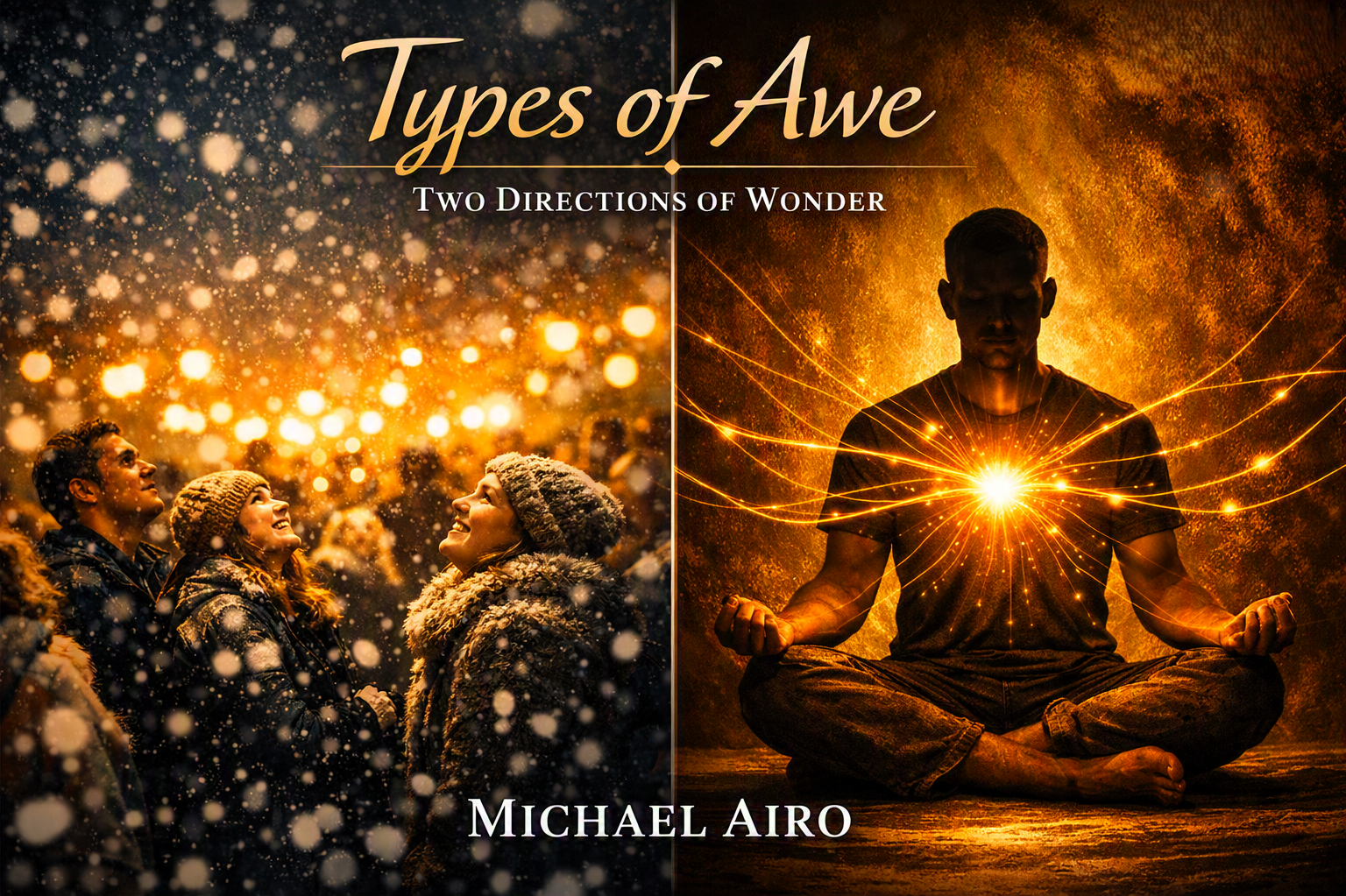
One points at the horizon. The other points straight down, into everything you carry.
The trick was knowing when to move, not where.
Everyone else had been staked out for twenty minutes already, blankets and strollers and elbows claiming curbs, planters, every flat surface with a sightline. We stood back near the edge of it, patient, her hand loose in mine, watching the crowd the way you’d watch a held breath.
Then the announcement crackled through hidden speakers, polite and final: everyone, please stand for the fireworks. And for one single beat, the entire prime section came apart. Bodies rising off curbs and blankets, shifting weight, some scrambling upright with a stroller wheel catching wrong, the tight-packed rows loosening into gaps just wide enough for two people who knew exactly what that instant was worth.
We went in sideways, her first, my hand at the small of her back, both of us slipping through shoulder-width openings that closed again the second we’d passed. Somebody’s elbow caught my ribs. A kid’s balloon string brushed my face. Thirty seconds of pure motion, reading the crowd like current, and then we were standing dead center, clean sightline straight up the middle of the castle, exactly where the blanket people had been sitting for twenty minutes and never quite managed to hold.
She looked at me like I’d done something illegal. Grinning the whole time.
Everything that whole day had gone smoothly in a way that had nothing to do with luck. No argument about where to eat. No irritation standing in a line. Just an easy current running underneath everything, her laugh landing exactly when something was actually funny, my hand finding hers without either of us deciding to reach. Not awe yet. Something warmer and quieter than that, closer to the ground, the particular ease of being fully at peace with the one person next to you, nothing to manage, nothing to prove.
We stopped moving near the hub and stayed there. Her shoulder against my arm, cold enough by then that the warmth of it registered as its own separate fact.
Then the sky went white.
Light always arrives first. The bloom hung above the castle for a half second in complete silence before the concussion caught up and landed in the chest rather than the ears, a low percussive thud the ribs answered from the inside. Another. Then a cluster, gold and red washing down the length of the street and across every upturned face at once. Gunpowder drifting down through the cold, sharp and mineral, cutting into the peppermint and the cinnamon coming from somewhere behind us.
Crowd noise didn’t stop. Crowd noise changed key, thousands of separate voices collapsing into one sound, rising as the shells rose.
Then the last one faded, and the street went quiet.
Not quieter. Quiet. A few thousand people deciding all at once, without any signal at all, to stop talking. Strollers stopped rattling. Somewhere far off, a door closed, and I heard it.
Into that silence, a voice.
Recorded decades before either of us was born, warm and worn and slightly grainy through speakers hidden in the eaves. Bing Crosby. White Christmas, in sixty-degree weather, on a street in Anaheim.
No idea it was coming. We hadn’t seen it before, didn’t know they’d paired the song with anything at all, and the not-knowing is what made the next part land the way it did.
First flakes came down through the cones of lamplight. Small, white, unhurried. Then more, then the whole street filling with it, falling steadily onto the awnings and the pavement and the shoulders of a crowd that had no idea it was coming either, every face turning up at once with the same startled, unguarded look.
One landed on my cheek and didn’t melt. Sat there warm, almost, then vanished into nothing and left the skin dry. Another caught in her hair and stayed, and I remember watching that instead of the sky.
Feet moving before either of us decided to move them. Not a real dance, nothing with steps to it, just weight shifting from foot to foot in time with a song neither of us controlled; both of us turned in toward each other now instead of up at the sky. Somewhere in there the rest of the street simply stopped existing. Not literally; thousands of people were still standing right there, but none of them registered anymore, no self-consciousness left to notice being watched, no crowd left to perform for. Just the two of us and the falling snow and a dead man’s voice, the entire world narrowed down to the small circle we were standing in.
Cold air. Peppermint. Gunpowder still settling. And Christmas arrived, not the date, the thing the date is supposed to point at, arriving in the body, behind the sternum, going warm and going wide in the same motion.
Something in me knew before any word for it existed. Not a thought about whether it was real. Closer to a flat certainty that it was being given to me on purpose, and that the purpose had landed.
Her hand found mine somewhere in there. Neither of us said anything for a long time.
Every piece of it was engineered. Machines mounted along the rooflines, a recording made in the 1940s, a cue sitting in a booth somewhere waiting for the last shell to fade. Knowing all of that, learned only much later, has never once changed anything about that night. Sixteen hours of walking had worn the analyzing part of me down to almost nothing, and whatever was left of it had no defenses up at all, and neither did the frame that love had already left open before a single firework ever went off.
Types of Awe: The Outward Direction
Almost everyone knows that one.
Awe from vastness outside the self is the version the culture recognizes and plans vacations around, and it’s the type of awe most people mean when the word comes up at all. Canyons. Cathedrals. Ocean from a cliff. Sixty thousand people in a stadium making one sound at the same instant. Dacher Keltner’s research at Berkeley documents the physiology of these moments in detail: the goosebumps, the widened eyes, the quieting of the brain regions most occupied with the self.
Snow falling where snow cannot fall does the same work as a canyon. Vastness isn’t measured in acres. Vast means larger than whatever frame you walked in carrying, and a body that has never felt snow land on its own skin has a very small frame for it.
There’s a second type of awe, though, and almost nobody goes looking for that one.
Types of Awe: The Inward Direction
A stranger goes down hard on the sidewalk ahead of you, and your legs are already moving before your mind has voted on it, or they don’t move at all, planted there while someone else steps around you to help, and either way you meet a version of yourself you hadn’t been formally introduced to before that second. Round six of something brutal, lungs burning past the point of negotiating, quads gone to something closer to static than muscle, and the thought arrives clean and uninvited: nobody’s watching this rep, nobody would know. Some people’s hands find the shortcut without deciding to, the rep counted that never quite happened, the range of motion that quietly shrinks when no one’s eyes are on it. Others feel the exact same thought pass through and keep going anyway, full depth, full count, for an audience of nobody, and the choice in that half second tells you something about yourself no conversation ever could. A sentence leaves your own mouth in your own kitchen, and underneath it rides your mother’s exact inflection, or your father’s exact silence, some string you didn’t know was attached to you pulling taut without warning. Throat still moving, words still landing in the room, and a full beat behind them the recognition arrives low in the chest, a small cold drop like missing a stair in the dark, and the floor of the moment gives out for exactly as long as it takes to know the voice wasn’t fully your own.
None of those moments announce themselves in advance. They arrive, show you something true and unasked for, and leave again, and the only real question afterward is whether you were paying enough attention to catch what was shown.
Asphalt held the day’s heat long after the sun had started sliding sideways, that flat driveway slap of a basketball landing over and over between my brother and me, when the front door banged open behind us.
She came through it already talking, already deciding, sentence half-formed before her feet had cleared the step, some pull toward the coast she couldn’t quite explain from where we stood holding a basketball. Santa Cruz. Car leaves in five minutes. If you’re not in it, you’re staying here.
Flat. Final. Delivered the way you’d call out a score, not a threat, and somewhere underneath the words was a kind of pure delight in getting to say it, watching the whole scramble that came after with her mouth already curling toward a grin.
Shoes flying. A towel yanked half-damp off the line, snapping once in the air, though she’d never once needed one herself. She was already backing the car out before the last door slammed shut, radio finding a country station through a burst of static, an audiobook narrator’s voice sometimes riding underneath it instead, depending on the week, her humming along to neither one, never quite committing to a full note, one hand drumming against the wheel because sitting still through a whole song was already asking too much.
Windows down the whole drive to the coast, salt riding in thick enough to taste at the back of the throat. By the time we hit the sand, she already had her spot picked, towel snapped flat in one motion, and she went down onto it with a paperback already cracked open, spine broken from being carried everywhere, eyes down on the page instead of up at the water. Never past her ankles, the whole afternoon. The rest of us screamed into water cold enough to seize the lungs, and she just sat there, turning pages, arrived completely, needing nothing beyond the exact six feet of sand she’d claimed.
She loved to walk more than almost anything, Pacific Avenue mostly, sometimes down through Capitola Village instead, block after block at a pace that looked, from the outside, exactly like being completely at ease and was really just restlessness wearing a calm face.
Whatever she wanted showed up for her, more often than made any rational sense. She’d decide on a thing, hold it loosely in her mind the way she held most things, and the parking spot would open, the person would call, the thing would simply arrive, watched it happen enough times across enough years that it stopped registering as coincidence and started registering as just how she moved through a day.
I got the engine. The restlessness, the refusal to sit still past thirty seconds, the legs that wanted to keep moving even when there was nowhere in particular to go, running in me exactly the way it ran in her. What I never got, and had to build by hand instead, over years, was her particular ignition. Hers turned over on belief alone, no doing required underneath the wanting. Mine needed the doing every single time, and it took a long while to stop treating that difference as a smaller version of her gift instead of simply a different engine, built for a different kind of road.
My father’s current ran differently, and it took longer to see it clearly, because it never once announced itself.
Every other weekend, my brother and I showed up at that house, and the house was already waiting for us before we’d gotten our shoes off.
Parisian sourdough on the counter, crust crackling faintly if you pressed a thumb into it, still holding the bakery’s warmth from that morning. Turkey and roast beef stacked in the fridge in neat waxed paper, cheese sitting right alongside them even though my father couldn’t stand the smell of it himself, bought and kept cold anyway because we liked it. Chinese food riding in the back seat on the drive over, containers ticking faintly against each other at every turn, steam fogging the plastic windows, the whole car filling with soy sauce and five-spice before we’d even pulled into the driveway. Homestead ravioli from a bag in the freezer aisle, Homestead sauce to go with it, nothing fancier than a Safeway run, and it never once occurred to any of us to want it any other way, because it was exactly what we asked for and exactly what showed up.
None of it required asking. He’d noticed once, weeks or months earlier, some offhand thing either of us mentioned without meaning it as a request, and by the time we came back it was simply there, restocked, waiting, like the house itself had been paying attention the whole time we were gone.
His actual pocket ran the same current in miniature, and it mystified us for years before either of us thought to ask how. Something breaks, a hinge, a zipper, a toy with a screw rattling loose inside it, and his hand goes into that jacket without any real searching in it, and out comes the exact tool the moment needs. Pocketknife most often, blade worn smooth along one edge from decades of use, handle warm from being carried so long it had stopped being separate from him. Fixed more things across more years than I could ever count on both hands, and every single time it produced the same small quiet magic, the sense that whatever the world had just broken, he already had the answer to it riding along in his coat, ready before the question had even finished forming.
Grandparents’ house ran that quiet arithmetic even in the smallest moments. Pour a glass of milk, cool linoleum under bare feet in summer, carry it out to the porch, drink half of it in the heat, set it on the railing, wander off to whatever came next. Come back later, screen door creaking behind me, and the glass would already be gone, rinsed, dried, standing back in its cabinet slot like it had never left it, cool ceramic against my palm when I reached for a replacement.
Then there was the theater, which taught me the whole pattern had a name I just hadn’t found yet.
Dark rolled through the rows like fog settling into low ground, thick enough to hum with the anticipation of everyone waiting for the picture to start. His hand went into that same jacket, easy, unhurried, and came out with a box of bonbons, foil crinkling under his thumb as he worked the lid open one-handed without looking down at it. I said no thanks, I eat trail mix, the kind of sentence a kid says once without meaning much by it and forgets somewhere around the parking lot.
He didn’t forget it. Months later, another theater, the same fog of dark settling into the same rows, and his hand went into that pocket again, and this time it came out with a small bag instead, peanuts and raisins rattling faintly against each other as he passed it across the armrest. Portioned out that afternoon on purpose. Carried in specifically because of one sentence from months before that he’d filed away without ever mentioning he had.
Nothing announced. No look that said remember what you told me. Just the bag, warm from the same pocket that had fixed a hinge, opened a stuck jar, produced a bandage nobody else in the family thought to carry, handed over like it had simply always been there waiting.
That pocket and that house were the same trick, run at two different sizes. Sourdough restocked before we arrived. Trail mix remembered months later. A glass rewashed before I’d even noticed it was gone. All of it simply happened, the way weather happens, constant and unannounced and specifically for you, and for years I half believed there was something almost magic in a man who always seemed to already have the thing you needed before you’d finished wanting it.
My father grew up inside that exact rhythm at Abbie’s table and absorbed the whole shape of it before he ever had language to name what he was learning. Abbie herself, the sweetest woman anyone in the family ever knew, the kind who’d hear a kid mention a favorite dish once, barely paying attention, and have it sitting warm on the table that same night, made from nothing, no announcement attached. Giving that way cost him nothing to think about, because thinking about it was never the point. Loving someone meant knowing what they needed before they said it, and having it ready.
What stayed with me, watching two generations run on that current, wasn’t dramatic. Slower than that. People who keep everyone else’s exact preference stocked and ready rarely stop to check what’s stocked for themselves. My father loved that way completely, without ever asking anything back for it, and my own version carries one addition his never quite got around to. Keep something in your own pocket too. Not instead of the trail mix. Alongside it, so there’s always somewhere full for the giving to keep coming from.
The Invisible Strings
Something threads through a life and pulls, and almost none of it is visible while it’s pulling.
Some strings were tied by people you remember. Others by people you never met, whose fears and hopes got handed forward without a note explaining what they were for. Pull hard on any single reflex, and the string runs back further than expected, through a parent, through a house, sometimes through a country nobody in the family lives in anymore.
Internal awe is the moment one of those strings catches the light.
Not the moment it gets cut. Seeing the string is not the same thing as being free of it; you can watch exactly where a reaction comes from and still feel it pull the next time it wants to, and any piece that promises otherwise, that ends with the string severed clean and the reader liberated for good, is selling something rather than telling the truth. What surfaced watching my mother and father, separately, across years, was smaller and stranger than freedom. Two strings that had been invisible my whole life became visible along their full length, and the length is what produced the chills.
James Redfield built an entire framework around this in The Celestine Prophecy, and the part that has stayed with me is the geometry of it. You were born to those two specific people, and the real you began in the position between their two truths. Not as an inheritance to carry. As a question to answer. Your work is the higher synthesis of what each of them stood for, and most people spend decades answering it without ever knowing the question was asked.
My mother’s truth was that belief moves the world, that wanting something with enough clarity is most of the mechanism. My father’s truth was that love means giving until there’s nothing left to measure it against, and never once counting the cost. Both were completely real. Neither one was complete on its own. She rarely needed the doing underneath the wanting, because her particular engine ran clean without it. He never once kept anything back for himself, because keeping something back had never occurred to him as an option worth considering.
The vastness in both of them was never smallness at all. Two full lives stacked inside a single household, running two different truths at the same time, and somewhere between them, without either one deciding it, a third thing was already being built.
What Maslow Found
Abraham Maslow spent years collecting accounts of people’s most transformative moments, and the phrase he gave them has outlasted most of his other work. Peak experiences. Moments of unusual intensity in which the ordinary managing self goes quiet and something larger comes through, arriving in two distinct types of awe he never ranked one above the other.
What matters is where those accounts came from. Some of his subjects described standing before something immense in the natural world. Others described nothing external whatsoever, a sudden total understanding of their own life, decades reorganizing themselves in an instant, delivered while sitting perfectly still. Same physiology. Same reported aftermath. Same sense of having briefly stepped outside the small self doing the managing.
Late in his life, Maslow placed self-transcendence above self-actualization, which is a technical way of saying he came to believe the highest thing available to a person is the experience of being briefly larger than themselves. He never specified a required direction. Outward at a firework or inward at a pattern, transcendence was the point.
Most people only know one of the two types of awe. Which one usually comes down to temperament and habit rather than any decision.
Why the Inward Direction Gets Missed
Outward awe is easier in every way that matters.
Falling snow requires no honesty from anyone standing under it. A canyon asks nothing except that you show up and look. External vastness arrives complete, and the only participation required is attention.
Internal awe charges admission. Seeing the shape of an inherited pattern means the shoulders coming up defensively at the mere suggestion of it, a small flinch in the chest arriving before the mind has agreed to look, the string going taut and every instinct in the body wanting to look away from exactly where it leads. A nervous system built to protect resists that recognition hard, because from the inside, recognition looks like exposure.
Stillness is the other requirement. Outward awe happens at speed, in crowds, on a schedule. The inward type needs a moment with nothing in it. A hand loose in someone else’s hand. Driving with the radio off. The first ninety seconds after waking, before the day installs its priorities. Places where attention has nowhere urgent to be and drifts, unsupervised, toward whatever has been waiting.
Fill every one of those gaps, and that direction closes quietly. The strings keep pulling on schedule, and a life goes by without any of them ever catching light.
Both Doorways
Once both types of awe are known, they start feeding each other.
Outward awe quiets the managing self, and a quieted self is precisely what the inward direction requires. Which is why some of the deepest self-recognitions in a life arrive not in an office with a therapist but on a trail, on a drive home, in the hour after the last shell fades and a street goes quiet. Something enormous does the work of getting you out of your own way, and then something you have needed to see for years finally has room to surface.
Internal awe returns the favor. Every string that becomes visible loosens the grip of the story you’ve been telling about yourself, and a person carrying a looser story is more available to be stopped by falling snow.
Both directions build the same single capacity. Not a technique. Not a string cut clean and set aside. A widening around whatever is still quietly pulling, room enough now to feel it working without needing it gone.
Snow kept coming down that night long after the last shell had faded, settling on the awnings and the lamps and the shoulders of a few thousand strangers who all knew perfectly well it came out of a machine.
Every bit of it was manufactured. Every bit of it landed anyway.
Some of what moves through a life gets built by people who came before, timed and mounted and released above your head without your knowledge or consent. Whether you spend the whole night with your face turned up watching it fall, or whether you look down at your own hands and finally see what they’ve been carrying, the movement is the same one.
Something opens. Something else turns out to have been enormous the entire time.
This piece is written by Michael Airo. New work is published regularly at michaelairo.com.
Read a connected piece: The Invitation: How to Experience Awe.
If you’re new here, you can learn more about my work and background on Michael Airo’s About Page.