Stop Counting Time. Start Weighing It.
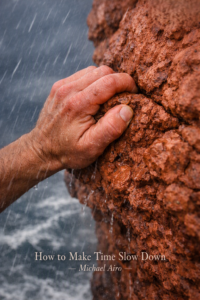
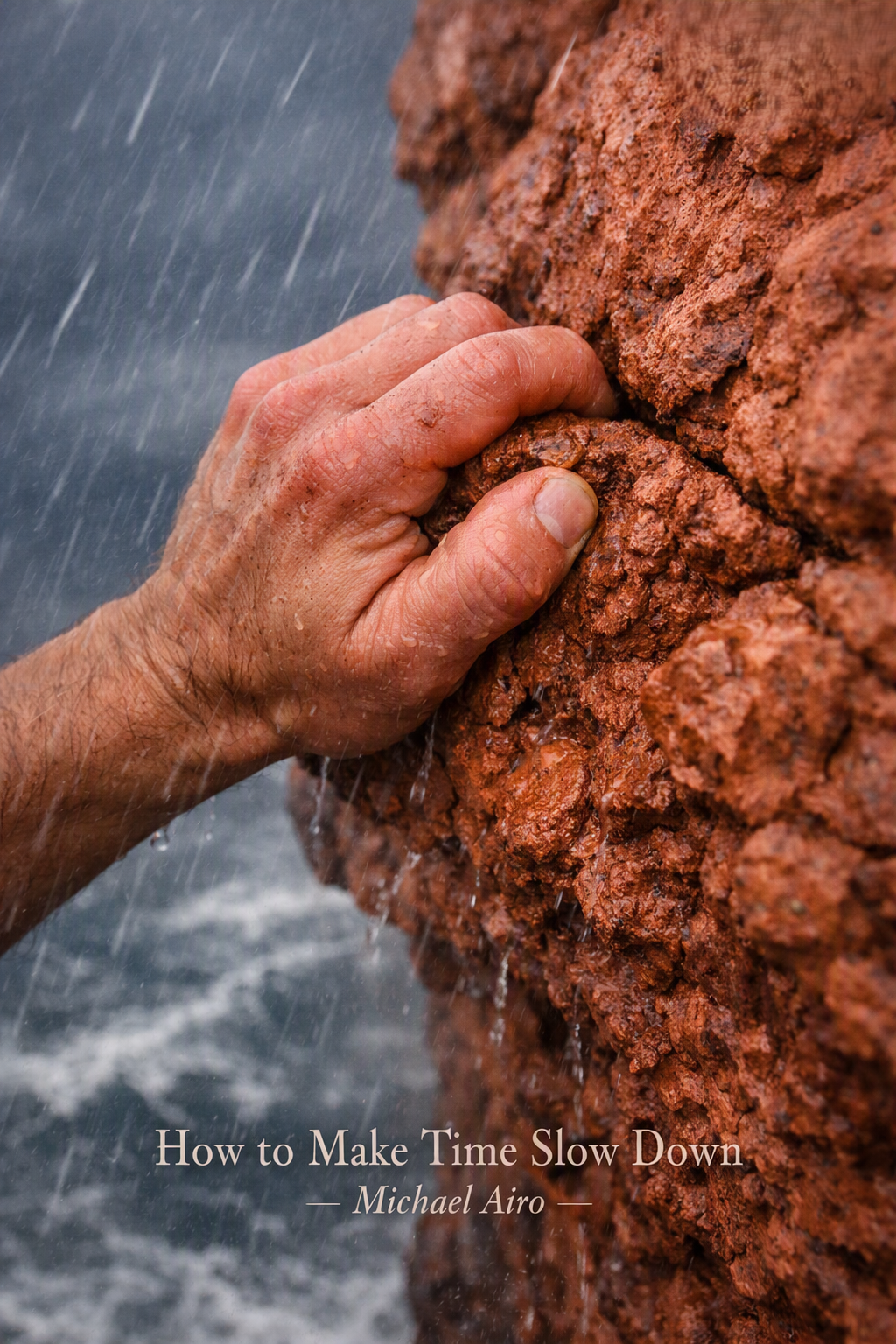
The rain came in sideways and found every seam. Cold slid down the inside of the collar in one thin line, followed the spine to the belt, and pooled there. The boots that promised to stay dry gave it up before the first switchback, and the socks went from damp to heavy to a second skin of cold.
The wall waited where it had dropped away on the way in. Same near-vertical face, but the sun that had warmed it was gone, and the stone had turned dark and slick, shining like a wet animal’s back.
Right hand. Weight low, hips under the hands. Breath short and careful.
Left hand. A ledge I could barely see, wet gray on wet gray. Reach. Settle.
Sound came in three parts. The falls behind us, a far roar the ears kept long after the eyes had left it. Rain hissing against stone. Breath going in and out through the teeth.
Salt air thick on the tongue, wet rock beneath it, rain over both. Grit packed under the nails. Where the ground used to be, it now slid under foot, and every step had to be negotiated instead of taken. The crashing waves mixed with the rain, performing a staccato drum beat on the world. Each sound chilling to the bone.
Hold. Weight. Hold. Weight.
Later, dry, with the heat finally back in the hands, the two halves of the day lay side by side in memory, the same nine miles walked in opposite directions, the way down bright and new with a waterfall pouring into the sea at the end of it, the way back new in a different key, gray and narrow and close, a different hike entirely. Both trails held awe, two moments stretched wide in time, one under sun and one under rain. The way back outlasted the way down. How to make time slow down starts with what the mind records, and that wall was written down to the grit.
Two Clocks
The clock keeps one kind of time, a steady tick against the wall. Memory keeps the other, and memory has no tick, only weight. A day that left a great deal behind sits heavy in the mind. A day that left nothing weighs nothing at all.
Physics says time bends with speed and gravity, and GPS satellites carry clocks that must be corrected for time slip every day. Time perception bends too, by different rules, and memory sets most of them.
Claudia Hammond calls the best-known case the holiday paradox. A week somewhere new flies by while it is happening, then stretches wide when you look back, because we judge how much time has passed partly by how many new memories were made inside it. In 2007, David Eagleman’s lab released volunteers from the top of a tower into a net and asked how long the fall took. They put their own fall at 36 percent longer than the same fall watched from the ground, though their eyes had caught nothing extra. A richer recording made the seconds feel long afterward. Researchers still argue about how far novelty reaches, and the evidence for whole decades is mixed. Anyone who wants to know how to make time slow down has to start with the recording, because the recording is where time lives.
The Week That Held a Year
Take a person who goes to work and does the same thing every day. The same road under the same tires, the same chair taking the same weight at the same hour, the same coffee gone lukewarm at the same point in the afternoon. Almost nothing new gets written down, so the year folds shut like a hand closing on air, and the person wonders where it went.
Send that same person to a city they have never seen. The air smells like nothing at home. The street has a slope the legs haven’t learned, and a doorway gives off a sweetness the nose can’t name. A few days fill with so much detail that each one weighs a year. Nothing about the clock changed. The recording did.
The first weeks of a new relationship work the same way. A pulse in the throat at a name on a screen, every street one they haven’t walked together, each moment kept in fine grain. Years in, the evenings are warm as a banked fire and just as quiet. Nothing is wrong with them. They are recorded thin, that is all.
I used to tell people this, in classrooms and out of them: step outside the comfort zone and time expands. The comfort loop runs on familiarity, and familiarity leaves nothing to grab. The price is real, though. New ground wears the body down faster than a weekend on the couch, and the tiredness is part of what the long life costs.
Two people can be the same age and have lived different lengths. The calendar adds the same years to both. Memory adds them unevenly, and a life of new ground, new people, and rooms that tighten the chest is a longer life than one on repeat. Go where the recording runs thick to learn how to make time slow down.
Three Places to Live
People live in three places, and each handles memory differently.
Some live in the past, replaying pictures. A Leave It to Beaver rerun, a house frozen at one particular year, a story told so many times it has become the room. They climb with both hands on the hold below, and the arms tire holding a grip that goes nowhere. Almost nothing new gets recorded.
Others live in the future. Long hours now so the money exists later. The jaw set, the shoulders leaning ahead of the feet. Saving toward the milestone. Saving themselves for someone they haven’t met, enjoying little in between, because the enjoying belongs to later. The arm reaching for a hold that isn’t on the wall yet goes numb to the shoulder, and the years pass like blank stone.
A few live only in the present. Across the table from a person, the phone dark, every bit of attention in the eyes and the ears. The money gets spent now. The account runs empty and the memory runs full.
Everyone ought to live in all three at certain times. The past can be entered on purpose, and so can the future. In the Felt Future practice you step into a moment five years ahead until the body recognizes it, then carry that recognition into an ordinary day and live like the person you are building.
Attention is How You Make Time Slow Down
Memory records what attention touched. Attention is the one gift that lengthens time, and nobody can lend it to you. In awe it sharpens until a ledge is no longer just a ledge. The ledge has a temperature, a grain, a lean to the left, and the ear pulls the waves apart from the rain and the rain apart from the breath. Each detail leaves an imprint on the soul.
Melanie Rudd, Kathleen Vohs, and Jennifer Aaker found that people who felt awe judged they had more time, grew more patient, and chose experiences over things. Awe pulls attention into the present, and the present fills.
In January, Alex Honnold climbed Taipei 101 with no rope. Afterward he told NBC he had “lost track of space and time to some extent,” and described the climb as one move at a time the whole way up. Space and time stretched together, with attention on a single move.
New ground gets recorded densely. Take the other road home. Learn the unfamiliar thing. Say yes to the room that tightens the chest. Then spend the attention once you’re there, because a trip taken with the phone in the pocket and the mind elsewhere leaves the same thin trace as a Tuesday.
Walking Through the Photograph
A recorded moment can be entered on purpose. Take an old photograph from a day that mattered. A favorite place will do, or a person long gone, a grandmother, say, caught mid-laugh. Paper soft at the corners, a faint chemical sweetness still in it. Hold it close until the edges drop out of sight.
Let the attention go in. The light first, then the temperature on the skin, then the smell the day had, then the sounds you can’t hear but know, someone laughing just outside the frame. Stand there until the ground has weight under the feet.
Then walk. The frame has an edge, and the day does not end at it. Keep going, past the border and off the other side, into the part nobody photographed, the room behind the room, the minutes after the shutter closed. With a place, the walk opens into the next bend of the path. With a person, it opens into the room she was walking toward, her voice arriving before the rest of her does. Done slowly, it takes me out of time. I stop looking at an afternoon and begin to relive it.
A version of the exercise sits in the Seth books of Jane Roberts, where time is called a spacious present. What it does in the body is what I trust.
Back in the chair. The photograph in both hands, the paper warm from the fingers. Breath low in the belly, and an afternoon from years ago, not finished yet.
Back to the Ledge
In the moment, the climb back in the rain was the part I would have traded away. Numb fingers, a wall nobody had asked for, a hundred small reasons to wish it over. Now I would not trade it for anything. Awe opened me up somewhere on that wall, and I still carry the hour in the finest grain. Comfort would have let it blur. Weather and risk and a ledge I could barely see kept every part of me in the room.
The clock counts the minutes. Memory weighs them. Attention decides what there is to weigh in the first place. No one gets handed more years, but a day met with the whole of the attention can open wide enough to hold one, and the hours you would skip if you could are sometimes the ones with the most room in them.
Rain on the knuckles. Cold stone under the right palm, gray on gray, the hold I could not see until the hand found it. Waves drumming below, breath hissing through the teeth. Left hand reaches. Weight settles.
Hold. Weight. The whole wet afternoon, still opening.
This piece is written by Michael Airo. New work in the Invited States series publishes regularly at michaelairo.com. If you’re new here, you can learn more about my work on my About page.
Read a connected piece: Recognizing: The Stories That Knew Us First, and the whole map at The Doorways of Awe.