Not smallness. The universe expanding until you can feel how large it always was.
Some mornings my grandmother was ahead of all of us before the gates had even opened.
The esplanade still cool under our shoes at that early hour when the air smells like nothing yet, no sugar, no popcorn, just the flat mineral scent of pavement before the day has warmed it. Small quick steps ahead of us, her heels clicking a rhythm none of the rest of us could match, blond pixie hair catching the first hard light and throwing it back white. She called over her shoulder, come on, come on, the words clipped short by how fast she was breathing them out, and something in the sound of her voice pulled at the chest the way a rope pulls a boat toward a dock, no choice in the matter, just motion.
Other mornings she barely moved at all. Main Street would be doing its usual thing, drawing every eye down toward the castle, brass rails already warm under the sun, the smell of something baking drifting out from a shop we hadn’t reached yet, and Sis would just stop. Dead center of the sidewalk. The crowd split and flowed around her like water finding the shape of a stone, footsteps and laughter passing on either side while she stood untouched by the current. Not glancing. Looking, the way you look at something you’re afraid will disappear if you blink.
Her name was Iona. She never once let anyone use it. Sis, from the time she was young enough to choose her own name and stubborn enough to make it stick.
I used to watch her face on those mornings, waiting to see which speed she’d be. Small, bright-eyed, quick, and if you’ve ever seen the pixie who flies from the top of the Matterhorn during the fireworks, you already know exactly what she looked like. Nobody in the family needed that pointed out. We all saw it every summer of our lives.
Here is the one I keep coming back to. Sis, at maybe seventy, standing at the base of the castle, one hand resting flat against her own chest the way people do when something in there has gotten too full too fast. Her mouth was open just slightly, past smiling, into something quieter. Her eyes were wet, not crying, just full, the full that happens before a single tear decides whether to fall. Somewhere behind her, a train whistle carried across the water, long and low, the sound Walt built the whole park around, and even that seemed to be arriving from somewhere very far away. She didn’t wipe her eyes. Didn’t seem to notice. She just stood there and let it happen to her, in public, in broad daylight, seventy years old, while her grandchildren tugged at her sleeve asking what was next.
I asked her once, years later, what she was thinking about in moments like that. She said she wasn’t thinking about anything. That was the whole point.
Something in me already knew that before she said it. A child doesn’t need the words for it, just the felt sense, watching a grandmother go quiet in a way that had nothing to do with being tired.
Whatever was moving through her didn’t wait for permission, and it never once asked to be explained.
That same quiet hunger showed up on the opposite side of the calendar too, when the California sun gave way to tinsel and the smell of pine needles drying out in a warm living room. She could not leave a wrapped present alone in a room. If you left her by the tree for five minutes, you’d hear it before you saw it, the faint dry whisper of tape lifting a half inch at a time, patient, practiced, a thumbnail working a gap wide enough to see a color, a shape, anything, then smoothed back down before anyone walked in. Caught every single year. Never once embarrassed about it. The wonder was sitting right there under the paper, and waiting felt, to her, like a genuine waste of the wonder.
Nobody taught her how to experience awe. No technique produced it. Something in her simply stayed open, year after year, the way some doors are hung a little loose on their hinges and swing wide at the smallest push.
Watching her was its own kind of arrival. Something in my own chest went wide and warm, standing there at seven, at twelve, at sixteen, watching a grandmother become a girl in front of me. Goosebumps I had no name for yet, rising along both forearms in the warm California air for no reason the temperature could explain.
Before the name, the body responds
Goosebumps arrive first for most people. Chills running down the forearms or the back of the neck, moving in waves, landing at the exact moment something vast does. Researchers studying the musical version call it frisson. Your body knew this before it had a word for it. A song found that old knowledge once, low in the chest, and something in you answered before you had a chance to stop it.
Breath goes next. A sharp intake, or a long, slow release you never decided to make. The exhale of standing at an overlook. Every language on earth has a sound for that moment, and almost none of them are words.
Tears without sadness, and this one confuses people. Watering eyes at a wedding, at a reunion video, at the sight of something enormous and old. A grandmother at the base of a castle, one hand on her own chest, not crying, just full. Nothing is wrong in those moments. The system is moved, and moved has to go somewhere.
Then the stranger signs, the ones that mark awe apart from almost everything else the nervous system does. The sense of self gets small. Not diminished. Right-sized, the way a held breath finally matches the size of the room it’s standing in. The edges of the body seem to loosen, shoulders dropping half an inch without deciding to, the tight managing hum behind the sternum going quiet the way a room goes quiet when a machine you’d stopped noticing finally shuts off. Something that had been gripping lets go, and the letting go itself is the relief, not a thought about relief, just the muscles reporting less work to do.
Tiny and enormous at once, which should be a contradiction and somehow isn’t. The chest feels wide open and the whole body feels light, almost weightless, the way it does stepping off a plane into different gravity.
Time stretches without any sense of it dragging. A held breath outlasts every breath around it. Whatever is directly in front of the eyes stays sharp while everything at the edges, the noise, the crowd, the ordinary hum of a place, goes soft and distant, the way sound goes underwater. And almost every time, the hands move before the mind catches up to why, reaching for the nearest arm, the nearest sleeve, some part of the body already trying to pull another person into the same widened space.
One more sign moves underneath all the others, and it rarely gets named. Sis’s hand had already found her own chest before a single thought had caught up to explain why. Some part of her recognized the moment before her mind did, the way a hand knows to catch a falling glass before the eyes have finished registering the drop. Intuition arrives first in awe, ahead of language, ahead of understanding, already certain of what the rest of you is about to feel.
If you’ve felt that cluster, the chills, the caught breath, the wet eyes, the sudden smallness that feels like freedom, the quiet knowing underneath it, you already know how to experience awe. Your body has done it many times without asking you. The real question is why it doesn’t happen more often, and what stands in the way.
The Name
Dacher Keltner, whose decades of research at Berkeley culminated in Awe: The New Science of Everyday Wonder and How It Can Transform Your Life, defines it precisely: awe is what we feel in the presence of something vast that transcends our current understanding of the world.
Two ingredients. Vastness, and a frame that has to stretch to hold it.
Vastness doesn’t mean size. A canyon qualifies, sheer red rock dropping away below your boots, a bird crossing it far below instead of overhead. So does a stranger’s act of courage, someone stepping between two others without a second of hesitation, the kind of moment your own chest tightens just watching. So does a child’s first step, that half second of pure falling forward before the legs figure out what they’re for, arms out, mouth open, and the whole room forgetting to breathe until the second foot lands. Vast means bigger than the frame you brought to the moment, and the ribs know it before the mind does, some involuntary catch in the breath announcing that whatever just happened doesn’t fit in the container you walked in with.
Awe is the only state that grows the frame itself, on the spot, to make room for what just walked in. The stretching is the feeling, that sensation of something in the mind giving way, widening, making room. No other state does that. Every other state operates inside the frame it’s handed. Awe renovates it.
The Inverse Movement
Contraction narrows your view of the world down to threats. Eyes locking onto the dangers around you, the body coiling tighter with each one, muscles loading like a spring gathering the energy for a jump it hasn’t taken yet, the whole system pulling inward the way a fist closes around something it means to protect. Anxious. Defensive. Overwhelmed. Different names for the same motion, the self gathering in tighter around itself until there’s barely room for anything else to exist.
Awe moves in the opposite direction. Not by making you smaller first. Everything else gets larger first, and the smallness arrives after, almost as an afterthought.
Stand somewhere dark enough that the sky finally shows you what it’s actually been holding, thousands of points where you’d counted dozens, and the neck tips back on its own, past the point where necks usually stop. Cold moves in through a thin jacket and nobody notices it moving in. The sky doesn’t shrink to fit your evening. Your evening expands to fit the sky, the chest opening the way it does on a long exhale that has nowhere it needs to be. Something in you simply stops holding its position, the tight little grip behind the sternum letting go one notch at a time, and the world you’d been managing gets quiet enough to hear the actual size of things again, ancient, indifferent, larger than every story you’d been carrying around about yourself all week.
That’s the order it happens in, even though the body swears it should run the other way. The muscles don’t clench down first to make room for something big. The muscles unclench, the jaw drops half an inch, the shoulders finally come down from around the ears, and only once all of that has happened is there room enough left over to notice how small you are inside it. Smallness isn’t the cause. Smallness is what’s sitting there once the performance stops holding its shape.
Because contraction, most of the time, is exactly that, a performance. A held posture, a managed face, a voice pitched to sound like it has everything handled. Wonder undoes the performance rather than requiring a better one, asking the jaw to hang open in public the way it isn’t supposed to, asking the eyes to go wet without checking first whether anyone’s watching. You cannot fake your way into that particular slackness. The instant you’re monitoring how the moment looks on you, the shoulders come right back up, and the experience is already gone.
But invitation is not passivity. A thumbnail working gently under wrapping paper, feeling for the gap by touch alone, is not passive. A body standing dead still while a whole crowd flows around it, refusing every pull to keep moving, is not passive either. Keeping a door unlocked for seventy years, when the world hands you a fresh reason daily to bolt it, takes a discipline most people never notice because from the outside it looks like nothing. Sis never once reached for the lock.
What Stands in the Way
Attention span isn’t fixed after childhood the way people assume, and it isn’t really about age either, once you’re grown. Roughly two minutes more than a child’s age each year, climbing steadily until it jumps to twenty minutes somewhere close to age ten, and then it simply stays there. An adult carries the same twenty-minute window a fourth grader earned, for the rest of a life, and no amount of getting older buys any more of it back. What most adults have instead of a longer window is a phone lighting up in a pocket a few dozen times a day, each buzz enough to snap the eyes down and start the same short window over again from zero.
Learning how to experience awe has almost nothing to do with stretching that window. It has to do with pointing the same twenty minutes somewhere else entirely. Most of a day’s attention stays turned inward, replaying a conversation from that morning, rehearsing the next thing to say, running a small anxious loop that checks and rechecks whether the last thing landed right, the jaw tightening slightly each time it comes back around. Awe asks that same attention to turn outward instead, toward something large enough to finally answer the question the loop keeps asking, or to turn inward in a completely different direction, down into an old memory rather than up into the churn.
The actual obstacle was never a shortage of time. A head that keeps turning back toward itself instead of turning out toward the horizon, the way a compass needle that’s been rattled keeps swinging back to the same false north.
Once a state has been named and actually heard, the mind stops latching onto the thought and circling it the way a dog chases its own tail, round and round the same few inches of ground. A settled system can afford to let its twenty minutes wander somewhere larger than its own next move.
The Country Ahead
Awe moves in two directions, outward toward canyons and symphonies, and inward toward the quiet click of recognizing yourself in something you didn’t expect to see. Doorways repeat themselves across every human life. Music that moves through the chest before the mind has parsed a single note, a bassline landing in the sternum like a second heartbeat. Stories that break something open that beauty alone can’t reach, the throat tightening at a page nobody else in the room has read yet. Wonder engineered on purpose, built by people who understood exactly which smell down which street would make a jaw drop, long before anyone had a name for what they were building.
Time does something strange under it, a held breath outlasting the ones around it while anxiety does the opposite, squeezing a whole afternoon down to nothing. Resilience gets fed by it, the shoulders finding room to drop even under real weight. Grief receives something quieter still, a held breath finally let out. Between two people, awe becomes the recognition of someone else’s realness, a bond built through standing shoulder to shoulder in silence instead of talking. And underneath everything, the very young and the differently attentive already carry a way of seeing without the filter of familiarity, a stillness the rest of us spend years crawling back toward.
Not mastery. Availability.
Every summer night, when the fireworks start, a pixie flies from the top of the Matterhorn, small and quick and bright against the dark, the crowd below exhaling all at once in a sound like wind moving through a field.
We had our own, flying a little slower down Main Street, and we never once had to look up to find her.
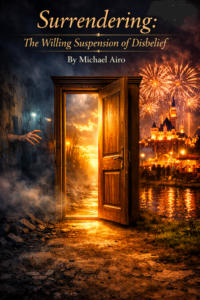
The door opens from the inside. This is the new country on the other side of it.
This piece is written by Michael Airo. New work is published regularly at michaelairo.com. Read a connected piece: Your Mind Isn’t Broken, It’s Configured.
If you’re new here, you can learn more about my work and background on Michael Airo’s About Page.