Where Sound Gets There First
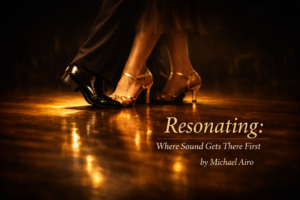
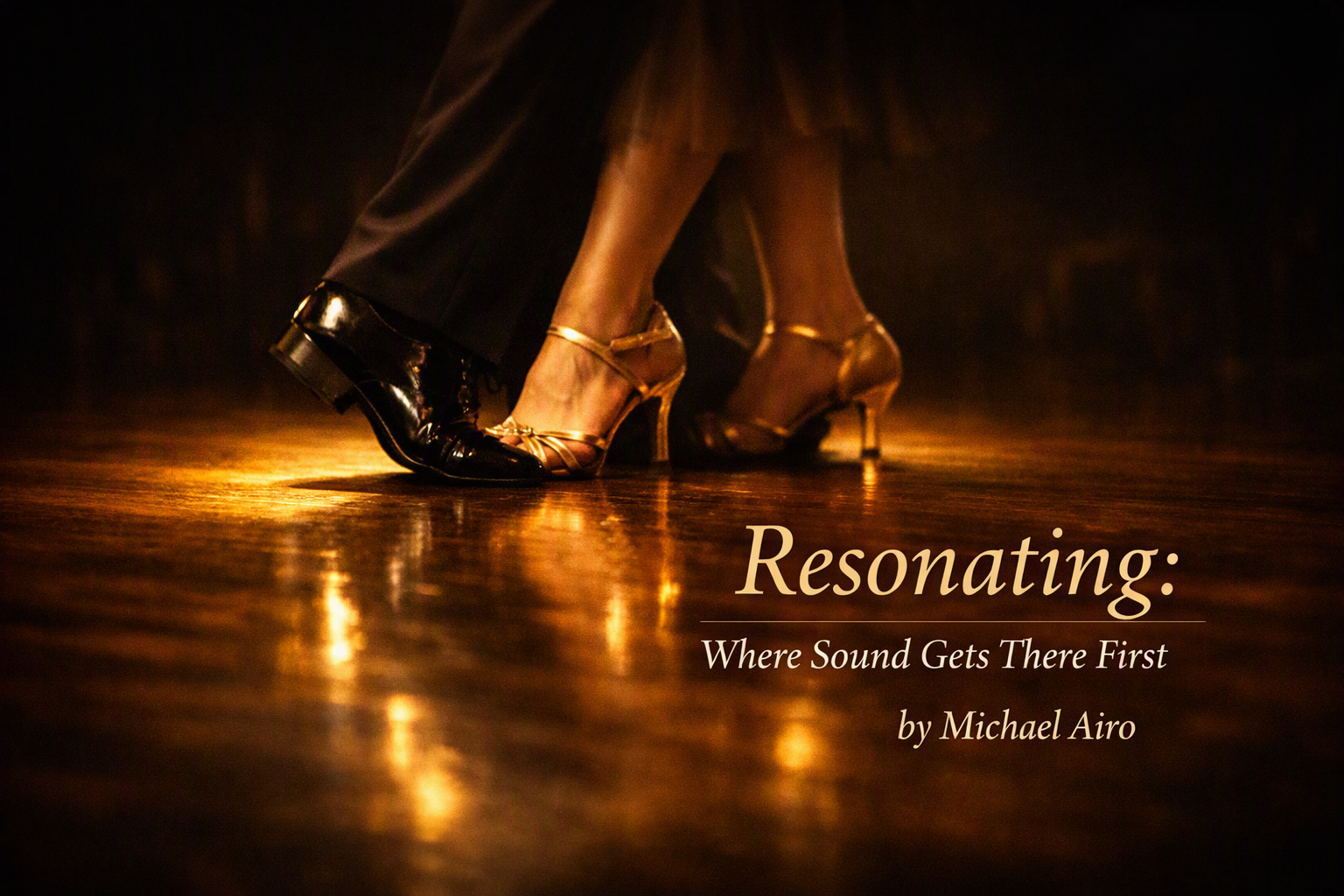
Salt rides under her perfume, sea air finding its way in through a door cracked somewhere behind the bar. A wide floor stretches out under low stage light, polished enough to hold a reflection of every fixture in the room, and empty enough that the emptiness itself becomes its own kind of invitation, nobody having claimed it yet tonight. She requests something at the booth without a word to him, three syllables passed to a stranger, and comes back with her hand already out, palm up, no question attached to the gesture at all. He takes it. Two steps onto that open floor and the decision has already been made in the body before either of them says so out loud. Her palm finds his spine. His hand answers at the small of her back. Weight rocks forward into the frame a half-second before the first note of anything sounds, the two of them already leaning into a shared center of gravity that has nothing to do with music yet. Argentine tango starts exactly like this, closer than a hold has any business being, breath passing between two people before a single beat arrives to explain why. Then the bandoneon answers what the bodies already began, low and certain, filling in a word for what the room is watching. Tango.
Throat tight, first. A single cord drawn taut behind the collarbone, pulling the shoulders half an inch closer to the ears without permission. The floor stays empty around them, no crowd of other dancers to fold into, no cover. Two bodies and a song neither one rehearsed for out loud.
Then something gives, all at once, the cord behind the collarbone slackening the way a rope slackens the instant a load finally settles into both hands instead of one. What follows doesn’t feel practiced so much as natural, the kind of natural that only ever shows up on the far side of nerves, once the body stops asking permission and starts simply doing the thing it already knows.
The song builds. Bandoneon pulling harder on every phrase, drums pressing the tempo up a notch at every turn nobody counted out loud, close enough to a second heartbeat that the body stops bothering to check whose rhythm it’s following. Skin rises along both forearms without either one noticing when it started. Everything past the two of them blurs at the edges, walls and light and every other face in the room shrinking down to something too small to matter, the space finally scaled to match just this: two bodies and the sound moving through both of them at once. Every hold turns stronger as the tempo climbs, a sharper pull at the waist, a firmer press through the spine, and none of it loses an ounce of grace doing it, strength and elegance sharing the same step instead of trading off. Leading and following stop being two separate jobs somewhere past the second verse, fold into one decision made by two spines at once, neither sure any longer who called the last turn or who is about to call the next one.
The final phrase drops the tempo without warning, the way a held breath drops when it’s finally allowed to leave, and the last note lands on a full stop: one sharp dip, her weight caught entirely in his arms, both of them frozen inside the very last chord before it finishes ringing out.
Applause lands warmer than the room usually spares for two passengers who paid the same fare as everyone else. A woman leans in before the next song even starts, asking whether the two of them dance professionally somewhere on this ship. The question keeps circling back for the rest of the cruise, until the ship’s own dancers, the ones who do this every night for their living, offer up free salsa lessons the next afternoon, one professional handing over an art she owed no one.
What the Body Already Knew
Neuroscientist Valorie Salimpoor tracked what happens in the seconds before a song’s peak lands, the swell before the chorus, the held note before it resolves, and found the brain releasing dopamine not at the peak but in anticipation of it, rewarding the reaching before the arriving. Skin rises on the forearm four seconds before a drop rather than during it, the actual mechanism behind why music gives you chills, reaching outpacing arriving every time. The body isn’t reacting to the music so much as leaning into what the music already promised.
Call it entrainment when a word is needed: heartbeat, breath, gait, syncing to a rhythm outside the body without being asked. A drum earns that trust faster than a lyric ever will. A lyric has to travel through language first. A drum doesn’t have to travel through anything. This is the same mechanism running under every doorway in this map, awe built on anticipation more than arrival, the body leaning toward what’s coming before the mind has caught up to name it. Resonating is just the doorway where sound gets there first.
The Ear That Had to Be Retaught
An hour each way, morning and afternoon, riding in Mom’s car up one side of the mountain and down the other before the school gates ever came into view. A brother in the back seat who never once complained about a country song running twice in one trip. Both of them loved the story more than the melody carrying it, a voice walking through somebody’s whole life in three minutes flat, verses that resolved like a book resolves. Listen for what the words are telling you: the ear this house handed down, whole, no negotiation attached. The beat rode along the whole time, underneath, patient, never once asked to carry anything.
Years passed before that training even got questioned. Dancing with friends one night, nothing formal about it, no class, no counted eight-count, just a room and a song running that didn’t sit right at all. A friend loved it anyway, moving to it like the song had been written specifically to fit that one body. The question came out before it could be stopped: what do you even hear in this? The answer landed flat, no ceremony attached to it: I don’t hear the words. I only hear the beat.
The friend on the dance floor already moved like someone who trusted the beat completely, and the one asking the question didn’t yet, not really, the gap between the two finally carrying its own explanation instead of just sitting there unnamed. A mirror, not a lecture. After that night the beat got permission to lead on a dance floor, and the words got their old job back everywhere else, in a car, in a kitchen, anywhere the feet weren’t the ones doing the listening.
After that, an orchestra stopped sitting in the background and turned into a body’s own anatomy laid out across a stage. Drums became a second heartbeat, steady under everything, a rhythm the chest could match without agreeing to it first. The trumpet took over the job of a human voice, cutting the air the way an actual voice cuts through a crowded room when it’s the only one saying something true. The violin carried whatever a moment refused to name outright. A night like the one that followed only became possible because of that architecture, ordinary hearing rebuilt into something awe could actually move through.
Lifted Somewhere Else Entirely
Night air holds a park-lamp cool against the back of the neck, damp grass releasing its held-in heat now that the sun’s been gone an hour. No history with this music walks in tonight, no genre familiar enough to brace against, nothing to expect. Stage lights come up amber against a curtain of oak leaves, and the first trumpet note arrives already answered, a violin rising underneath it before the note even finishes, the two instruments trading the same phrase back and forth like a question asked twice by two different voices.
The trumpet climbs. The violin follows a half-step behind, close enough to almost be the same instrument, far enough apart that the gap between them is where the actual feeling lives. Neither one resolves alone. Each one waits for the other to answer before either lets the phrase land, the trumpet reaching up into something almost too bright to hold, the violin catching it on the way back down, softer, sadder, warmer, whatever the trumpet just wasn’t. Something in that exchange carries an ache nobody asked for, beautiful in the specific way that also unsettles, a beauty with a shadow folded into it rather than one that only shines.
The ribs widen before the mind agrees to let them. Not a breath taken on purpose, something closer to a room deciding to be bigger than it was a second ago, space opening up on the inside to match whatever’s arriving from outside. Skin rises on both forearms at once. Whatever was sitting here a minute ago, ordinary, tired, half-listening, goes small and unimportant against what the two instruments are building together, self-shrinking down to the right size for once instead of taking up the whole room. Nothing physical moves, and everything moves anyway, carried out past the edge of the park into a place built entirely out of trumpet and violin still answering each other, haunting enough that the ordinary version of this body doesn’t fully return for a while after the last note fades.
The same widening still arrives every time the song plays again, years later, in a kitchen, in a car, wherever it happens to start. Something in that body never goes all the way back to who it was before that first night, not because of anything the song says, only because of what it does, every single time, on contact.
What the Beat Remembers for You
She never called herself a singer. One song came out of her without hesitation anyway: low, off the cuff, sung across a nursing infant before that infant had words to file it under. “Leaving on a Jet Plane,” the same way every time, no performance in it, no held-back note for fear of the pitch. Shoulders still drop half an inch when the opening bars find their way back into a room, decades later, at a register no other voice will ever occupy.
Other songs get in by a rougher door. Doublemint’s jingle, four words about doubled pleasure, decades off the air, still surfaces mid-shower, halfway through a grocery line, nowhere near gum. Nobody asked to keep it, and it stayed anyway, filed where rhythm alone holds the key.
French came in the same door. Verb endings that wouldn’t sit still on a page locked into place riding a melody instead, the tune doing what a highlighter never could. A classroom somewhere is probably still singing Conjunction Junction, tying two clauses together over a horn line nobody in that room forgot. Hamilton did the same thing decades later for a much bigger classroom, two centuries of history riding a beat instead of sitting flat in a textbook. A fact set to rhythm gets carried whole. A fact printed on a page gets studied, and then, mostly, gets left behind.
Frequency Is the Doorway
Every sound arrives as a wavelength before it arrives as anything else, and different wavelengths clearly have different jobs once they land. Low, slow frequencies pull a nervous system down toward sleep the same way a lullaby always has, long before anyone put a science to it. Certain tones get used deliberately now in sound-healing practice, for focus, for settling a body enough to finally rest, frequency doing on purpose what a mother’s off-key lullaby has always done by accident. The body responds to the wave before it ever gets around to judging the song attached to it.
A real measure of mismatch lives here, more precise than taste ever was. Rap and heavy metal, run at full volume, don’t do any of that work. They don’t slow a body down toward sleep, don’t settle a nervous system enough to focus, don’t reach for whatever a healing frequency reaches for. They can excite, move a crowd, do real teaching work elsewhere, all real jobs. Rest and repair were just never among them, not by design and not by accident either.
What Won’t Settle
A doorway that opens for one set of ears can stay shut for another, and the frequency underneath a song has nothing to do with deciding which. The same beat that lets a stranger drop into sleep, or moves an entire dance floor as one body, can still fail completely for the person standing three feet away, and the words riding on top of it are usually why. Words that arrive with enough force crowd out whatever settling the rhythm underneath was built to do, canceling the frequency’s own job before it ever gets started. No flaw in the song sits behind that, and no flaw in anyone who loves it either, only a mismatch specific enough to apply to exactly one listener at a time, the same reason no doorway on this whole map opens the identical way for everyone standing in front of it.
The Wiring Runs Both Ways
A song can weld itself to a scene so precisely that neither one gets called up again without dragging the other behind it, the way a couple’s first-dance song stops belonging to the radio the day they choose it. “Everything” by Lighthouse did that to a love scene on a television screen, Clark and Lana caught in a frame that ended decades ago and never let go of the song underneath it. The opening chords still reopen the same door on command: love as a live possibility, present tense, whether or not there’s a hand to reach for when the song starts. Disney runs the same trick inside its own films; melody stitched so tightly to scene that neither survives being recalled alone.
The wiring runs both directions. Sometimes a feeling arrives first and goes hunting for the song that fits it, heartbreak digging for something sad enough to finally move instead of sitting locked behind the ribs. Evanescence works the opposite shift, less a release valve than a lit match, built to take a body that doesn’t want to move and get it moving anyway. And sometimes the song shows up first and manufactures the feeling from nothing, a stranger’s car stereo in a parking lot conjuring a mood that had no business existing thirty seconds earlier. One television show built its whole premise on this exact wiring, a woman trailed everywhere by a soundtrack that previews whatever she’s about to feel before she’s found the word for it herself. Fiction on the page, documentary in the chest.
The Doorway You Can Choose
The music a person keeps returning to most days says something about the weather already running inside them before any of it gets said out loud. Someone who reaches for something slow and unhurried tends to be carrying calmer average conditions to begin with. Someone who reaches for heavy metal or alt rock on a regular rotation is usually carrying more heat than that, using the genre the way a valve gets used, letting something out that had nowhere else built for it to go. No judgment sits inside either choice. Each genre already fits the temperature the listener showed up wearing.
The same question flips the whole thing over the moment it gets asked seriously: if the genre already matches the weather, does deliberately switching the genre move the actual weather underneath it. Psychologist Ethan Kross spent Chatter mapping how much say a person actually has over an internal voice that mostly runs on its own, and Shift picked up from there with a toolkit for changing an emotional state before insight or willpower ever get a vote. Music sits near the top of that toolkit, not because it explains the feeling, but because it can move the body’s baseline in minutes, the same way a drum moved two strangers into a shared frame before either one had time to think it through.
A reader gets to walk through that same doorway on purpose, not by waiting for the right mood to show up before choosing the right song, which has the order backward from the start. The frequency gets chosen first, aimed at wherever the next twenty minutes are supposed to land rather than wherever the last twenty minutes already sat, and the body follows the same way it always follows a rhythm it hasn’t been asked to approve. A room can change temperature in the time it takes one chorus to land. Nobody needs permission for that. Only the choosing of what plays next.
The Floor Gets Wider
A stadium does this at a different scale than one pair of bodies ever could. Thousands of throats find the same chorus in the same half-second, and every ounce of self-watching goes first, a name and a face and a full day’s weight gone slack inside a sound too large to stay embarrassed inside of. Nobody checks whether the stranger beside them can carry a tune. Ten thousand hearts find the one drumbeat that was already running through each of them separately, same organ, same rhythm, only louder now, the door open wide enough for a whole room to walk through it together.
The steps from that cruise-ship floor still live behind the sternum, ready the instant a song asks for them without permission. Some doors open only once. Not this one, which keeps reopening, on a different stage, in a different room, in a body that stopped checking long ago whether it’s allowed back through.
This piece is written by Michael Airo. If you’re new here, you can learn more about my work on my About page.
Read a connected piece: Aching: The Ones Who Give Without Being Asked, and the whole map at The Doorways of Awe.