The Key to Wonder
Dilapidated fence, its paint gone the color of something left out in weather too long, wood beneath it soft with rot in places a hand could find blind, leaning as though it had given up standing straight decades ago and simply hadn’t been given permission to fall.
Fog moved first, low across the ground, curling around ankles like something that meant to climb higher given time. The chill of it found bare skin before the mind had decided to notice cold at all, a fine prickling along both forearms, hair rising there without instruction.
Cologne, someone’s, too sweet and applied with a heavy hand, tangled itself into the fog’s own chemical sweetness until the two smells became one thing, cloying, thick enough to sit at the back of the throat. Somewhere behind, a laugh came too fast and too loud, the particular pitch a body makes when it is already afraid and has not yet admitted it to itself.
A line moved forward. Shoe-scuff, shoe-scuff, gravel shifting underfoot, small stones finding their way inside a sneaker and staying there, ignored, because there was no room left in the body to attend to something so small.
The plan had been simple the whole ride over, repeated enough times in the car that it had worn a groove. Whatever comes, the face stays flat.
Door.
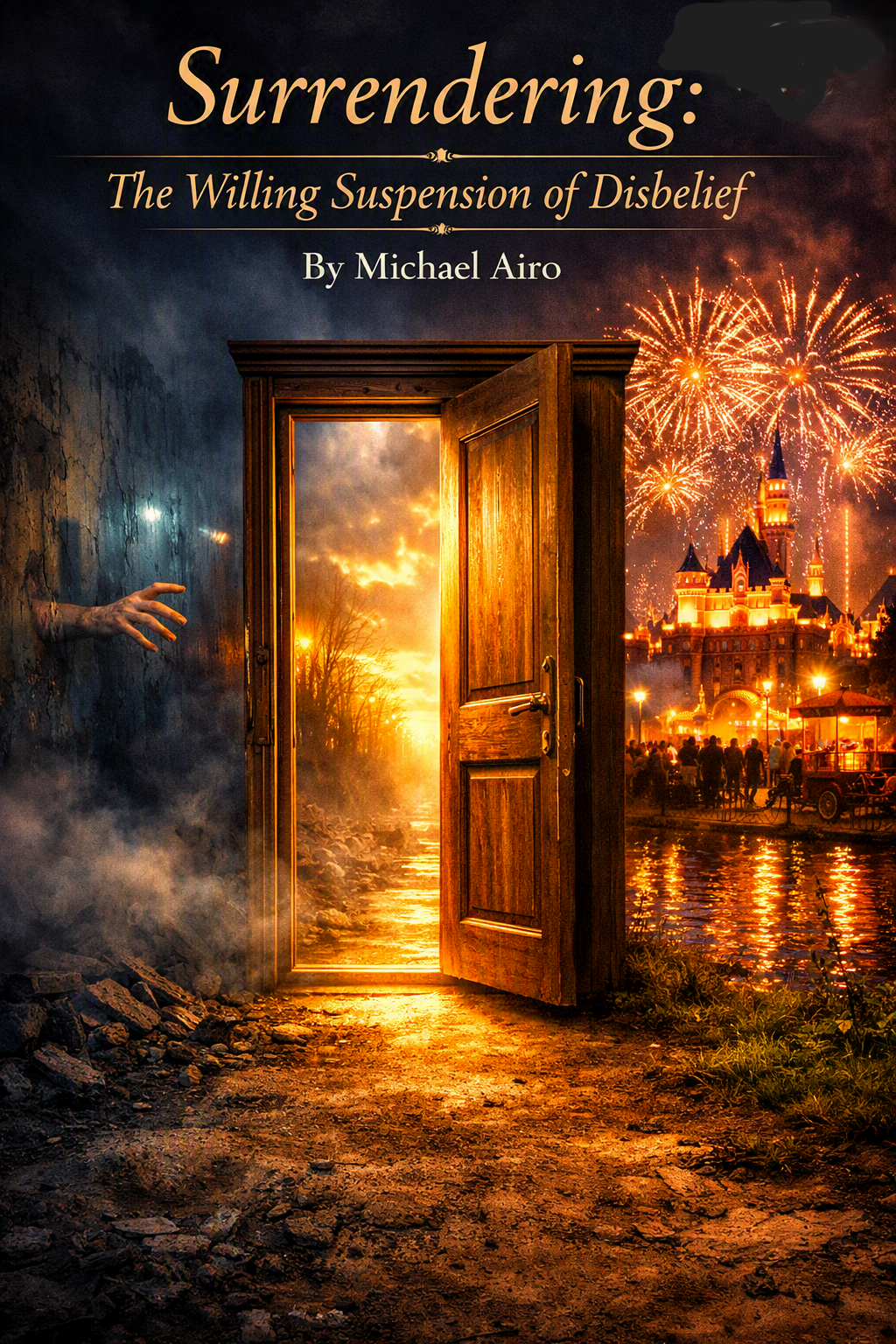
Black swallowed everything past it, thick enough to press against open eyes the way water presses against a diver going down too fast. Something screamed from a distance that turned out, impossibly, to be no distance at all, breath hot enough to register against the back of a neck a half second before any shape resolved out of the dark to explain it.
A hand. Out of a wall. Where no hand should have had room to exist.
Roar tore through the corridor next, a chainsaw’s pitch, and it landed in the chest before it had finished arriving in the ears, some old wiring translating loud and close into danger long before any higher reasoning could weigh in on the matter.
The face stayed flat.
Not through will. Through a story, repeated silently, quiet enough that no one walking alongside could have heard it running underneath: that shape, a person, rubber and paint. That roar, a motor sound buried beneath it that no true threat would ever require. Say a thing enough times through enough corridors and the fear genuinely leaves the body, replaced by something colder, flatter, the particular stillness of watching a machine complete a sequence it was built to complete.
The last door came and went. Light beyond it, ordinary and flat and unwelcome.
Nothing had touched. Nothing had landed. A whole building’s worth of careful engineering, and the walk out the other side happened from somewhere just outside the body doing the walking, the way a person watches footage of themselves rather than remembers being there, a clean pane of glass slid in without permission between the self that had entered and the self now leaving, the entire night reduced to something viewed rather than something felt.
That was the cost of the flat face. Paid without knowing, for years, before anyone understood there had been a bill at all.
That same wall stood between me and a stage once, years before any of it made sense.
Chosen, pulled up out of a crowd along with a dozen others, folding chairs scraping in a loose row under lights hot enough to prickle the scalp and sting a little behind closed eyes. Somewhere in the dark past the lights a few hundred people breathed as one low sound, waiting.
The hypnotist’s voice moved low and even down the line, a voice built for exactly this, no hard edges anywhere in it, counting backward, asking for heaviness in the eyelids, asking for the arms to feel like something too tired to lift, each word landing soft and slow enough to feel almost physical against the skin.
Said it out loud before anyone could stop the words, throat tight around them. I can’t be hypnotized.
My mother had said the same thing for years, flat and certain, the particular certainty of someone who has already run the experiment and filed away the result. People had tried. Nothing had ever taken.
Stood up. Chair legs scraping loud against the stage floor, the sound of it far too big for the room, heat rising fast up the back of the neck with every step back toward the folding chair in the audience. Arms crossed hard over the chest, jaw set, sitting on the wrong side of something that had just closed without so much as a click.
The others stayed under. A grown man barked, full-throated, spit flying, tongue out, utterly convinced he belonged on four legs. Someone else strutted in tight circles, elbows tucked to sides like wings, clucking with total commitment, no irony anywhere in his face. A third climbed halfway into a stance and threw a backflip that should have needed months of training behind it, body arcing clean through the air and landing soft, no fear anywhere in a body attempting something it would never have agreed to while awake.
Then the instruction changed. Relax. Let the body believe two full days of rest have already happened.
Shoulders dropped around the room, one after another, a whole row of faces going slack in a way no amount of willed calm ever quite manages on its own, jaws unclenching, breath slowing visibly, real rest or something close enough to it that the difference stopped mattering, arriving on command, on a stage, under lights, in front of strangers.
Arms stayed locked across the chest the whole time, certainty sitting hard and cold behind the ribs that the show was rigged, that every person up there was performing rather than experiencing, because the alternative meant admitting the door had been standing open the entire time and something in me had refused, on principle, to walk through it.
Years later a girlfriend went under, easily, the same low counting voice, the same request for heaviness, and her face did the thing none of the others’ faces had quite managed to convince me of. Loosened. Genuinely loosened, not performed, some tension she’d been carrying for longer than either of us had known each other simply gone by the time her eyes opened, the whole shape of her face rearranged into something lighter.
Belief arrived that night for the first time, whole and unquestioned, right along with her face.
Never went back up on a stage since. A door stood open the entire time, and the only thing keeping it shut was a pair of arms crossed tight enough to ache. Stop guarding what was never locked. Walk through it.
The same door swings open in gentler places too, built by no one but the two hands closest to you.
Sun hammered flat and white against a golf cart parked crooked near the twelfth hole, the exact stretch of grass a family had once lived close enough to that its particular green smell, cut and sweet and faintly gasoline-touched from the mower that had passed through an hour earlier, counted as the smell of home itself. Vinyl seats had gone hot enough to sting the backs of two sets of bare legs. Dust hung above the cart path in a fine gold veil, refusing to settle, catching the light and holding it.
A phone, propped crooked against the dash, threw a thin brass fanfare into all that heat, horns climbing fast, urgent, the kind of sound built specifically to convince a body that something enormous was already underway.
A shove came first. Then a scramble, one set of hands finding the roll bar, weight lunging from the back seat toward the front, a knee catching hard against the frame and not caring. A brother’s shoulder took the second shove, hard enough that his whole body pitched toward the open side of the cart, one hand shooting out and closing white-knuckled around the frame at the very last possible instant, the cart itself rocking under two bodies suddenly convinced that three miles an hour and a strip of manicured grass constituted mortal danger.
Breath came ragged now, laughter breaking through it in gasps too big for the lungs producing them, the whole cart shuddering with the weight of two boys fully inside a chase across a bridge that did not exist, being pursued by nothing, running from nothing, and somehow entirely, completely convinced.
No engineer had built this. No hydraulics moved beneath that cart, no motor sound was hiding under any roar. Only a song playing tinny and small from a phone, and two brothers who had agreed, without a single word passing between them, that an ordinary Tuesday afternoon would become something else entirely, and then simply made it so.
Fear moves through a stranger kind of door on the water.
Stage lights climbed slow over a floor gone flat and silver, water lying across it in a sheet thin enough to read, at first glance, as solid ground. Figures crossed it without incident, bare feet finding purchase, ripples spreading soft and slow behind each footfall and then smoothing themselves back to stillness, the whole surface behaving exactly the way a floor behaves.
High above, near the rafters where the dark thickened past what the lights could reach, a second stage held two more figures, and something about the shape of their movement read wrong immediately, too fast, too rough at the edges to be dance. An arm locked hard around a throat. A shove landed with a full body’s weight behind it, and a foot lost its purchase on a beam no wider than a shoulder.
A second shove. Both hands, full force, no hesitation in it at all.
Gone.
The body fell the way a stone falls, straight and without argument, arms and legs finding nothing in fifty feet of open air to slow the drop, headed directly for the same patch of water two performers had strolled across without a care only moments before. Every hand in that section found an armrest at once and gripped it bloodless. Breath caught high, useless, refusing to move.
Water swallowed the fall whole. A single column rose clean and folded back down to stillness, and the stage held its silence one beat too long. Then another. No arm broke the surface reaching for air. No head. The lights shifted, slow and deliberate, drawing every eye somewhere else the way a hand redirects a child’s gaze from something it isn’t ready to explain, and the next sequence began as though the fall had never happened at all.
No one in that theater ever saw him surface.
Sat there afterward with a hand still locked white around the armrest, the not-knowing doing more to the chest than any resurfacing ever could have managed. Somewhere beneath that stage a floor had opened wide enough to turn a wading pool into something with real depth, and not one soul watching had any way of seeing it happen. The show never gave the answer back. Walked out of that theater still holding the fall, unfinished, the way a held breath stays held long after any reason for holding it has passed.
Some evenings the water itself becomes the door, and no explanation ever follows it home.
Evening folded slow over a wide dark river, the sky sliding from white-gold through orange into the particular deep blue that means something enormous is close enough to smell in the air. Popcorn and hot butter drifted somewhere from a cart along the bank, mingling with river-damp and the crush of a few thousand bodies pressed shoulder to shoulder in the dark. Water below lay flat and still, holding itself the way a breath holds itself the instant before release.
A breeze crossed it first, faint, barely there, the surface trembling once and settling again, the way skin trembles a half second before a hand ever touches it.
Then it caught.
No warning worth naming, no seam between one moment and the next. Flame spread thin and impossible across the surface, orange light licking along a current that had no business burning and burned anyway, heat reaching bare skin from thirty feet off, mist rising to catch the color of the fire until the whole night air seemed lit from within. A single gasp rose along both banks at once, unified, involuntary, a few thousand strangers understanding in the exact same breath that they had just watched two things that should never coexist hold together in front of them regardless.
No mechanism ever arrived to explain it. Nothing wanted explaining, either. Whatever machinery let a river burn without burning itself down stayed exactly where it belonged, hidden, and the not-knowing did half the work the wonder needed done, watching fire ride water like the two had simply agreed, for a handful of minutes, to stop being enemies.
Fear itself became the clearest door of all, years after the fence and the fog had first taught the opposite lesson entirely.
A hand locked around one arm hard enough to leave a mark that lasted into the following morning, breath beside it already gone high and thin before the first door had even opened. Fog rolled low through the same corridors as years before, and this time every flinch beside me was real, unrehearsed, unguarded, breath catching audibly each time something shifted at the edge of what either of us could see.
The monsters knew it the way certain dogs know exactly which body in a room carries fear closest to the surface. They followed. Peeled away from other groups entirely to trail three extra steps behind her through every doorway, leaning close enough that her whole body jerked sideways, again and again, straight into mine.
Comfort was the plan walking out. An arm around trembling shoulders, some line about none of it being real, the very same argument that had worked on an entirely different body years earlier, in this very building.
What came back instead was a grin, wide and immediate, eyes still bright and wet from whatever had just happened in that final room.
Let’s go again.
That single sentence turned the whole door around on its hinges for good. Fear had never been the thing to keep locked outside that hallway. Fear was the price of admission, and paying it in full was what finally let the rest of the night through. Argued away the way a teenager once argued it away, the maze stayed exactly what it had always been, rubber and a motor sound hidden under a roar. Let all the way in, allowed to land in the chest precisely the way it was built to land, and something opened on the other side of that door no amount of clever detachment had ever once managed to produce.
What the Mind Actually Chooses
Every door in this piece asks the same question, and the question was never can the mechanism be found. Almost anyone can find it, eventually, given enough looking, a hidden platform under a shallow pool, a chemical compound that burns cool enough to ride on water, a motor sound buried under a roar. The mechanism was never the barrier. Looking for it was.
Neuropsychologist Norman Holland spent years studying exactly this trade, why a mind watching Spider-Man swing between buildings feels no skepticism at all, no internal alarm insisting the physics are wrong. His answer cuts against what most people assume is happening. The mind isn’t fooled. Nothing gets suspended the way the phrase suggests, belief set aside like a coat on a hook. Reality-testing simply stops, the mind no longer checking a world it has no plan to act inside. Reality-testing, in Holland’s account, is tied to movement, to the body preparing to reach out and change something. Watch a fall from fifty feet up with no intention of catching the person falling, and the part of the mind built to check whether that fall is truly dangerous simply never activates. Nothing was suspended. Something was never summoned in the first place, because it had nothing left to do.
That’s the actual trade running underneath every scene here. Not blindness. A choice, made below the threshold of most decisions, to hold still and let a thing happen rather than reach toward proving it false. The teenager in the maze reached, constantly, and the reaching itself was what kept the fear from ever landing. A pair of arms crossed on a folding chair reached the exact same way, refusing a stage for the same reason a face refused a hallway years earlier. Years later the choice reversed, and the not-reaching, the letting the fear through without a single hand raised against it, was what finally let something larger arrive behind it.
Awe was never on the other side of the mechanism being invisible. Awe was on the other side of the choice to stop reaching for it.
The Wall Cynicism Builds
Some minds cannot make that choice, or make it only rarely, and it’s worth naming plainly why, since the failure isn’t laziness or lack of imagination. It’s usually the opposite. A mind trained to notice everything, to catch the seam in the illusion before the illusion has finished forming, has usually been trained that way for good reason. Missing the trick once, somewhere in the past, cost something. Vigilance became the safer bet. Reaching for the mechanism, always, every time, stopped feeling like a choice at all and started feeling like the only responsible way to move through a room.
That vigilance protects, and that same vigilance closes the exact door this piece has been walking through, because the door only opens for a mind willing to let its guard down on purpose, briefly, on its own terms, and a mind that has learned vigilance as survival rarely trusts itself to set it down even for a few minutes at a stage show or a bonfire lit on water.
The willing suspension of disbelief asks for exactly the thing a defended mind finds hardest to offer. Not naivety. Permission.
The Same Door, Held Open on Purpose
This is the same door the whole map keeps opening onto, contraction pulling a mind tight around what it can verify and control, expansion asking it to loosen that grip and let something larger than verification move through instead. Every protective state in this work has been a form of reaching, scanning, checking, holding the mechanism at arm’s length until it can be named and therefore controlled. Surrendering asks for the opposite motion on purpose, choosing not to reach, and discovering that the not-reaching is what lets the room get larger than the person standing in it.
The willing suspension of disbelief isn’t something a mind stumbles into by accident, the way falling snow or a night sky might simply arrive and do the work themselves. This doorway has to be chosen, actively, every single time, which makes it one of the few doorways in this whole map where a person is asked to build the very thing they’re about to be moved by. Choose the fall over the floor holding it up. Choose the fear over the argument built to talk a body straight out of it. Choose the fire on the water and let it stay exactly as unexplained as it deserves to remain.
That choosing is the awe. Not a reward waiting on the other side of it. The choosing itself, each time it’s made, is the door swinging open.
This piece is written by Michael Airo. New work is published regularly at michaelairo.com.
Read a connected piece: The Doorways of Awe.
If you’re new here, you can learn more about my work and background on Michael Airo’s About Page.