Believing Was the Doorway All Along
Laughter came first, the way it always did before that room ever settled down for the night. A pillow connecting hard enough to knock someone half off the bed, both boys shrieking through it, Big Dog and half a dozen other stuffed animals scattered into the corner in the scramble, socked feet skidding across brown tile gone slick with energy that had nowhere left to go except into noise. A voice down the hall eventually cut through it, patience running thin the way it always did, and the wrestling wound down into two bodies settling, breath still catching in leftover hiccups of laughter, toward two separate beds. My brother took the long way there every night, three extra steps around the blue shag of the Cookie Monster chair wedged in the corner, the same chair that was his by every daylight rule of that house, cartoons piled on its cushion most Saturday mornings, claimed and unquestioned. Something about it stopped being his the second the overhead light went off, and he gave it a wide, wordless berth on his way past every night, no explanation offered and none ever asked for.
Sleep came easy on one side of that room. Always had. A head hit the pillow most nights and the rest of it simply happened somewhere else, without me, nothing worth remembering, no waking for sounds or shifts of any kind until morning arrived on its own schedule.
A few nights passed before the cold registered as anything worth noticing.
Then the shape across the room stopped looking like a sleeping brother, three years further along than me in nearly everything, and started looking like something the bed itself had swallowed. Blankets pulled up past the crown of his head, not a sliver of him left showing, breath moving the fabric in short, fast pulls.
Asked once. Got silence back, and a slightly firmer grip on the blanket’s edge.
Asked again a different night, breath fogging faint in air gone strange and cold in the exact same spot as before.
The answer came slow that time, dragged out from somewhere underneath all that fabric, hoarse, broken in the wrong places. A man. In the chair. Watching. Only him, every single night, and the covers were the only wall left to raise against a gaze that needed no invitation to arrive.
Never saw him. Not that night, not any night after. Felt the cold that came with him, believed every broken word describing him, and remained, somehow, the one person in that room he had no interest in looking toward.
Something in that house had already proven as much once before, in a smaller room down the same hallway.
Eight years old, feet planted flat on the tile the way an older kid’s feet reach, alone with the door mostly closed the way older kids get left alone in bathrooms, trusted with just enough privacy to finish the job.
The wall gave without warning. Not a crack widening slow enough to track. A seam, whole and finished, and a whole world arrived through it at full size, trees rising first, a station platform assembling itself plank by plank, grown figures taking shape on a platform twice as wide as the bathroom had any business holding, the walls themselves seeming to step back to make room for it. Then the train itself, full size, full weight by the sound it made coming in, wheels turning, a conductor standing at its side in a uniform pressed sharp, smoke rolling thick and gray off a stack that reached higher than the ceiling should have allowed.
A voice called out, matching the size of everything around it.
All aboard.
Five years old and close enough down the hall to hear it happen, the particular quality of noise that means something has gone wrong in a room built for the opposite of wrong. Feet hitting tile at a dead run before any decision to run had been reached, pants low, a whole body moving faster than a body that size should be able to move. Hallway stretching too long and too narrow at once, ending the only way it could end at that speed, straight into a grandfather already sitting exactly where he sat most nights, waiting the way a man waits at a river he’s fished a hundred times without a bite.
He’d been hoping the house might finally show him something directly. Something walked straight past him instead, chose the second-smallest body in the house this time rather than the smallest, alone in a room with the door barely closed. Checked the bathroom himself after, calm in a way that made no sense that night and made complete sense every year afterward. Nothing there. No seam. No warmth left hanging where something large had recently idled.
Stood in the hallway close enough to watch all of it happen. Close enough to hear the whole story land in real time, my brother’s breath still ragged, my grandfather’s calm already settling back into place. Not close enough, somehow, for the wall itself to have opened for me instead.
What a Threshold Experience Actually Opens Onto
A pattern was setting in by then, quiet enough that neither of us noticed it arriving, and it never once ran in just one direction. Every one of these moments was a threshold experience in the oldest sense of that phrase, a person caught standing between two states, no longer entirely in one world and not yet released into the next.
Whatever moved through that family didn’t only show itself as men in chairs and trains through walls. Grandpa carried a second thread alongside the first, a way of knowing things before they’d happened yet that ran on the exact same current as his seeing what already had. A feeling that arrived ahead of a phone call. A wrongness in a room before anyone could name why. The same door, worked from both directions, backward into what already existed unseen and forward into what hadn’t happened yet, and neither direction seemed to require his permission to open.
Theologian Rudolf Otto spent a career trying to name what sits behind experiences like these, coining a phrase still used a century later. Mysterium tremendum et fascinans, the awe-inspiring and fascinating mystery, terror and pull arriving as one indivisible feeling rather than two competing ones, in the presence of something recognized immediately as wholly other. Not fear alone. Not wonder alone. Both, refusing to separate, aimed at a presence that announces itself as belonging to some different order of thing entirely. A threshold experience, in Otto’s own terms, is simply what happens to a person standing at the exact edge his phrase describes.
A chair in the corner of a child’s room shares that shape with a train arriving through a wall that shouldn’t hold one, and both share it with a feeling that lands in a chest before a phone ever rings. Vastness doesn’t only come from canyons and night skies. Encountering something the mind has no frame ready to hold does the same work, and threshold is the doorway that opens specifically at the edge where explanation runs out and the body’s certainty hasn’t finished arriving to replace it.
Otto noticed something else worth carrying directly into this family’s specific pattern. The numinous has never required direct encounter to move a person, and has always traveled just as well through testimony, through one person’s account believed completely by someone who never stood in the room themselves. A congregation moved by scripture nobody in it personally witnessed. A grandson lying awake, cold settling into his own chest, believing every hoarse word his brother whispered about a chair across the room.
Hearing a threshold story and believing it completely, without once demanding proof, is its own doorway into the same room. Not a lesser version of seeing. A different entrance into the identical mystery.
My own childhood took its whole shape from that exact distinction. My brother stood at the threshold nightly, buried under blankets pulled tight enough to trap his own breath, and still refused to run. A grandfather stood at it deliberately, night after night, both directions of the door open to him at once. I stood nearby, believing everything, feeling the cold arrive on schedule, and remained the one person the door never once turned to address directly.
The pattern went on long enough to start feeling less like coincidence and more like the actual shape of things, until one night made the absence impossible to keep ignoring.
Two yellow couches sat in an L against one wall, the same two couches that would still hold that exact shape forty years on. Firelight had burned down to its last coals by the hour Grandma usually read until, embers throwing off just enough orange to catch the edge of a page turning slow in her hand. Wooden sliding doors stood open between that room and the hallway, the way they almost always stood open, and straight through that gap sat one particular bed, close enough that a glance left without even meaning to would land straight inside it.
She woke without a sound to account for it. Just awake, the way a person wakes when something decides the waking should happen now.
Someone sat beside her.
Weight settled the cushion, close enough that the old fabric registered it plainly, and she spoke to him the way she spoke to any grandson wandering in during the quiet hours, unhurried, easy, some story pulled out and offered the way stories get offered to whoever happens to be sitting closest in the dark. Told him something worn smooth from having been told before, to more than one listener, across more than one year.
Turned away, the fire needing a look, no longer than that.
Turned back to a cushion holding nothing. Not even the dent a body leaves behind in old, soft fabric.
Looked left instead. Straight through the open doors. Found a boy asleep in that bed, breathing slow and even, wearing clothes that matched nothing at all like what she had just spent several minutes describing to someone sitting an arm’s length away.
The sleeping boy was me, present in the story only as the thing a stranger’s face was measured against once he’d already gone.
Every threshold this family ever stood at had chosen someone. My brother. My grandfather. My grandmother, on a couch, in the middle of an ordinary night. Never once me, not directly, not even when the visitor wore my own face and sat close enough to touch.
What the Bravery Was Actually For
Something ran underneath all of it that took years to name properly, and it showed itself clearest outside the house entirely, on a stretch of dark path most summer nights.
Adam’s place sat up in the mountains a few blocks off, the kind of blocks that ran long enough to make the distance feel a good deal farther than it measured, evenings running long on basketball and swimming and games in the dark until the porch light behind was the only proof daylight had ever existed. Nine that year, or close to it. My brother three years further along, old enough that the difference should have run the other way entirely.
The walk back cut first through a wooded stretch still lined with houses, porch lights holding the dark back window by window, easy enough that neither of us thought twice about it. Then came the garages, a long row of them shouldering the road, no trees anywhere along that stretch, just flat concrete and closed metal doors and the same amber bulb over each one throwing down its own small circle of light and nothing past the edge of it, so the walk turned into pools of orange stitched together by stretches of complete black in between. Last came the trees proper, the road curving into a stretch of forest thick enough to swallow whatever light the garages had left behind, and that curve was where it always happened. Shadows there did what shadows do to a mind already primed, somewhere below reasoning, to read danger into every dark shape, mouths opening in forms that had never once been mouths by daylight, branches reaching down with fingers built out of nothing, snagging at hair and collar with a touch that never actually landed.
Walked it together at first, every time, pace matched easily right up through the garages and into the curve.
Then something in him simply gave out, always right there, at that same bend. No warning distinct enough to predict beyond knowing the curve was close, just a shift, and he was gone, feet pounding dirt hard enough to raise dust even in full dark, vanishing ahead into trees that had somehow stopped frightening him the instant running became the only option left. Sometimes he looked back. Sometimes the path stayed empty the whole way through.
Walked it alone nearly every night that summer, shadows doing everything shadows know how to do, and let it happen anyway. Stood inside that fear the way a person stands in weather, felt every bit of what sent him sprinting, and simply kept walking, uneasy the entire way and never once handing the unease the final word.
Nothing in those trees ever revealed itself as more than trees. But the discipline built there, the specific willingness to remain at the exact edge where fear peaks and explanation runs dry, without flinching toward running or toward some story built to make the fear make sense, turned out to be exactly the muscle a door like this one requires from whoever hopes to finally stand in front of it and have it open the right direction for once.
The Door Finally Turns
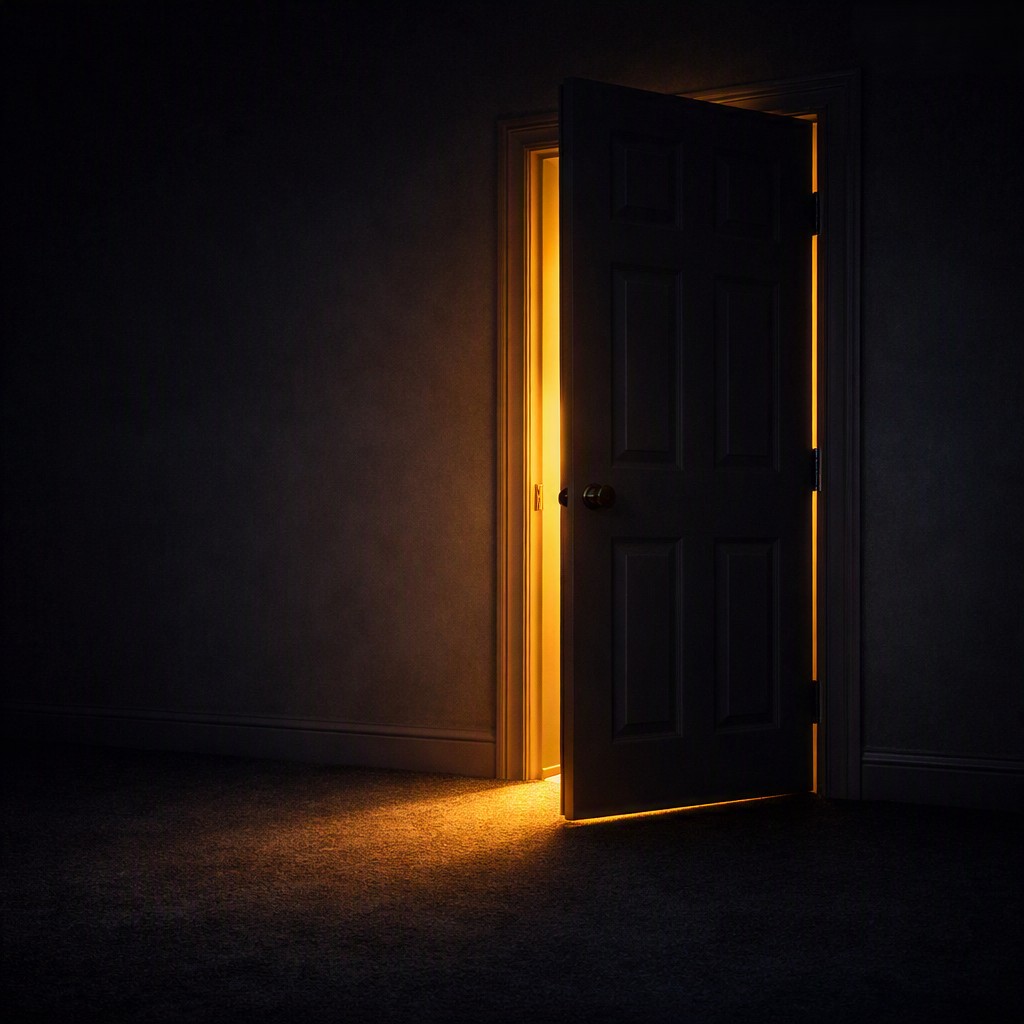
That door turned once, years later, on a day loud enough with somebody else’s celebration to apparently shake something loose, the rarest kind of threshold experience there is, the kind that finally chooses the person who has spent a whole life standing near it rather than in it.
The Anaheim Convention Center sits close enough to Disneyland that a competition finishing up there spills straight into the park afterward, and the whole place carried an unusual amount of noise that day, sharp bursts of chanting rolling through the crowd from somewhere behind, cheerleaders fresh off a stage and still running hot on whatever current a competition leaves in a body afterward.
The walk in came first, the way it always came first, through rooms built to loosen something in a person well before any ride actually started moving. Then two seats in a buggy, cousin close enough that a shoulder found a shoulder on every turn, wheels running some track hidden beneath the floor, carrying both of us deeper into the house at a pace that felt, somehow, slower than walking.
The buggy carried them over that threshold before either boy registered it as one, cold reaching bare forearms first, a cold with actual weight to it, pressing rather than settling. Music rose up behind that cold the way it always rose in that room, louder there than anywhere else in the house, built specifically to bury whatever the room might otherwise let slip through underneath it, and under the music ran something closer to true silence than any silence a room that loud had a right to hold. The smell arrived next, crossing further into the dark, cold stone that had never once felt real weather, threaded with wax and something sweeter underneath that neither of them could ever quite name. The room itself stayed half lit and partial the whole way through, green light pooling low and sickly across a side table nobody could fully make out, the kind cast members still refuse to lay a hand on even now, even in daylight, even with a supervisor standing right there watching. Instruments floated the room on their own current, a tambourine turning slow through the dark, a trumpet drifting past overhead with no hand anywhere near it, a violin bow sawing at strings held up by nothing at all, edges of everything dissolving before they resolved into edges at all.
Between two of those instruments, in the exact stretch of air where nothing has ever once been, in years of passing through that same room and finding it exactly as empty as the year before, something gathered. Not a face yet. Only a density the low light bent around.
Then it resolved. A face, coalescing out of the dark the way breath coalesces on cold glass, eyes finding a way to exist before a nose or a mouth had finished deciding to. It looked around the room once, slow, searching, the particular unhurried attention of something taking its first inventory of a space it had never occupied before. Found the buggy. Found the two riders in it. Settled there.
Something metallic touched the back of the tongue in that same instant, faint, arriving a half second before the mind agreed to notice it at all. Then the face came apart the way smoke comes apart when a door opens somewhere and pulls it sideways, dragged into nothing in less than a second, gone so completely and so fast that the dark behind it looked, immediately after, exactly the way it had looked every other year.
Nobody else in that buggy saw it. Not the cousin close enough to touch. Just a face that had arrived once, in a room walked through empty for years, and chosen, for reasons that trace back somehow to a cheerleading competition next door, to appear specifically for the one person who’d been looking at that same dark air without result the whole time.
My cousin found his own the same day, further along the ride, stepping out of the buggy into daylight and glancing at the mirror operators use to check that a car has cleared before the next group loads in. A boy, small, running back into the ride itself, disappearing the direction the cars had just come from.
Told the operator after. Got a name back, offered plainly, the way a man offers a fact he’s been asked about a hundred times before.
Years of standing near a door built for other people, and it finally opened the right direction, in a room walked past without result for years, on the one day loud enough with somebody else’s celebration to apparently shake something loose. Stay. Don’t run toward an explanation and don’t run away from the thing itself. Let the door decide, on its own schedule, whether this is finally the day it turns.
Faith Was Always the Point
A brother’s hoarse whisper about a chair. A grandfather’s calm certainty walking back from an empty bathroom. A grandmother’s plain account of a face that wasn’t mine, delivered without a shred of doubt attached to it. None of it required my own eyes to land as real. Belief did the work seeing never got the chance to do, every single time, until one day in a room built for tourists finally let the eyes catch up to what the rest of the family had been running on for years.
Seeing was never actually the doorway. Believing was, all along, opening in smaller, quieter ways than a chair or a train ever needed to. Every threshold experience in this family, seen or unseen, ran on the exact same fuel.
Carl Jung gave a name to the plainest version of it, decades after ghosts had already made their case for the same idea. Synchronicity, a meaningful coincidence, two events with no causal thread connecting them arriving close enough together in time that the meaning between them becomes impossible to shrug off. Think of someone rarely thought of, and the phone rings with their name on it that same afternoon. Hold a want quietly in the chest for exactly the right thing, specific enough it could never be mistaken for a general hope, and watch it arrive within the week, unasked for by any visible chain of cause.
Nobody needs the mechanism explained for a moment like that to land as awe. The not-needing is the whole point. Demand a chain of cause first and the moment shrinks back down to coincidence, filed and forgotten. Let it stand instead, unexplained, believed completely on nothing but its own weight, and the same door that opened for a grandmother on a couch opens again, smaller, quieter, in a phone call or a name arriving at exactly the right hour.
Religion has run on this exact mechanism since long before anyone gave it a Latin phrase or a Swiss psychiatrist’s name attached to it. Proof only ever shows up after, trying to explain a room that already let someone in without it. My brother is still under those blankets some nights in my mind, breath fogging in that same cold spot, and I still believe him before I ever need to see a single thing myself.
This piece is written by Michael Airo. New work is published regularly at michaelairo.com.
Read a connected piece: The Doorways of Awe.
If you’re new here, you can learn more about my work and background on Michael Airo’s About Page.